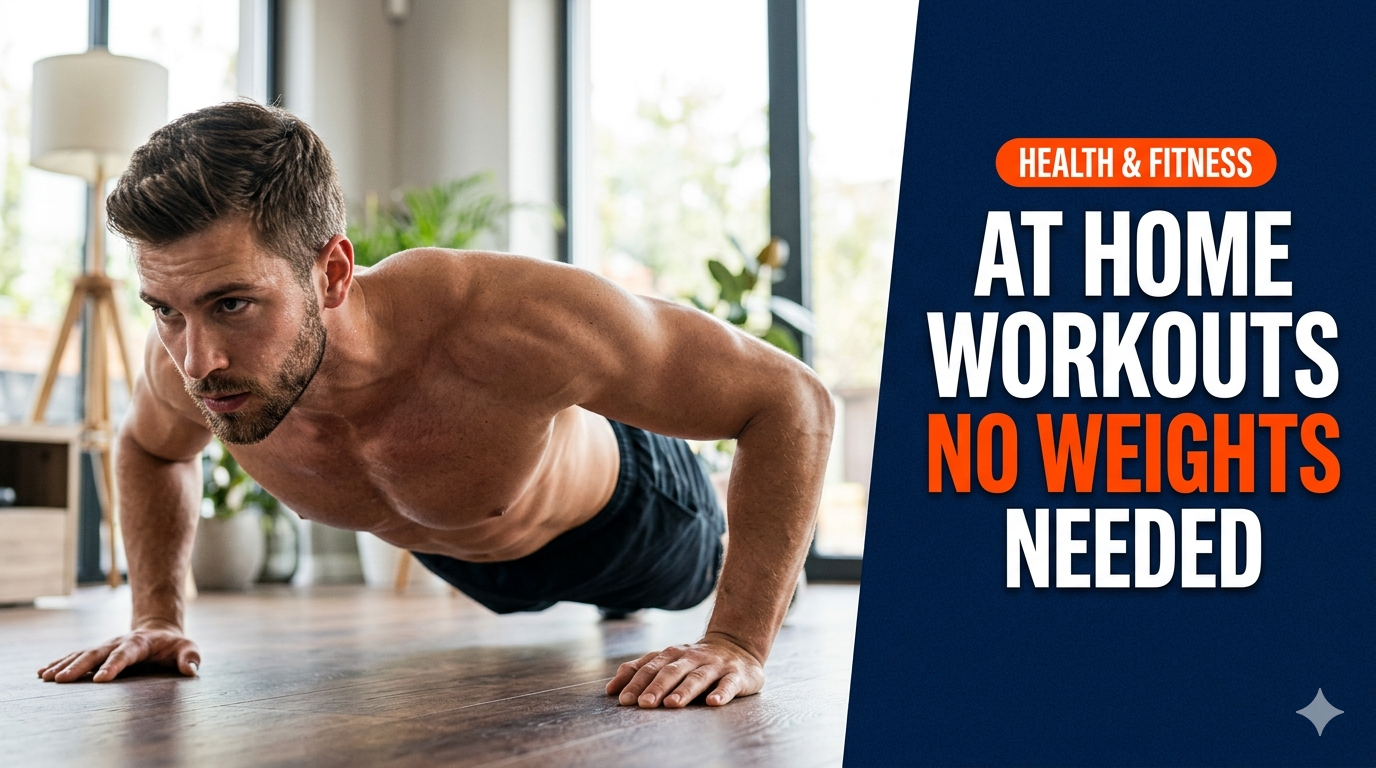
Most men assume that building a strong, lean physique requires a gym membership, a rack full of dumbbells, and at least two hours of free time every day. That assumption is wrong, and it has kept a lot of men from ever getting started.
The truth is that some of the most effective strength and conditioning workouts ever developed use nothing but bodyweight. Military training programs, martial arts conditioning, and elite athletic development have all relied heavily on bodyweight work for decades. The equipment is not the point. The effort, the consistency, and the programming are.
This guide covers the 12 best at home workouts for men without weights that build real, functional strength and can be done in your bedroom, living room, or backyard with zero equipment and zero excuses.
Table of Contents
Why Bodyweight Training Works for Men
Before getting into the exercises, it is worth understanding the actual mechanism behind why bodyweight training builds muscle and burns fat effectively.
Muscle growth is driven by mechanical tension, metabolic stress, and muscle damage. Weights are one way to create these stimuli. Your own bodyweight, applied through the right exercises and progressions, creates the same stimuli just as effectively when programmed correctly.
Research published in the Journal of Human Kinetics found that bodyweight resistance training produces significant improvements in strength, body composition, and cardiovascular fitness comparable to equipment-based resistance training in men when intensity and progressive overload are properly applied.
The key phrase there is progressive overload. The same principle that drives progress in the gym, gradually increasing the challenge over time, applies exactly the same way to bodyweight training. You progress by adding reps, reducing rest time, slowing the movement down, or graduating to harder exercise variations.
For men specifically, bodyweight training is particularly effective because it builds what is often described as functional strength, the kind that translates directly into real-world performance, athletic ability, and injury resistance rather than just gym numbers.
What You Can Realistically Achieve Without Weights
This is a fair question and it deserves an honest answer.
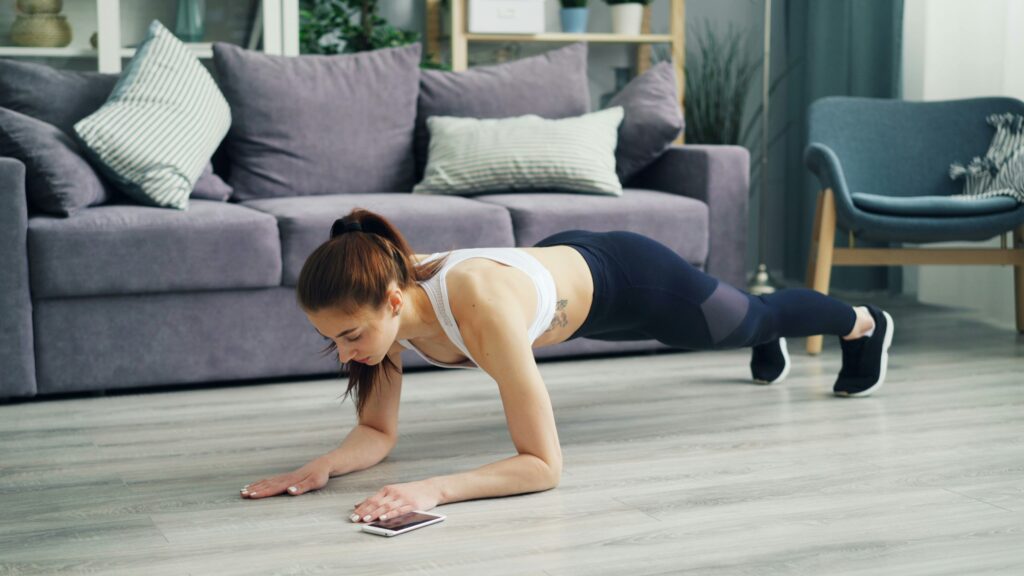
Without weights, you can absolutely build a lean, muscular, athletic physique. You can develop significant upper body pushing strength through push-up progressions. You can build impressive leg and glute development through single-leg exercises and jump variations. You can develop a genuinely strong core through plank progressions, hollow holds, and anti-rotation work.
What becomes harder without weights is building maximum absolute strength and very large muscle mass beyond a certain point. If your goal is to compete in powerlifting or become extremely large, you will eventually need external resistance. But for the vast majority of men whose goals are to look better, feel stronger, move well, have more energy, and be healthier, bodyweight training done seriously and consistently will get you there completely.
The men who say bodyweight training is too easy have simply not tried the harder progressions. A one-arm push-up, a pistol squat, or a planche push-up will humble anyone.
1. Push-Up Variations
The push-up is the foundation of any at home workout for men without weights. It trains the chest, anterior deltoids, triceps, and core simultaneously. And unlike a bench press, it trains the shoulder blades to move freely, which is far more natural and joint-friendly.
The reason push-ups are listed as variations rather than just a single exercise is that progressing through different push-up styles is how you keep getting stronger over time.
Standard push-up: Hands slightly wider than shoulder-width, body in a straight line from head to heels, elbows at roughly 45 degrees from the body. Lower your chest to within an inch of the floor and press back up.
Wide push-up: Wider hand placement shifts more emphasis onto the chest and reduces tricep involvement.
Close grip push-up: Hands directly beneath the shoulders or slightly closer. Shifts emphasis heavily onto the triceps.
Archer push-up: One arm extends straight to the side while the other bends to lower the body. This is a powerful unilateral progression toward the one-arm push-up.
One-arm push-up: The ultimate push-up progression. Requires significant shoulder stability, core strength, and pushing power.
Beginner target: 4 sets of 12 to 15 reps of standard push-ups. Intermediate target: 4 sets of 20 standard push-ups or 3 sets of 10 to 12 archer push-ups.
2. Diamond Push-Ups
Diamond push-ups deserve their own section because they are one of the single best tricep exercises you can do without any equipment, and most men significantly undertrain their triceps when working out at home.
Your triceps make up approximately two thirds of your upper arm size. If building bigger, more defined arms is part of your goal, you cannot achieve it by training biceps alone.
How to do them: Place your hands close together beneath your chest, forming a diamond shape with your thumbs and index fingers. Keep your elbows close to your body throughout the movement as you lower your chest to your hands and press back up.
Why they work so well: The close hand position and elbow path put the triceps under maximum mechanical tension throughout the full range of motion. This is more direct tricep loading than most dumbbell tricep exercises can achieve.
Target: 3 to 4 sets of 8 to 15 reps depending on your current strength level.
3. Pike Push-Ups
Most home workout guides for men completely neglect shoulder training, which creates a significant gap in upper body development. Pike push-ups solve this problem with zero equipment.
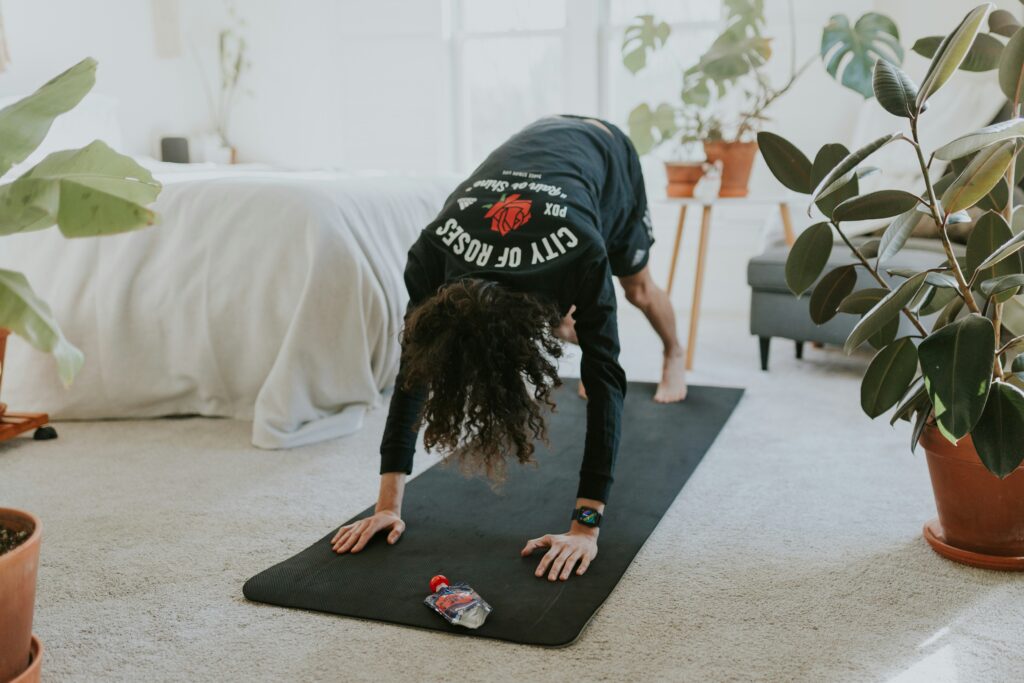
The pike push-up positions your body in an inverted V shape, which shifts the angle of pushing force toward your shoulders rather than your chest. It is the bodyweight equivalent of an overhead press.
How to do them: Start in a standard push-up position, then walk your feet toward your hands until your hips are high and your body forms a sharp inverted V. From this position, bend your elbows and lower the top of your head toward the floor between your hands. Press back up to the starting position.
Progression: As you get stronger, elevate your feet on a chair or couch to increase the challenge and move progressively toward a full handstand push-up, which is one of the most impressive feats of bodyweight shoulder strength.
Target: 3 sets of 8 to 12 reps.
4. Bodyweight Squats and Jump Squats
Your legs contain the largest muscle groups in your body. Training them effectively without weights is one of the most underappreciated aspects of at home training for men, but it absolutely can be done.
Standard bodyweight squat: Feet shoulder-width apart, toes slightly out, hips pushed back and down until thighs are parallel to the floor, chest up throughout. Press through heels to stand.
The standard squat becomes relatively easy once you have built a decent fitness base, which means progression is essential. This is where jump squats and single-leg variations become important.
Jump squat: Perform a standard squat descent, then drive explosively through the floor to jump into the air. Land softly with bent knees and immediately sink into the next rep. Jump squats develop explosive lower body power, raise the heart rate significantly, and create a strong metabolic stimulus for fat burning.
Target: 4 sets of 15 squats or 3 sets of 10 jump squats with 60 seconds rest between sets.
5. Bulgarian Split Squats
If there is one exercise that makes grown men question their life choices, it is the Bulgarian split squat. It is arguably the most challenging and effective single-leg exercise available without equipment, and it will develop your quads, hamstrings, and glutes to a level that standard bodyweight squats simply cannot match.
How to do them: Stand about two feet in front of a chair or couch. Place your rear foot on the elevated surface behind you with the top of your foot resting on the seat. Lower your back knee toward the floor, keeping your front shin roughly vertical and your torso upright. Drive through your front heel to return to standing.
Why they are so effective: The elevated rear foot stretches the hip flexor of the rear leg while placing the front leg under significant load. This combination creates a training stimulus similar to a loaded single-leg squat.
Target: 3 sets of 8 to 12 reps on each leg. Expect significant muscle soreness in the first week or two. That is normal and a sign the exercise is working exactly as intended.
6. Reverse Lunges
Reverse lunges are more knee-friendly than forward lunges and equally effective at training the quads, hamstrings, and glutes. They also challenge balance and core stability in a way that bilateral exercises cannot.
How to do them: Stand tall with feet hip-width apart. Step one foot back and lower your rear knee toward the floor, stopping just before it makes contact. Both knees should be at roughly 90 degrees at the bottom. Push through your front heel to return to standing.
Adding difficulty: Once standard reverse lunges feel manageable, try the curtsy lunge variation, stepping back and across behind the standing leg, which adds a hip adductor challenge. Alternatively, add a knee drive at the top of each rep, pulling your rear knee forward and up to hip height before stepping back for the next rep.
Target: 3 sets of 10 to 12 reps on each leg.
7. Burpees
If you could only choose one exercise for a full-body conditioning workout at home, the burpee would be a very strong candidate. It combines a squat, a push-up, and a jump into a single continuous movement that challenges nearly every muscle in the body while simultaneously providing an intense cardiovascular stimulus.
How to do them: Stand tall. Drop your hands to the floor and jump your feet back into a push-up position. Perform one push-up. Jump your feet back to your hands. Explosively jump up, reaching your arms overhead. Land softly and immediately repeat.
Why men often avoid them: Because they are genuinely hard. A set of 15 burpees performed with full effort will raise your heart rate to near maximum and leave most men breathing heavily within the first minute. That difficulty is exactly what makes them so effective.
Target: 3 sets of 10 to 15 reps for intermediate fitness. Beginners can start with sets of 5 to 8 and build from there.
For men interested in the cardiovascular benefits of high-intensity bodyweight training, read our article on healthy lifestyle habits for energy, focus, and productivity.
8. Mountain Climbers
Mountain climbers are a staple of military fitness programs for good reason. They build core strength, hip flexor endurance, shoulder stability, and cardiovascular fitness all at once, and they can be performed in a space no larger than a yoga mat.
How to do them: Start in a high push-up position with arms straight. Drive one knee toward your chest, then quickly switch, bringing the other knee forward as the first returns. Maintain a flat back and level hips throughout. The faster you go, the greater the cardiovascular demand.
Variations: Slow mountain climbers, where you hold each knee-to-chest position for two to three seconds, place more emphasis on core strength and hip flexor development. Fast mountain climbers prioritize cardiovascular conditioning.
Target: 4 sets of 30 to 45 seconds with 20 seconds rest between sets.
9. Plank Variations
The plank is not just a core exercise. It is a full-body tension exercise that trains the ability to maintain rigid midline stability under load, which is fundamental to every other movement you do.
Forearm plank: Elbows directly beneath shoulders, body in a straight line from head to heels. Hold while breathing normally.
High plank: Same position but on straight arms. Slightly more shoulder demand.
Side plank: Body in a straight line supported on one forearm and the outer edge of one foot. Trains the obliques and lateral hip stabilizers heavily.
Plank with shoulder taps: From a high plank, alternately lift one hand to tap the opposite shoulder while resisting any rotation in the hips. This is a significantly more challenging variation that builds anti-rotation core strength.
Target: Work up to 3 holds of 60 seconds in the standard plank. For side planks, 3 holds of 30 to 45 seconds on each side.
10. Tricep Dips
Tricep dips using a chair or couch are one of the most effective upper arm exercises in any at home workout for men without weights. Combined with diamond push-ups, they provide comprehensive tricep development that most men’s home training programs completely lack.
How to do them: Sit on the edge of a sturdy chair with your hands gripping the seat beside your hips. Slide forward off the seat, supporting your weight on your hands. Bend your elbows to lower yourself toward the floor, keeping your back close to the chair, then press back up to straight arms.
Make it harder: Extend your legs straighter out in front of you rather than keeping them bent. This increases the percentage of your bodyweight you are lifting on each rep and significantly increases the difficulty.
Target: 4 sets of 12 to 15 reps.
11. Glute Bridges and Single Leg Bridges
Most men skip glute training entirely. This is a mistake that leads to lower back pain, poor athletic performance, and underdeveloped posterior chain strength.
Strong glutes protect the lower back and knees, improve explosive power in jumps and sprints, and contribute significantly to the athletic, V-shaped physique most men are training toward.
Standard glute bridge: Lie on your back with knees bent and feet flat on the floor. Drive your hips toward the ceiling, squeezing your glutes hard at the top. Hold for one to two seconds and lower slowly.
Single leg glute bridge: Same movement but with one leg extended straight out. All the load transfers to one glute and hamstring, making this considerably more challenging and effective.
Target: 3 sets of 15 standard bridges or 3 sets of 10 to 12 single-leg bridges on each side.
For context on why glute and posterior chain strength matters beyond aesthetics, read our article on muscle mass and metabolic health.
12. Superman Hold and Back Extensions
The lower back and posterior chain are among the most undertrained areas in any at-home program. The Superman hold addresses this directly and requires nothing but floor space.
How to do it: Lie face down with arms stretched straight overhead. Simultaneously lift your arms, chest, and legs off the floor as high as possible, squeezing your glutes and the muscles of your lower back and upper back. Hold for two to three seconds at the top and lower with control.
Progression: For a more dynamic variation, perform the movement as a repetition, lowering and lifting continuously rather than holding the top position. This increases time under tension and cardiovascular demand slightly.
Target: 3 sets of 12 to 15 reps.
This exercise directly addresses the postural weakness that comes from prolonged sitting and desk work, which affects the majority of working-age men.
The 4-Week At Home Workout Plan for Men
Here is a complete four-week plan that combines all twelve exercises into a structured, progressive program.
Week 1 and 2: Foundation
Day 1: Upper Body Push Focus Standard push-ups 4 sets of 12, diamond push-ups 3 sets of 10, pike push-ups 3 sets of 8, tricep dips 3 sets of 12, plank hold 3 sets of 30 seconds.
Day 2: Lower Body and Posterior Chain Bodyweight squats 4 sets of 15, reverse lunges 3 sets of 10 each leg, glute bridges 3 sets of 15, Superman hold 3 sets of 12, mountain climbers 3 sets of 20 seconds.
Day 3: Rest or light walking.
Day 4: Full Body Conditioning Burpees 3 sets of 8, jump squats 3 sets of 10, mountain climbers 4 sets of 30 seconds, plank shoulder taps 3 sets of 10 each side, pike push-ups 3 sets of 8.
Day 5: Rest.
Day 6: Full Body Strength Bulgarian split squats 3 sets of 8 each leg, archer push-ups 3 sets of 8 each side, single leg glute bridges 3 sets of 10 each leg, side plank 3 sets of 25 seconds each side, diamond push-ups 3 sets of 12.
Day 7: Rest.
Week 3 and 4: Progression Add one to two reps to every set. Reduce rest periods by 10 seconds. Replace standard bodyweight squats with jump squats. Progress push-up variations to harder versions where possible.
Use Our Free Tools to Track Your Results
Training hard is one side of the equation. Understanding your body’s numbers gives you the other side, and together they produce real, measurable results.
Calculate Your TDEE Knowing how many calories your body burns each day is essential for both muscle building and fat loss. Use our TDEE Calculator to find your exact daily energy expenditure so your nutrition plan supports your training goals.
Set Your Calorie Target Use our Calorie Calculator to find the daily intake that supports either muscle building, fat loss, or body recomposition depending on your specific goal.
Track Your BMI Use our BMI Calculator to monitor your overall body mass as your training progresses and body composition shifts.
Measure Your Body Fat Percentage Weight on a scale does not tell you whether you are gaining muscle or losing fat. Use our Body Fat Calculator to track the metric that actually reflects your training progress.
Find Your Ideal Weight Use our Ideal Weight Calculator to establish a realistic and healthy goal weight for your height and frame.
Optimize Your Sleep Testosterone, growth hormone, and muscle protein synthesis all peak during deep sleep. Use our Sleep Calculator to find the sleep schedule that maximizes your recovery and training results.
Nutrition Tips to Get the Most from Your Training
Training without proper nutrition is like building a house without materials. The workout creates the blueprint. Food provides everything that actually builds the structure.
Protein is your top priority. Muscle is built from amino acids, and amino acids come from dietary protein. Aim for at least 1.6 to 2.2 grams of protein per kilogram of bodyweight daily. Chicken, eggs, Greek yogurt, fish, beef, and protein supplements are your best sources.
Do not undereat. Many men cut calories too aggressively while training and end up losing muscle along with fat. Unless your goal is purely fat loss, eat at or slightly above your maintenance calorie level to support muscle building.
Time your carbohydrates around training. Eating carbohydrates before and after your workout ensures your muscles have glycogen for performance and replenishment for recovery. Oats before training and rice or potatoes after training are practical, effective choices.
Omega-3 fatty acids reduce training-related inflammation and support muscle protein synthesis. Fatty fish, walnuts, and flaxseeds are good food sources. For a full breakdown, read our article on omega-3 fatty acids benefits and food sources.
Magnesium supports muscle function, sleep quality, and testosterone production. Most men are deficient in it. Read our article on 7 types of magnesium and their benefits to understand which form is most effective for men who train.
For men specifically, testosterone levels play a direct role in how effectively you build muscle and recover from training. Read our article on low testosterone symptoms in men to understand whether hormonal health is a factor worth addressing in your training journey.
Common Mistakes Men Make Training at Home
Even motivated men with solid programs make these errors regularly. Knowing them in advance saves weeks of wasted effort.
Training the same muscle groups every day. Muscles need 48 to 72 hours of rest after a training session to repair and grow. Training chest and triceps every single day produces diminishing returns and increases injury risk. Rotate muscle groups using the plan structure provided above.
Never progressing the difficulty. If you are doing the same exercises at the same rep ranges you started with six weeks ago, you have stopped making progress. Progressive overload is not optional. It is the entire mechanism of improvement. Add reps, reduce rest, slow the tempo, or graduate to harder variations every one to two weeks.
Neglecting the posterior chain. Most men focus almost entirely on pushing exercises like push-ups and dips and completely skip the back, glutes, and hamstrings. This creates muscular imbalances that lead to poor posture and injury over time. The Superman holds, glute bridges, and reverse lunges in this program are not optional additions. They are essential.
Skipping warm-up and cool-down. Five minutes of joint mobility work and light movement before training dramatically reduces injury risk and improves performance. Five minutes of stretching afterward accelerates recovery. Neither takes long enough to justify skipping.
Expecting results in two weeks. Visible physical changes in body composition take a minimum of six to eight weeks of consistent training and appropriate nutrition to become clearly apparent. Strength improvements come faster, often within two to three weeks. Trust the process and track your performance metrics rather than obsessing over the mirror in the early weeks.
FAQ: At-home workouts for men without weights
1. Can you really build muscle doing at home workouts without weights?
Yes, absolutely. Muscle grows in response to mechanical tension and progressive overload, not specifically to barbells or dumbbells. Bodyweight exercises applied with increasing difficulty over time create the same muscle-building stimulus as weighted exercises. Hundreds of research studies and millions of real-world examples confirm this. The key is progressive overload and sufficient protein intake.
2. How long should an at home workout for men take without weights?
Thirty to forty-five minutes is sufficient for a complete and effective session. A five-minute warm-up, twenty-five to thirty-five minutes of structured exercise, and five minutes of cool-down and stretching covers everything you need. Sessions longer than sixty minutes without proper fueling and recovery capacity tend to produce diminishing returns.
3. How many days per week should men train at home without weights?
Three to four days per week is ideal for most men. This provides enough training stimulus to produce consistent strength and muscle gains while allowing adequate recovery time. More experienced trainees with good recovery can push to five days using a split approach, but three to four days is the sweet spot for most.
4. What is the best at home workout for men to build a bigger chest without weights?
Push-up variations are your primary chest builder at home. Standard push-ups, wide push-ups, and archer push-ups all target the chest effectively. The key is performing them through a full range of motion, maintaining good form, and progressively increasing the difficulty over time. Elevating your feet on a chair and performing decline push-ups adds an upper chest component similar to an incline press.
5. Can you lose belly fat with bodyweight workouts at home?
Fat loss is primarily driven by caloric deficit, meaning burning more calories than you consume. Bodyweight workouts, particularly high-intensity circuits involving burpees, jump squats, and mountain climbers, burn significant calories and raise your resting metabolic rate. Combined with appropriate nutrition, consistent bodyweight training is an effective fat loss tool. Spot reduction of belly fat specifically is not possible, but overall fat loss will reduce abdominal fat progressively.
6. Do I need to eat differently to build muscle with bodyweight training?
Yes. Regardless of whether you are using bodyweight or free weights, building muscle requires adequate protein intake and sufficient total calories. Aim for at least 1.6 grams of protein per kilogram of bodyweight daily and eat at or slightly above your maintenance calorie level. Without adequate nutrition, even the best training program will produce limited results.
7. How do I make bodyweight exercises harder as I get stronger?
The most effective ways to progress bodyweight exercises are: advancing to harder exercise variations, increasing reps per set, reducing rest time between sets, slowing the tempo to increase time under tension, adding pauses at the hardest point of the movement, and combining exercises into supersets or circuits. Each of these strategies applies the principle of progressive overload without requiring any additional equipment.
Conclusion
The gym is a tool. It is a useful one, but it is not the only path to a strong, lean, capable body.
The 12 at home workouts for men without weights in this guide give you everything you need to build genuine strength, improve your physique, and develop the kind of functional fitness that carries over into every area of your life. All of it can be done in your living room, bedroom, or backyard, today, without spending a single pound or dollar on equipment.
The program works. The question is simply whether you will work the program.
Start with the foundation phase. Follow the four-week plan. Track your numbers using the free tools at Vitality Nexus. Fuel your body properly. Sleep well. And keep showing up consistently even on the days when motivation is low, because consistency is what actually builds the body you are after.
Explore our full health and fitness resources for more training and wellness guidance. And check out our nutrition and supplements section to make sure your diet is working as hard as your training.