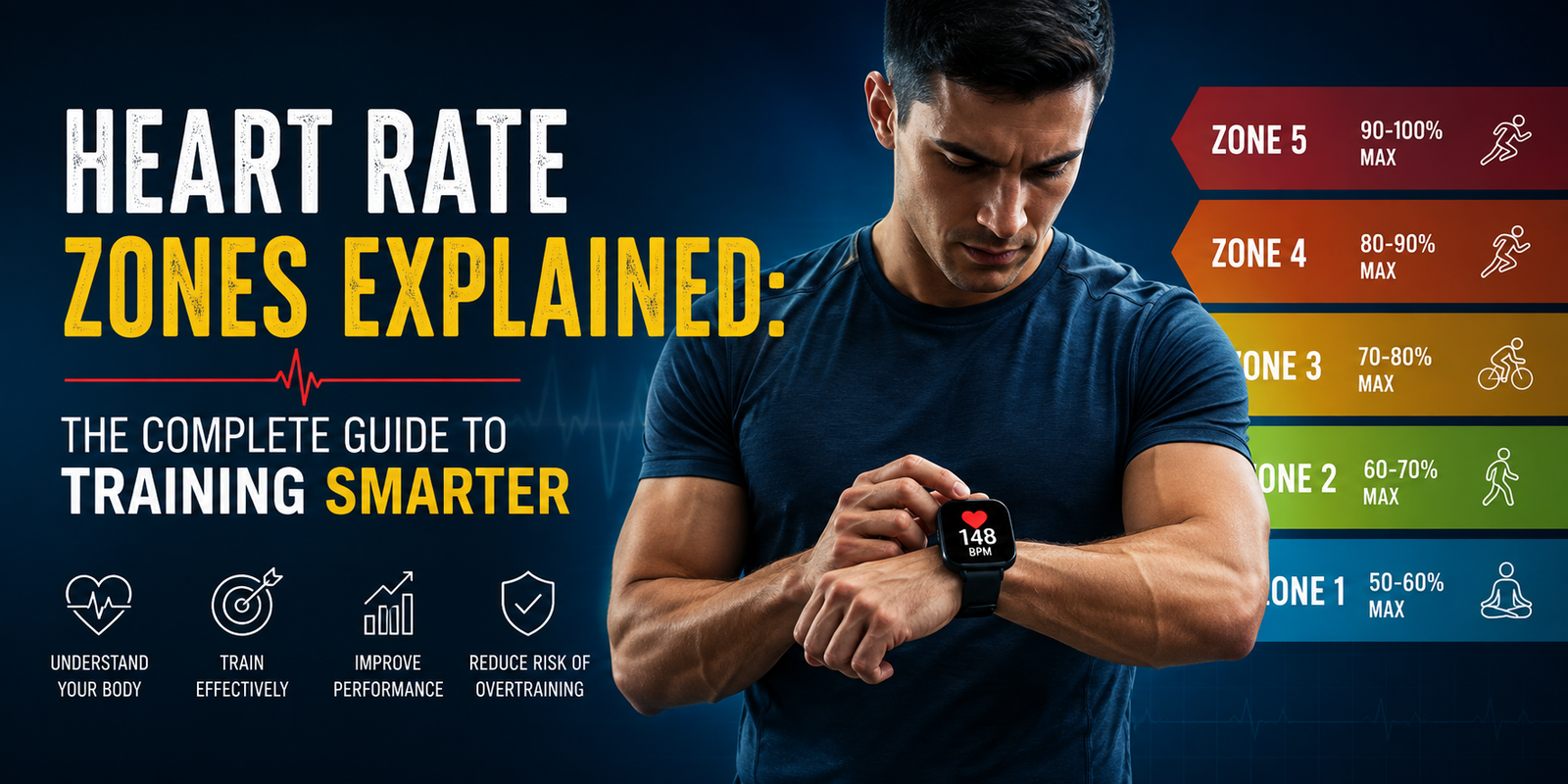
Heart rate zones explained the right way can change how you train for good. If you have ever wondered why some workouts leave you gasping while others barely raise a sweat, the answer usually comes down to which heart rate zone you were in. Heart rate zones are ranges of your heart rate, measured as a percentage of your maximum, that correspond to different levels of exercise intensity and different training benefits.
This guide breaks down what each zone means, how to find yours in under two minutes, and which zone to train in depending on your goal, whether that is fat loss, endurance, speed, or simply staying heart healthy for the long run. If you’re interested in maximizing aerobic fitness and improving endurance, Zone 2 Heart Rate Training is one of the most effective methods to understand before building your personalized training plan.
Quick Answer: What Are Heart Rate Zones?
Heart rate zones are five ranges of heartbeats per minute, each tied to a percentage of your maximum heart rate. Zone 1 is very light activity, Zone 5 is an all out sprint. Training across different zones builds different systems in your body, from fat burning efficiency to raw speed.
Why Heart Rate Zones Matter
Your heart rate is one of the simplest, most honest signals your body gives you during exercise. It tells you exactly how hard your cardiovascular system is working in real time, without guesswork. Understanding heart health can also help you see why monitoring your heart rate is such an effective way to improve long-term fitness and reduce cardiovascular risk.
Training without paying attention to heart rate often leads to one of two problems. Either you train too easily, week after week, and your fitness plateaus. Or you train too hard, too often, and you end up fatigued, injured, or burned out before you see real progress.
The American Heart Association recommends that most healthy adults aim to spend time in moderate and vigorous heart rate zones, generally 50 to 85 percent of maximum heart rate, to support cardiovascular health. Athletes and coaches use the same zones with more precision, structuring entire training plans around the time spent in each one.
Understanding your zones lets you:
- Train at the right intensity for your specific goal
- Avoid overtraining and reduce injury risk
- Track real progress instead of guessing based on how a workout “felt”
- Get more value out of a wearable fitness tracker like an Apple Watch, Garmin, Polar, or Fitbit
The Five Heart Rate Zones
Quick Answer: The five heart rate zones range from Zone 1 (very light, about 50 to 60 percent of max heart rate) to Zone 5 (maximum effort, 90 to 100 percent). Each zone shifts your body from fat burning to sugar burning to pure anaerobic power as intensity rises.
Zone 1: Very Light (50 to 60 percent of max heart rate)
This is warm up territory. A light walk, gentle stretching, or easy recovery movement. Zone 1 supports blood flow and recovery without adding meaningful training stress.
Zone 2: Light to Moderate (60 to 70 percent of max heart rate)
Often called the fat burning zone, Zone 2 is a pace where you could hold a full conversation. This is the zone endurance athletes spend the most time in, because it builds aerobic base and improves how efficiently your body uses fat for fuel.
Zone 3: Moderate (70 to 80 percent of max heart rate)
This is a comfortably hard pace. You could speak in short sentences, but not hold a full conversation. Zone 3 improves cardiovascular efficiency and is common in steady state cardio sessions.
Zone 4: Hard (80 to 90 percent of max heart rate)
Talking becomes difficult. This zone builds speed, power, and your body’s ability to clear lactate, which is directly tied to your lactate threshold, the point where lactic acid builds up faster than your body can process it.
Zone 5: Maximum Effort (90 to 100 percent of max heart rate)
An all out sprint that can only be sustained for short bursts, typically under two minutes. Zone 5 builds top end speed and anaerobic power and is used heavily in HIIT training.
Heart Rate Zone Comparison Table
| Zone | Percent of Max Heart Rate | Effort Level | Talk Test | Primary Benefit |
| Zone 1 | 50 to 60% | Very light | Full conversation | Recovery, warm up |
| Zone 2 | 60 to 70% | Light to moderate | Full conversation | Fat burning, aerobic base |
| Zone 3 | 70 to 80% | Moderate | Short sentences | Cardiovascular efficiency |
| Zone 4 | 80 to 90% | Hard | One or two words | Speed, lactate threshold |
| Zone 5 | 90 to 100% | Maximum | Cannot talk | Power, top end speed |
Benefits of Each Zone
| Zone | Fitness Benefit | Best Suited For |
| Zone 1 | Active recovery, improved blood flow | Rest days, warm ups |
| Zone 2 | Fat oxidation, aerobic endurance | Long runs, easy rides |
| Zone 3 | Cardiovascular fitness, VO2 max support | Tempo runs, steady cardio |
| Zone 4 | Lactate threshold improvement | Interval training |
| Zone 5 | Anaerobic power, top speed | Sprint intervals, HIIT finishers |
Heart Rate Zone Chart by Age
According to the American Heart Association, your estimated maximum heart rate is roughly 220 minus your age, and target heart rate zones fall between 50 and 85 percent of that number for most moderate to vigorous exercise.
| Age | Estimated Max Heart Rate | Zone 2 (60 to 70%) | Zone 4 (80 to 90%) |
| 25 | 195 bpm | 117 to 137 bpm | 156 to 176 bpm |
| 35 | 185 bpm | 111 to 130 bpm | 148 to 167 bpm |
| 45 | 175 bpm | 105 to 123 bpm | 140 to 158 bpm |
| 55 | 165 bpm | 99 to 116 bpm | 132 to 149 bpm |
| 65 | 155 bpm | 93 to 109 bpm | 124 to 140 bpm |
These numbers are estimates. Fitness level, medications, and individual physiology all affect your true numbers, so use this chart as a starting point rather than an exact prescription.
How to Calculate Your Heart Rate Zones
Quick Answer: The simplest method is 220 minus your age to estimate your maximum heart rate, then multiply that number by each zone’s percentage range. A more precise method, the Karvonen formula, also factors in your resting heart rate.
Method 1: The Basic Formula
Step 1. Subtract your age from 220 to estimate your maximum heart rate.
Step 2. Multiply your maximum heart rate by the lower and upper percentage of the zone you want.
Worked example for a 40 year old finding Zone 2:
Maximum heart rate: 220 minus 40 equals 180 bpm
Zone 2 lower bound: 180 times 0.60 equals 108 bpm
Zone 2 upper bound: 180 times 0.70 equals 126 bpm
Zone 2 range: 108 to 126 bpm
Method 2: The Karvonen Formula (Heart Rate Reserve)
This method is more personalized because it accounts for your resting heart rate, which reflects your current fitness level.
Step 1. Find your resting heart rate (measured first thing in the morning, before getting out of bed).
Step 2. Subtract your resting heart rate from your maximum heart rate. This is your heart rate reserve.
Step 3. Multiply your heart rate reserve by the target percentage, then add your resting heart rate back in.
Worked example for a 40 year old with a resting heart rate of 65 bpm, targeting Zone 3 at 75 percent:
Maximum heart rate: 180 bpm
Heart rate reserve: 180 minus 65 equals 115
Target: (115 times 0.75) plus 65 equals 151 bpm
Heart Rate Reserve vs Maximum Heart Rate
Quick Answer: Maximum heart rate is a single number based mostly on age. Heart rate reserve is the gap between your maximum and resting heart rate, and it produces more personalized, more accurate training zones because it reflects your actual fitness level, not just your birth year.
Two people who are both 40 years old can have very different resting heart rates. A trained endurance athlete might have a resting heart rate near 45 bpm, while someone new to exercise might sit closer to 75 bpm. Using the basic 220 minus age formula gives both people the same target zones. The Karvonen formula does not, which is why coaches and exercise physiologists generally consider it the more accurate option.
Zone 2 Explained
Quick Answer: Zone 2 is a light to moderate intensity, roughly 60 to 70 percent of your maximum heart rate, at a pace where you can still hold a full conversation. It is widely considered the most important zone for building aerobic endurance and improving fat-burning efficiency over time.
Zone 2 training has become popular in endurance and longevity circles because it trains your body to become more efficient at using fat as fuel, which spares your limited glycogen stores for when you actually need them, like the final push of a race. With consistent training, many people also notice improvements in their lower resting heart rate, a key indicator of better cardiovascular fitness.
The catch with Zone 2 is that it feels almost too easy. Most people who try it for the first time naturally speed up past the zone without realizing it. A heart rate monitor, whether a chest strap or a wrist-based tracker like an Apple Watch, Garmin, Polar, or Fitbit, makes it much easier to stay honest about pace.
Heart Rate Zones for Weight Loss
Quick Answer: There is no single “fat burning zone” that outperforms all others for weight loss. Zone 2 burns a higher percentage of calories from fat, but higher zones burn more total calories per minute. For weight loss, total weekly calorie burn matters more than which specific zone you train in.
Once heart rate zones explained this way start to make sense, weight loss becomes less about chasing one magic zone and more about strategy. A mix works best for most people. Longer Zone 2 sessions build an aerobic base and are sustainable several times a week. Shorter Zone 4 and Zone 5 intervals burn more calories per minute and can boost metabolism for hours afterward through a phenomenon known as excess post exercise oxygen consumption.
Training Goals by Zone
| Goal | Recommended Zone(s) | Typical Session Length |
|---|---|---|
| Fat loss | Zone 2, with Zone 4 intervals mixed in | 30 to 60 minutes |
| General heart health | Zone 2 and Zone 3 | 20 to 45 minutes |
| Endurance building | Zone 2 primarily | 45 to 90+ minutes |
| Speed and power | Zone 4 and Zone 5 intervals | 15 to 30 minutes |
Heart Rate Zones for Running
Quick Answer: Most running training plans build a base of easy Zone 2 mileage, add Zone 3 tempo runs for cardiovascular efficiency, and use Zone 4 and Zone 5 intervals sparingly for speed work. This mirrors how competitive runners structure their weekly mileage.
For runners specifically, heart rate zones explained through an 80/20 lens tend to click fastest. A common structure follows something close to an 80/20 split, where roughly 80 percent of weekly training happens in Zone 2, and the remaining 20 percent happens in Zone 3 and above. This keeps the body building endurance without accumulating excess fatigue from too many hard efforts.
Heart Rate Zones for Cycling
Quick Answer: Cyclists use heart rate zones similarly to runners, but because cycling is lower impact, riders can often sustain slightly longer sessions in Zone 3 and Zone 4 without the same joint stress that running creates.
Indoor cycling and spin classes frequently push riders into Zone 4 for extended intervals since the controlled environment makes it easier to hold a consistent hard effort. Outdoor endurance rides, on the other hand, often stay in Zone 2 for the bulk of the ride, with short climbs pushing into Zone 3 or Zone 4.
Heart Rate Zones for HIIT
Quick Answer: HIIT, or high intensity interval training, deliberately alternates between Zone 4 or Zone 5 work intervals and Zone 1 or Zone 2 recovery intervals. This structure trains both anaerobic power and the body’s ability to recover quickly between efforts.
A typical HIIT structure might look like 30 seconds at Zone 5, followed by 90 seconds of active recovery in Zone 1, repeated for 15 to 20 minutes. Because Zone 5 is so demanding, most HIIT sessions stay short, often 20 minutes or less including warm up and cool down.
Exercise Examples by Zone
| Zone | Example Activities |
|---|---|
| Zone 1 | Slow walking, gentle stretching, easy recovery spin |
| Zone 2 | Brisk walk, easy jog, relaxed bike ride |
| Zone 3 | Steady state run, moderate paced swim |
| Zone 4 | Tempo run, hill repeats, spin class intervals |
| Zone 5 | All out sprints, max effort intervals, finishing kicks |
Common Mistakes with Heart Rate Zone Training
Quick Answer: The most common mistakes are relying on the 220 minus age formula without adjusting for individual fitness level, going too hard during Zone 2 sessions, and trusting wrist based heart rate readings during high intensity intervals when accuracy tends to drop.
Even with heart rate zones explained clearly on paper, these mistakes still trip up most beginners in practice.
- Skipping the warm up. Jumping straight into Zone 3 or 4 without a Zone 1 warm up increases injury risk and often produces inaccurate early heart rate readings.
- Training too hard, too often. Spending most workouts in Zone 4 and Zone 5 without enough Zone 2 recovery work is one of the fastest paths to burnout and plateaus.
- Ignoring outside factors. Caffeine, dehydration, stress, poor sleep, and heat can all raise your heart rate independent of effort, which can throw off zone based training if you are not accounting for it.
- Trusting wrist sensors during intervals. Optical wrist sensors can lag or misread during fast, jerky movements. A chest strap monitor is generally more accurate for high intensity interval training.
- Never adjusting your zones. As fitness improves, resting heart rate typically drops and true maximum heart rate can shift. Recalculating your zones every few months keeps training accurate.
Expert Tips for Training with Heart Rate Zones
- Recalculate your zones using the Karvonen formula rather than the basic age based formula if you want more personalized numbers.
- Use the talk test as a simple backup when you do not have a monitor handy: full sentences means Zone 1 or 2, short phrases means Zone 3, single words or silence means Zone 4 or 5.
- Spend the majority of your weekly training time in Zone 2 if your main goal is long term aerobic fitness or fat loss.
- Reserve Zone 5 efforts for short, well spaced intervals rather than sustained training, since this zone is meant to be brief.
- Recheck your resting heart rate periodically, ideally first thing in the morning, since a dropping resting heart rate is one of the clearest signs your cardiovascular fitness is improving.
Applying these tips is really what heart rate zones explained in theory look like once you put them into an actual weekly routine.
Frequently Asked Questions
What are the five heart rate zones?
The five heart rate zones range from Zone 1 (50 to 60 percent of max heart rate, very light) to Zone 5 (90 to 100 percent, maximum effort). Each zone reflects a different intensity level and trains a different physical system, from fat burning to top end speed.
How do heart rate zones work?
Heart rate zones work by dividing your heart rate range, from resting to maximum, into five bands. Training in a specific zone stresses your body in a specific way, whether that is building aerobic fat burning capacity in Zone 2 or building anaerobic power in Zone 5.
Which heart rate zone burns the most fat?
Zone 2 burns the highest percentage of calories from fat. However, higher zones burn more total calories overall, so for weight loss purposes, total calories burned across the week generally matters more than the specific zone.
What is Zone 2 heart rate?
Zone 2 is roughly 60 to 70 percent of your maximum heart rate, a pace where you can still hold a full conversation. It is considered the foundation zone for building aerobic endurance and fat burning efficiency.
How do you calculate heart rate zones?
Subtract your age from 220 to estimate maximum heart rate, then multiply that number by each zone’s percentage range. For a more personalized number, use the Karvonen formula, which also factors in your resting heart rate. This is the core question behind heart rate zones explained for anyone training with a goal in mind.
What are heart rate zones by age?
Maximum heart rate estimates decline with age, roughly following the 220 minus age formula. A 25 year old has an estimated max heart rate near 195 bpm, while a 65 year old is closer to 155 bpm, with each zone scaling down accordingly.
Are heart rate zones good for beginners?
Yes. Heart rate zones give beginners an objective way to gauge effort instead of guessing based on how a workout feels. Most beginners benefit from spending the majority of early workouts in Zone 1 and Zone 2.
Which heart rate zone is best for weight loss?
There is no single best zone for weight loss. A combination of frequent Zone 2 sessions for sustainable calorie burn, plus occasional Zone 4 intervals for a higher calorie burn per minute, tends to produce the best overall results.
Which heart rate zone is best for running?
Most running plans build the bulk of weekly mileage in Zone 2, with smaller amounts of Zone 3 tempo work and Zone 4 or 5 interval work added for speed development.
What is heart rate reserve?
Heart rate reserve is the difference between your maximum heart rate and your resting heart rate. It is used in the Karvonen formula to calculate more personalized, more accurate training zones than the basic age based formula alone.
Is resting heart rate or maximum heart rate more important?
Both matter, but for different reasons. Resting heart rate reflects your current cardiovascular fitness level, while maximum heart rate is used to calculate the upper boundary of your training zones. Together, they produce the most personalized zone calculations through the Karvonen formula.
Conclusion
Heart rate zones explained simply come down to this: five ranges of intensity, each with a different purpose, from easy recovery in Zone 1 to all out effort in Zone 5. Knowing your numbers, whether through the basic age based formula or the more personalized Karvonen method, turns guesswork into a real training strategy. Once heart rate zones are explained clearly and applied consistently, they stop being a number on a screen and start becoming a real training tool.
References: Heart rate zone ranges and target heart rate calculations in this guide are based on official guidance from the American Heart Association and the Mayo Clinic, along with exercise intensity standards published by the American College of Sports Medicine.