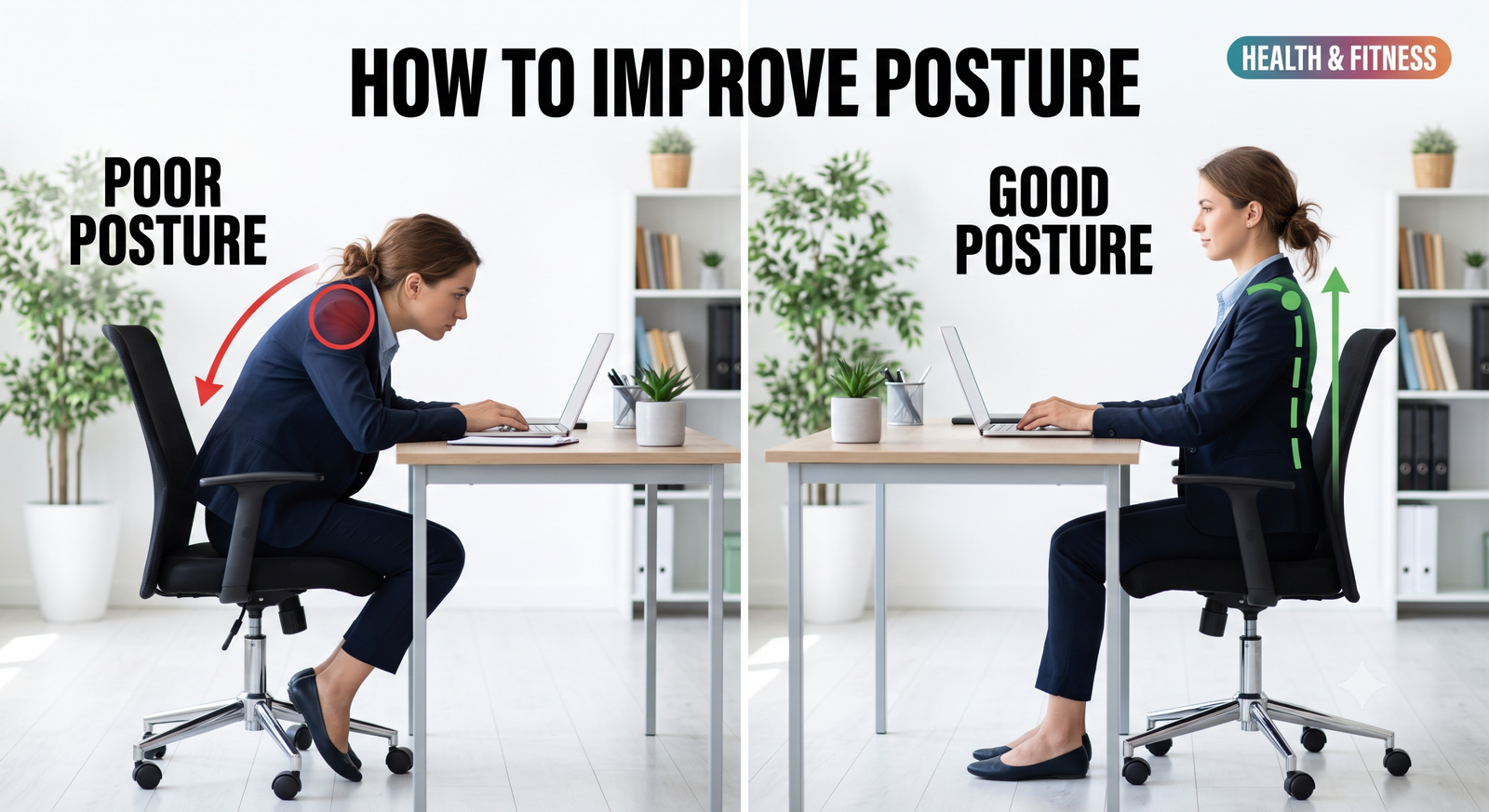
If your back aches by midday, your neck feels tight after work, or you keep catching a hunched reflection in shop windows, learning how to improve posture is one of the most practical health habits you can build. Poor posture is not just about appearances. It causes real, lasting pain and affects your breathing, digestion, confidence, and even your mood.
The good news is that posture is not fixed. Your body adapts to the positions you hold most often, which means the same adaptability that caused your posture to worsen can be used to improve it. With the right daily habits, consistent stretches, and a few smart adjustments to how you sit and stand, most people notice meaningful changes within a few weeks.
In this guide, you will learn how to improve posture through 10 proven daily fixes, why good posture matters for your health beyond aesthetics, the most common causes of poor posture, and the exercises that correct it fastest.
Table of Contents
Why Good Posture Matters More Than You Think
Posture is the position your body defaults to when you are not consciously thinking about it. Good posture means your bones, muscles, and joints are in alignment so that your body uses the least amount of effort to maintain any position, whether sitting, standing, or moving.
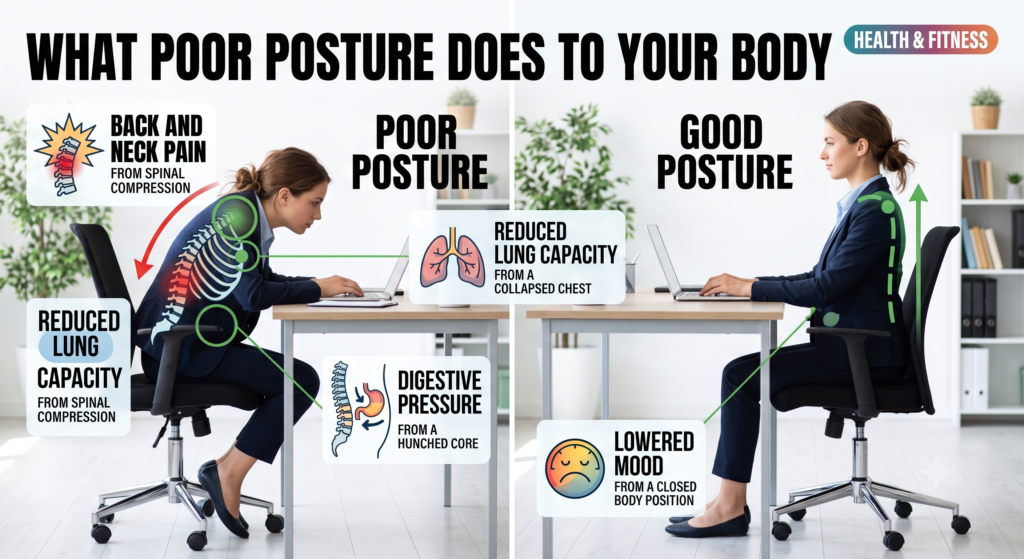
When posture is poor, certain muscles become chronically shortened and tight while others become overstretched and weak. This imbalance creates pain, reduces range of motion, and places excess load on joints that were not designed to carry it. The neck, lower back, and shoulders absorb most of this strain, which is why desk workers, smartphone users, and people who drive long distances so frequently report pain in exactly these areas.
The effects go beyond pain. Hunched posture compresses the chest cavity and reduces lung volume by up to 30 percent, impairing breathing efficiency. It places pressure on the digestive organs. It affects balance and increases fall risk in older adults. According to Harvard Health, good posture protects the spine, reduces wear on joints, and prevents the muscle fatigue and pain that result from poor alignment over time.
There is also a psychological dimension. Research has found that adopting upright, open postures influences hormone levels and mood, with more open postures associated with higher confidence and lower stress.
Common Causes of Poor Posture
Understanding what caused your posture to worsen makes it easier to fix the right things rather than just doing generic exercises.
Prolonged sitting is the most widespread cause. The human body is not designed to remain seated for eight or more hours daily. Sitting shortens the hip flexors, weakens the glutes and core, and rounds the upper back and shoulders forward into what is sometimes called text neck or desk posture.
Smartphone and screen use adds to this. Looking down at a phone for extended periods places enormous extra load on the cervical spine. At a 60-degree angle, the effective weight on the neck can rise to around 27 kilograms, which over hours per day gradually pulls the head forward and rounds the upper back.
Muscle weakness is an often-overlooked cause. Weak core muscles cannot adequately support the spine, so the lower back compensates by arching or collapsing. Weak upper back and rear shoulder muscles cannot hold the shoulders back, allowing them to round forward. Poor footwear and carrying heavy bags on one shoulder also contribute.
How to Improve Posture: 10 Proven Daily Fixes
These ten practical fixes address how to improve posture from every angle, covering your workstation, your movement patterns, your exercises, and your body awareness.
1. Adjust Your Desk Setup
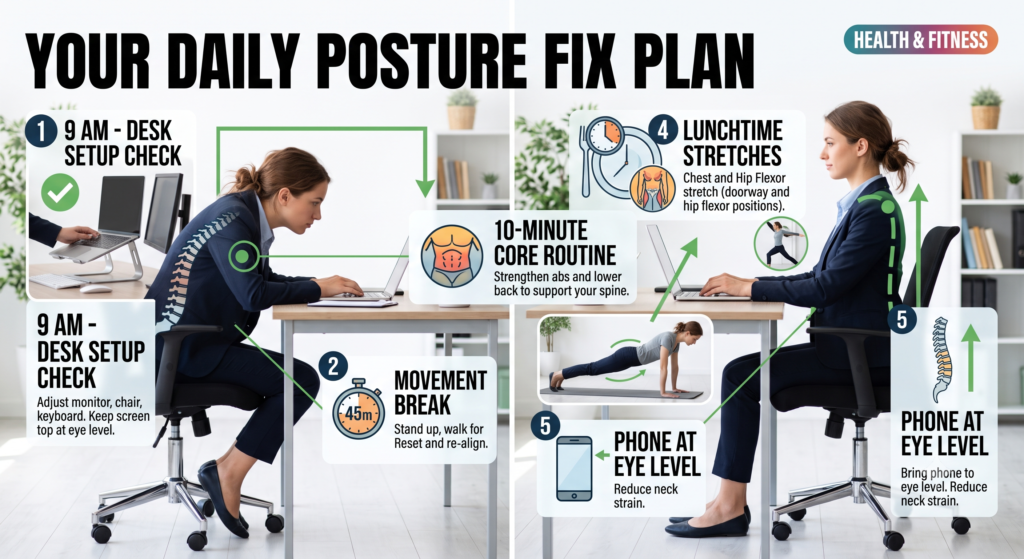
Your environment shapes your posture more than willpower does. A monitor at eye level, a chair with lumbar support adjusted so your feet rest flat on the floor, and your keyboard positioned so your elbows are at roughly 90 degrees removes the structural pressures that force your body into poor alignment.
Most people sit with their monitor too low, pulling their head and neck forward over hours. Raising it to eye level is often the single fastest fix for neck and upper back pain.
2. Set a Movement Reminder Every 30 to 45 Minutes
No chair or desk setup can fully offset the effects of continuous sitting. Standing, walking, or stretching for two to five minutes every 30 to 45 minutes interrupts the muscle shortening and spinal compression that accumulates with prolonged sitting.
A simple phone alarm, a browser extension, or a sticky note is enough. The habit of regular breaks does more for posture and back health than any single exercise.
3. Strengthen Your Core Every Day
The core is the muscular corset around your spine that keeps it supported and upright. When core muscles are weak, the spine has insufficient internal support and collapses into poor alignment under the load of daily life.
You do not need intense core workouts. Dead bugs, bird dogs, planks, and glute bridges performed for ten to fifteen minutes daily build the foundation your posture depends on. Our article on home workouts without equipment includes practical beginner-friendly core routines.
4. Stretch Your Chest and Hip Flexors Daily
The muscles most shortened by desk work are the chest, front shoulders, and hip flexors. Daily stretching of these areas counteracts the forward-pulling force that rounds the upper back and tilts the pelvis forward.
A doorway chest stretch, a kneeling hip flexor lunge stretch, and a seated figure-four stretch for the glutes each take under a minute and together address the three biggest contributors to desk posture. Our guide on stretching exercises for beginners gives step-by-step instructions for each of these and more.
5. Strengthen Your Upper Back and Rear Shoulders
Weak upper back muscles cannot resist the forward pull of the chest and gravity, so the shoulders round forward and the upper spine hunches. Rows, face pulls, band pull-aparts, and reverse flies all directly target the muscles that pull the shoulders back and hold the upper spine in alignment.
Two to three sets of any of these exercises, three to four times per week, produces noticeable changes in shoulder position and upper back strength within four to six weeks.
6. Check Your Sleeping Position
You spend seven to nine hours in bed each night, and how you sleep significantly affects your posture. Sleeping on your stomach places the neck in prolonged rotation and arches the lower back, making it one of the worst positions for spinal alignment over time.
Side sleeping with a pillow between the knees, or back sleeping with a pillow under the knees, maintains more neutral spinal curves. A pillow that keeps your head level with your shoulders, neither too high nor too flat, protects the cervical curve during sleep.
7. Be Mindful of Your Phone Position
Raising your phone to eye level when you use it, rather than looking down at it in your lap, eliminates one of the most significant daily loads on the cervical spine. It feels unnatural at first because the habit of looking down is so ingrained, but the neck strain it prevents is substantial.
Limiting total daily screen time and taking regular breaks from phone use also reduces cumulative neck loading significantly.
8. Wear Supportive Footwear
High heels and flat unsupportive shoes both alter the way your weight travels up through the ankles, knees, hips, and spine. High heels shift weight forward, increasing lumbar arch and knee strain. Very flat unsupportive shoes can reduce shock absorption and alter pelvic tilt.
Supportive footwear with a modest heel of around two centimeters, arch support, and cushioning maintains more neutral lower body alignment that supports the spine from the ground up.
9. Carry Bags Symmetrically
A heavy bag carried on one shoulder for years creates chronic asymmetry. One side of the neck and trapezius works harder, the spine bends slightly to compensate, and muscles on opposite sides develop differently in response.
Using a backpack that distributes weight evenly across both shoulders, or alternating which shoulder carries a single strap bag, prevents this cumulative imbalance.
10. Practice Standing Tall Deliberately
Periodically throughout the day, take a moment to stand or sit deliberately tall. Gently pull the crown of your head upward as if a string were attached to it, let your shoulders drop down and back, engage your core lightly, and breathe into your chest. Hold for thirty seconds.
This deliberate practice builds the body awareness and muscle memory that gradually makes good posture more automatic rather than something you have to constantly remember.
Best Exercises to Improve Posture at Home
Beyond the daily fixes above, a targeted posture exercise routine accelerates the structural changes that realign the spine and shoulders.
The cat-cow stretch mobilizes the entire spine and is an ideal morning warm-up. Thoracic extensions over a foam roller or rolled towel counteract the forward rounding of the upper back. Wall angels, performed standing with your back flat against a wall, train the shoulder movement pattern that good posture depends on.
Chin tucks correct the forward head position by retraining the deep cervical flexors that support the neck. Simply draw the chin gently straight back to create a slight double chin and hold for five seconds, repeating ten times. This exercise alone addresses text neck more specifically than almost anything else.
Our guide on low impact cardio for seniors includes gentle movement routines that also benefit spinal health, and our best home workouts for beginners guide covers beginner-friendly strength work that supports posture improvement.
How to Improve Posture at a Desk
Desk workers face the greatest postural challenge because they accumulate the most hours in a fixed seated position. A few specific adjustments make a significant difference.
Your monitor should be at eye level and about an arm’s length away. Your chair should allow your feet to rest flat on the floor with your knees at about 90 degrees. Your lower back should have support, either from the chair’s lumbar support or a small rolled towel placed at the lumbar curve. Your shoulders should be relaxed, not raised, and your elbows close to your body.
Alternating between sitting and standing if a standing desk is available prevents the continuous compression of any one posture. Even standing for twenty to thirty minutes per hour dramatically reduces spinal load compared to continuous sitting.
How to Improve Posture While Standing and Walking
Good standing posture involves distributing your weight evenly across both feet, keeping your knees soft rather than locked, allowing your pelvis to sit in a neutral position, and letting your shoulders sit back and down naturally rather than being forced.
Walking posture improves when you look forward rather than down at your phone or feet, let your arms swing naturally at your sides, and keep your core lightly engaged. Our article on the benefits of walking daily covers how consistent walking builds the muscle tone and cardiovascular health that makes good posture sustainable over time.
According to the Mayo Clinic, standing tall with a neutral spine, engaged core, and relaxed shoulders is the foundation of good posture during all upright activities.
Build Posture Awareness Into Your Day
The greatest challenge with posture improvement is not knowing what to do. It is remembering to do it consistently. Building small posture check-ins into existing habits solves this.
Check your posture every time you sit down at your desk, every time you pick up your phone, every time you stop at a traffic light, and every time you walk through a doorway. These micro-moments of awareness gradually wire new postural habits into your automatic behavior without requiring constant conscious effort.
Pairing posture work with your existing health habits compounds the benefit. If you already walk daily, work on upright walking posture during those walks. If you already stretch in the morning, add one thoracic extension and one chest stretch. Our article on healthy lifestyle habits for energy and focus explains how stacking new habits onto existing ones dramatically increases consistency.
Track Your Health and Progress
Posture improvement is gradual, and tracking your progress helps you stay motivated. Take a side-profile photo on the first day, then once every four weeks. The changes in shoulder position, head position, and spinal curve often become clearly visible over two to three months of consistent effort.
Notice also how your pain levels and energy change. Many people find that consistent posture work reduces back and neck pain significantly within six to eight weeks, and that better breathing from an open chest raises their daily energy. For your broader physical health, use our free BMI calculator and calorie calculator to ensure your nutrition is supporting the muscle development that good posture depends on.
Frequently Asked Questions
How long does it take to improve posture?
Most people notice reduced pain and improved awareness within two to four weeks of consistent daily habits. Visible structural changes in shoulder and head position typically appear within six to twelve weeks of regular stretching, strengthening, and posture check-ins.
Can you fix bad posture permanently?
Yes, with consistent effort. Since posture is a product of muscle length and strength, systematically stretching the tight muscles and strengthening the weak ones produces lasting structural change. Maintaining the habits that created the improvement is what makes it permanent.
What is the fastest way to improve posture?
Adjusting your workstation to put your monitor at eye level, setting a movement reminder every 45 minutes, and doing a daily chest stretch and chin tuck exercise produce the fastest noticeable changes. These address the three most common causes of poor posture simultaneously.
Can poor posture cause headaches?
Yes. Forward head posture places excess load on the cervical spine and the muscles that support it. Chronic tension in these muscles frequently produces tension headaches and neck pain that improve significantly when posture is corrected.
Is standing all day better than sitting for posture?
Neither continuous standing nor continuous sitting is ideal. Alternating between sitting, standing, and moving produces the best posture and spinal health outcomes. Standing desks are valuable when used with movement breaks rather than as a replacement for movement.
What exercises help posture the most?
Core strengthening exercises including planks and dead bugs, upper back exercises including rows and face pulls, and daily chest and hip flexor stretches produce the most significant posture improvements. Chin tucks specifically address forward head position.
Does posture affect confidence and mood?
Research suggests yes. Open, upright postures are associated with higher feelings of confidence and lower stress hormones compared to closed, hunched positions. Improving posture often produces psychological benefits alongside the physical ones.
Final Thoughts
Learning how to improve posture is one of the most practical investments in your daily comfort, long-term joint health, and physical confidence. The fixes are not complicated, they are consistent. A better desk setup, daily stretching and core work, regular movement breaks, and a few moments of deliberate body awareness each day compound into a straighter, stronger, more comfortable body over months.
Start with one change today. Raise your monitor, set a movement alarm, or do ten chin tucks right now. Add another habit next week. Within a few months, how to improve posture will shift from something you think about to something your body simply does.
Explore more of our health and fitness guides on Vitality Nexus for practical, science-backed habits that support a strong, capable, pain-free body at every age.
Medical Disclaimer: This article is for general information only and is not medical advice. If you have chronic pain, a spinal condition, or injury, please consult a qualified physiotherapist or doctor before starting any posture correction exercises.