Starting a workout routine feels exciting in theory. But when you actually stand in your living room wondering what on earth to do, it can get confusing very quickly.
You do not need a gym membership. You do not need expensive equipment. You do not even need a lot of time. What you need are the right exercises, a basic plan, and the confidence that comes from knowing you are doing something that actually works.
This guide covers the best home workouts for beginners in a way that is practical, honest, and easy to follow from day one. Whether you want to lose weight, build strength, boost your energy, or simply start moving your body consistently, everything you need is right here.
Let us get started.
Table of Contents
Why Home Workouts Work Brilliantly for Beginners
A lot of people assume that real fitness only happens in a gym. That is simply not true.
Home workouts are actually ideal for beginners in several specific ways. There is no commute, no waiting for equipment, no feeling self-conscious in front of experienced gym-goers, and no monthly fee. You can pause the workout when life gets in the way and come back to it without losing momentum.
More importantly, your bodyweight is enough resistance to build genuine strength, improve cardiovascular fitness, and burn meaningful calories when the exercises are done correctly and consistently.
Research published in the Journal of Exercise Science and Fitness consistently shows that bodyweight training programs produce significant improvements in strength, endurance, and body composition when followed with proper progressive overload. The gym is one way to get fit. It is not the only way.
For beginners specifically, starting at home also removes the most common barrier to exercise: the friction of getting there. When your workout space is your living room or bedroom floor, the excuse of not having time to get to the gym simply disappears.
What to Know Before You Start
Before jumping into the exercises, a few things will make a real difference in how well your beginner journey goes.
Start Slower Than You Think You Should
Most beginners overdo it in the first week and then feel too sore to continue. This is one of the most common reasons people quit. Starting with two to three sessions per week at moderate intensity is far more effective long-term than going all-out every day and burning out.
Warm Up Every Single Time
A five-minute warm-up is not optional. Jumping into intense movement with cold muscles increases injury risk significantly. A simple warm-up can be arm circles, leg swings, light marching in place, and gentle hip rotations for about five minutes.
Focus on Form Before Speed or Reps
Doing twenty sloppy squats does far less for you than ten controlled, properly executed ones. Learning the correct movement pattern first protects your joints and makes every rep count.
Rest Days Are Part of the Program
Your muscles do not grow during the workout. They grow during rest. Beginners should take at least one to two rest days between strength sessions targeting the same muscle groups.
Track Your Numbers From Day One
Before you begin, calculate your baseline. Knowing your current body weight, BMI, and calorie needs gives you real data to measure your progress against. You will find the free tools you need in the calculator section further down this article.
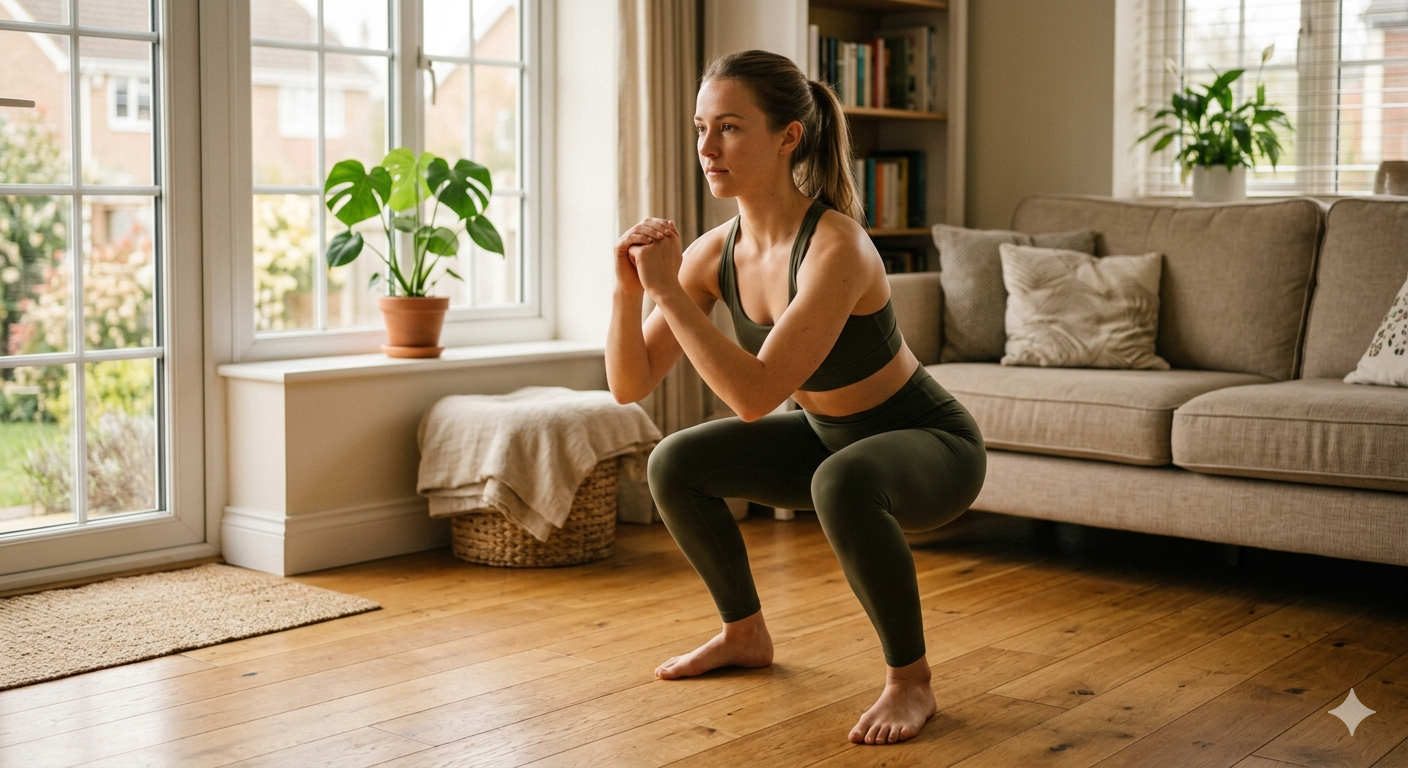
1. Bodyweight Squats
If there is one single exercise every beginner should master first, it is the squat.
Squats work the quadriceps, hamstrings, glutes, and core simultaneously. They mimic one of the most fundamental human movement patterns, sitting down and standing up, and the strength they build transfers directly to everyday life.
How to do it correctly: Stand with your feet shoulder-width apart and your toes pointing slightly outward. Push your hips back as if you are about to sit into a chair. Lower yourself until your thighs are roughly parallel to the floor, keeping your chest up and your knees tracking over your toes. Press through your heels to stand back up.
Beginner target: 3 sets of 10 to 15 reps with a 60-second rest between sets.
Common mistake to avoid: Do not let your knees cave inward as you lower. If they do, slow down and think about pushing your knees out actively throughout the movement.
2. Push-Ups (and How to Modify Them)
Push-ups are one of the best upper body exercises you can do with no equipment. They train the chest, shoulders, triceps, and core all at once.
The reason many beginners avoid them is that the full version is genuinely hard if you are starting from zero. The good news is that the knee push-up modification is not a lesser exercise. It is simply the appropriate starting point.
How to do the knee push-up: Start on all fours with your knees on the floor, hands slightly wider than shoulder-width. Lower your chest toward the floor, keeping your elbows at roughly a 45-degree angle from your body. Push back up to the starting position.
How to progress to full push-ups: Once you can do 15 clean knee push-ups, start working on the full version. The form is identical except your knees are off the floor and your body forms a straight line from head to heels.
Beginner target: 3 sets of 8 to 12 reps. Stop when your form starts to break down.
3. Glute Bridges
This exercise is a favourite among physical therapists and fitness coaches for a very good reason. It activates the glutes, strengthens the lower back, and helps correct the hip weakness that comes from spending long hours sitting down.
How to do it: Lie on your back with your knees bent and feet flat on the floor, hip-width apart. Press your feet into the ground and lift your hips toward the ceiling, squeezing your glutes hard at the top. Hold for one to two seconds, then lower slowly.
Beginner target: 3 sets of 12 to 15 reps.
Why it matters for beginners: Most people starting a fitness routine have underactive glutes from prolonged sitting. The glute bridge wakes these muscles up, which reduces lower back pain and makes all other lower-body exercises more effective.
4. Plank Hold
The plank is one of the most efficient core exercises available. It builds strength through the entire midsection, including the deep stabilizing muscles that most crunches completely miss.
How to do it: Place your forearms on the floor with your elbows directly beneath your shoulders. Extend your legs behind you so your body forms a straight line from head to heels. Hold this position while breathing normally. Do not let your hips sag or lift into the air.
Beginner target: 3 holds of 20 to 30 seconds, working up to 60 seconds as you get stronger.
What you will feel: The temptation is to hold your breath. Resist this. Breathe slowly and steadily throughout the hold. The moment your hips drop significantly, stop the set. Quality over duration.
5. Jumping Jacks
Jumping jacks are one of the simplest and most underrated cardio exercises for beginners. They raise your heart rate quickly, involve the whole body, require zero equipment, and can be done in a very small space.
How to do them: Start standing with feet together and arms at your sides. Jump your feet out to shoulder-width while raising your arms overhead. Jump back to the starting position and repeat in a rhythmic, controlled manner.
Beginner target: 3 sets of 30 seconds, with 30 seconds of rest between sets.
For people with joint sensitivity, a low-impact modification involves stepping one foot out at a time instead of jumping. The benefits are similar with significantly less impact on the knees and ankles.
Adding jumping jacks between strength exercises is a great way to keep your heart rate elevated and turn a strength session into a combined cardio-strength workout.
6. Mountain Climbers
Mountain climbers are a genuinely challenging full-body exercise that builds core strength, cardiovascular endurance, and hip flexor mobility all at once. They look simple but will test you in a good way.
How to do them: Start in a high push-up position with arms straight and body forming a straight line. Drive one knee toward your chest, then quickly switch legs in a running motion, alternating as fast as your form allows.
Beginner target: 3 sets of 20 seconds, building up to 40 seconds as your fitness improves.
Form tip: Keep your hips level throughout. It is very tempting to lift the hips up as you get tired. Resist this. Keeping the body flat is what makes the exercise effective and protects the lower back.
7. Lunges
Lunges train each leg individually, which helps identify and correct any strength imbalances between sides. They build the quadriceps, hamstrings, glutes, and also require balance and core stability.
How to do them: Stand tall with feet hip-width apart. Step one foot forward and lower your back knee toward the floor, stopping just before it touches. Both knees should be at roughly 90-degree angles at the bottom position. Push through your front heel to return to standing.
Beginner target: 3 sets of 8 to 10 reps on each leg.
Common mistake: Stepping too short. If your front knee is shooting past your toes significantly, take a longer step. The shin of the front leg should stay roughly vertical at the bottom of the movement.
For people with knee discomfort, reverse lunges, stepping backward instead of forward, place less stress on the knee joint and are a great starting modification.
8. Tricep Dips Using a Chair
You do not need a dip station to train your triceps at home. A sturdy chair or couch does the job perfectly.
How to do them: Sit on the edge of a chair with your hands gripping the edge beside your hips. Slide your hips off the seat and bend your elbows to lower yourself toward the floor, keeping your back close to the chair. Press through your palms to straighten your arms and return to the starting position.
Beginner target: 3 sets of 10 to 12 reps.
Safety note: Make sure the chair is against a wall or otherwise stable before doing this. A sliding chair is a real injury risk.
Tricep dips complement push-ups nicely in a beginner routine because they hit the back of the upper arm from a slightly different angle, building more complete arm strength.
9. High Knees
High knees are an excellent cardio exercise for beginners that also strengthens the hip flexors and improves coordination. They get the heart rate up fast and can be done in a single square meter of floor space.
How to do them: Stand with feet hip-width apart. Drive one knee up toward your chest while pumping the opposite arm forward, then quickly alternate. Try to maintain a running-in-place rhythm while keeping your posture upright.
Beginner target: 3 sets of 30 seconds with 30 seconds rest between sets.
Low-impact option: March with high knees instead of running the movement. Lift each knee deliberately and slowly, focusing on hip flexor engagement rather than speed. This is much gentler on the joints while still providing meaningful cardiovascular and muscular benefits.
10. Superman Hold
The Superman hold is one of the best exercises for beginners to strengthen the lower back, glutes, and posterior chain. These are the muscles that support your spine and are typically very weak in people who sit for long periods.
How to do it: Lie face down on the floor with your arms stretched straight out in front of you. Simultaneously lift your arms, chest, and legs off the floor as high as comfortable, squeezing your glutes and back muscles. Hold for two to three seconds at the top, then lower slowly.
Beginner target: 3 sets of 10 to 12 reps.
This exercise is a perfect complement to planks and glute bridges in a beginner routine because it trains the muscles that work directly opposite to the ones engaged during sitting, which is exactly what most beginners need.
How to Build Your Weekly Beginner Workout Plan
Having a collection of exercises is one thing. Knowing how to structure them into a weekly plan is what actually produces results.
Here is a simple and effective three-day beginner schedule that works for most people:
Day 1: Full Body Strength Bodyweight squats, push-ups, glute bridges, plank hold, Superman hold. Perform 3 sets of each with 60 seconds rest between sets.
Day 2: Rest or Light Walking A 20 to 30 minute gentle walk is ideal. It promotes recovery without adding stress to muscles that are still adapting. Read our article on morning vs night walks for weight loss and wellness to understand how to make the most of these active recovery days.
Day 3: Cardio and Core Jumping jacks, mountain climbers, high knees, lunges, tricep dips, plank hold. Perform each exercise for 30 to 40 seconds with 20 seconds rest, completing two to three full circuits.
Day 4: Rest
Day 5: Full Body Strength Repeat Day 1 with a focus on improving your form and adding one or two reps to each set compared to Day 1.
Days 6 and 7: Rest or Light Activity
This structure gives your muscles enough stimulus to adapt and grow while giving them the recovery time they genuinely need. After four weeks, gradually increase the difficulty by adding reps, reducing rest time, or progressing to harder variations of each exercise.
Use Our Free Tools to Track Your Progress
Working out at home is far more motivating when you can actually measure your progress. These free tools on Vitality Nexus give you the data you need to set real goals and see real results.
Check Your BMI Use our BMI Calculator to understand where your current body mass index sits and track how it changes as your fitness routine takes hold.
Find Your Ideal Weight Use our Ideal Weight Calculator to set a realistic, science-based weight goal that is healthy for your specific height, age, and body type.
Calculate Your Daily Calorie Needs Exercise only works at its best when you are fueling your body properly. Use our Calorie Calculator to find out exactly how many calories you need each day to support your activity level and reach your goals.
Know Your TDEE Your Total Daily Energy Expenditure changes as you become more active. Use our TDEE Calculator to calculate how many calories your body burns each day so your nutrition plan keeps pace with your fitness progress.
Calculate Your Body Fat Percentage Weight alone does not tell the full story. Use our Body Fat Calculator to track changes in your body composition as you gain muscle and lose fat, which is what real fitness progress actually looks like.
Optimize Your Sleep Sleep is when your muscles repair and grow. Use our Sleep Calculator to find the sleep timing that supports your recovery and keeps your energy high for every workout.
Common Beginner Mistakes to Avoid
Even with the best intentions, beginners tend to fall into the same traps. Knowing them in advance saves a lot of frustration.
Doing too much too soon. Enthusiasm is great. But your muscles, tendons, and joints need time to adapt to new demands. Starting with two to three sessions per week is not taking it easy. It is being smart about long-term consistency.
Skipping the warm-up. Every single session. No exceptions. Five minutes of light movement before your workout drastically reduces injury risk and actually improves performance.
Neglecting nutrition. Exercise creates the demand. Food provides the raw material. Without adequate protein and calories, your body cannot build the muscle or replenish the energy that your workouts require. Read our article on healthy lifestyle habits for energy, focus, and productivity for practical guidance on how nutrition and fitness work together.
Comparing your progress to others. Fitness is deeply individual. Your starting point, your recovery capacity, your hormones, your sleep quality, and your stress levels all influence how quickly you progress. The only comparison that matters is you versus your previous self.
Quitting when it gets uncomfortable. Discomfort during exercise is normal and expected. Pain that is sharp, localized, or accompanied by swelling or instability is a signal to stop. Everything else is simply your body adapting to something new, which is exactly what you want it to do.
Ignoring sleep. Many beginners focus entirely on the workout and the diet and completely overlook sleep. But growth hormone, which is essential for muscle repair and fat burning, is secreted primarily during deep sleep. Consistently poor sleep undermines every other effort you make. Read our article on magnesium for sleep for natural strategies to improve sleep quality as part of your fitness routine.
FAQ
1. What are the best home workouts for beginners with no equipment?
The most effective no-equipment exercises for beginners are bodyweight squats, push-ups or knee push-ups, glute bridges, planks, lunges, jumping jacks, mountain climbers, high knees, tricep dips using a chair, and the Superman hold. These exercises cover all major muscle groups and can be combined into a complete full-body routine without needing a single piece of equipment.
2. How many days per week should a beginner work out at home?
Three days per week is the ideal starting point for most beginners. This gives your muscles enough training stimulus to adapt and grow while providing adequate rest for recovery. After four to six weeks of consistent three-day training, you can gradually add a fourth session if your body is recovering well.
3. How long should a beginner home workout be?
Twenty to thirty minutes is perfectly sufficient for a beginner. A five-minute warm-up, fifteen to twenty minutes of main exercises, and a five-minute cool-down is a complete and effective session. Longer is not always better, especially for beginners whose muscles and connective tissue are still adapting to training stress.
4. Can you really get fit doing home workouts?
Absolutely. Cardiovascular fitness, muscular strength, flexibility, and body composition can all improve significantly through well-structured home workouts. Many people have achieved remarkable physical transformations using nothing more than bodyweight exercises and a consistent schedule. The gym provides more tools. Home workouts provide more consistency for many people, and consistency wins every time.
5. How soon will I see results from home workouts?
Most beginners notice improved energy and mood within the first week or two. Visible changes in body composition typically begin to appear after four to eight weeks of consistent training and appropriate nutrition. Strength improvements often come faster than aesthetic changes, which is a useful and motivating thing to track in the early weeks.
6. Do I need to eat differently when starting a home workout routine?
Yes. Exercise increases your body’s demand for protein to support muscle repair and carbohydrates to replenish energy. Most beginners benefit from slightly increasing protein intake and ensuring they are eating enough total calories to support their training. Undereating is a very common reason why beginners plateau or feel excessively tired from their workouts.
7. What should I do if an exercise feels too hard?
Use a modification. Every exercise in this guide has an easier version. Knee push-ups instead of full push-ups. Stepping high knees instead of running them. Shorter plank holds. Shallower squats until mobility improves. Starting at the modified version and progressing when ready is the intelligent approach, not a compromise.
Conclusion
Getting started is genuinely the hardest part. Once you have done your first workout and felt that post-exercise energy, the motivation to continue tends to take care of itself.
The best home workouts for beginners are not complicated. They are the ones you actually do, consistently, over weeks and months. The ten exercises in this guide cover your entire body, require no equipment, and can be adapted to any fitness level starting from zero.
Begin with three sessions per week. Focus on your form before your speed or reps. Fuel your body well, sleep properly, and track your numbers using the free tools at Vitality Nexus.
Explore our full health and fitness resources for more guidance on building a lifestyle that supports your goals. Your living room is ready. All that is left is for you to begin.