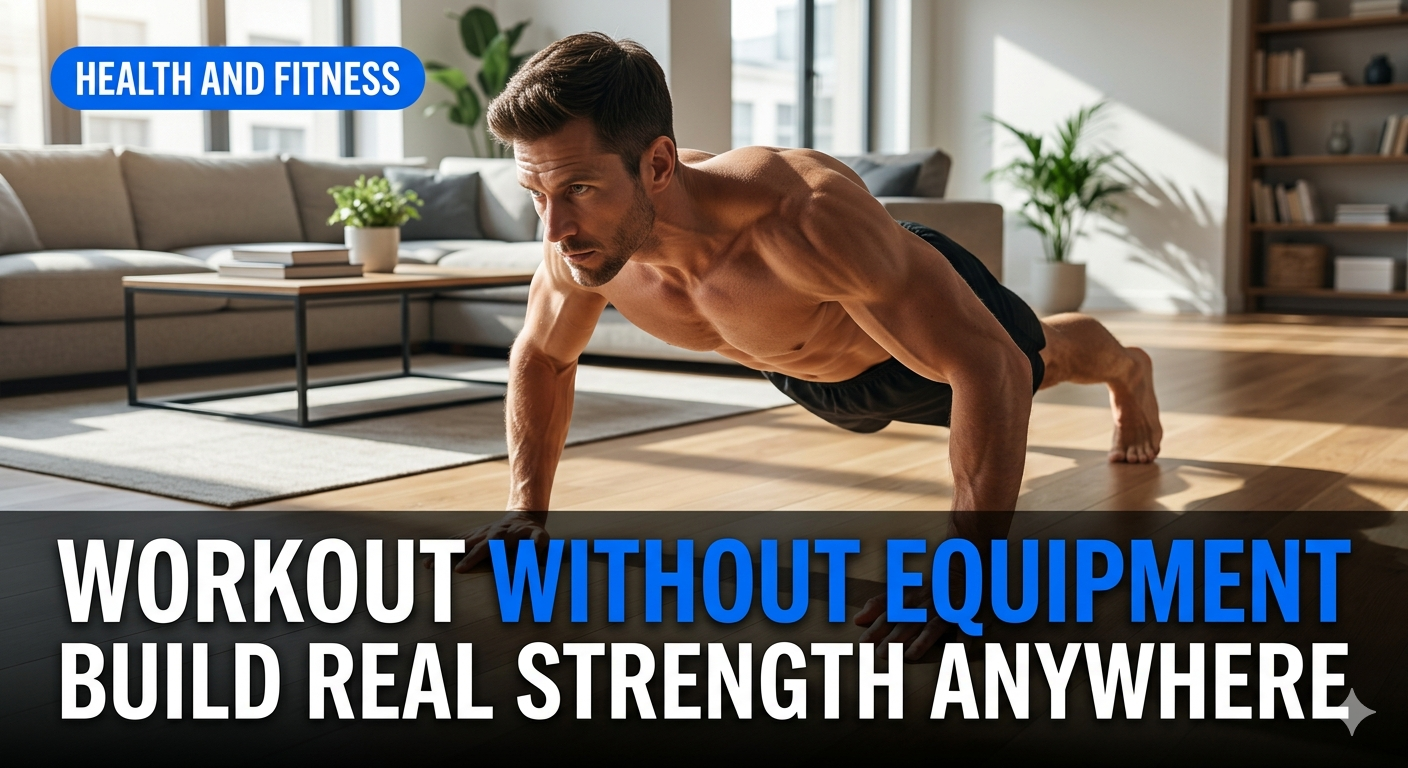
You do not need a gym. You do not need dumbbells. You do not need a barbell, a cable machine, a resistance band, or a single piece of equipment to build a genuinely strong, lean, and capable body.
That statement is not wishful thinking. It is backed by decades of exercise science, military training traditions, and the lived experience of millions of people who have transformed their fitness using nothing but their own bodyweight and the floor beneath their feet.
The problem is not access to equipment. The problem is not knowing what to do without it. That is exactly what this guide solves.
Here are the 10 best workout without equipment routines you can start today, whether your goal is building strength, burning fat, improving endurance, or simply staying active without the hassle and cost of a gym membership.
Table of Contents
Why a Workout Without Equipment Works Better Than You Think
Most people assume that serious fitness requires serious equipment. This assumption is understandable because gyms are everywhere, fitness influencers post from weight rooms, and the industry profits from selling gear.
But consider this. Military training programs across the world have relied almost exclusively on bodyweight exercise for generations. Special forces units build extraordinary physical capacity through push-up variations, pull-ups, squats, lunges, and running. Gymnasts develop arguably the most impressive strength-to-weight ratios of any athletes alive through bodyweight skill work.
The reason bodyweight training works is fundamental. Muscle grows in response to mechanical tension and progressive overload. These stimuli are created whenever a muscle is challenged beyond its current capacity. Your bodyweight is a load. Applied through the right exercises and progressions, it creates that challenge just as effectively as any barbell.
According to research published in the Journal of Human Kinetics, bodyweight resistance training produces statistically significant improvements in muscular strength, endurance, and body composition when structured with appropriate progressive overload, comparable to results achieved with free weights in untrained to moderately trained populations.
The key difference between an effective workout without equipment and an ineffective one comes down to structure, progression, and effort. All ten routines below address each of these.
The Science Behind Bodyweight Training
Understanding why these workouts produce results makes you a smarter, more consistent exerciser.
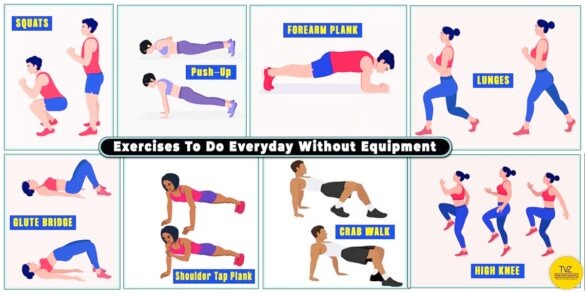
Every exercise in this guide works through one of three primary movement patterns. Pushing movements, which include push-ups, pike push-ups, and tricep dips, train the chest, shoulders, and triceps. Pulling movements, which at home without a bar include rows under a table or towel-based rows, train the back and biceps. Hinging and squatting movements, which include squats, lunges, glute bridges, and deadlift-pattern hip hinges, train the posterior chain and legs.
A well-structured workout without equipment addresses all three movement patterns across a training week. This ensures balanced muscular development and reduces the risk of the postural imbalances and overuse injuries that come from training some muscles while neglecting others.
Progressive overload, the gradual increase in challenge over time, is what keeps driving adaptation. Without it, your body adapts to the current demand and stops changing. The section on progression later in this guide covers exactly how to keep advancing without adding a single piece of equipment.
Workout 1: The Classic Full Body Circuit
This is the foundational workout without equipment that forms the backbone of most effective bodyweight programs. It hits every major muscle group in a single session and takes approximately 30 to 35 minutes.
Perform each exercise back to back with minimal rest between exercises. Rest for 60 to 90 seconds after completing all exercises in the circuit. Complete the circuit 3 times.
Push-ups: 12 to 15 reps. Standard form with hands slightly wider than shoulder-width and elbows at 45 degrees.
Bodyweight squats: 15 to 20 reps. Feet shoulder-width, hips back and down, chest up throughout.
Plank hold: 30 to 45 seconds. Elbows beneath shoulders, body in a straight line.
Reverse lunges: 10 reps on each leg. Step back and lower the rear knee toward the floor with control.
Glute bridges: 15 reps. Drive hips toward the ceiling and squeeze hard at the top.
Mountain climbers: 30 seconds. Alternating knees driven toward the chest from a push-up position.
Superman hold: 12 reps. Lying face down, simultaneously lift the chest, arms, and legs.
This circuit is suitable for all fitness levels when the reps and rest times are adjusted appropriately. Beginners can reduce reps and extend rest periods. More advanced trainees can reduce rest and add a fourth circuit.
Workout 2: The Upper Body Blaster
Upper body pushing strength is entirely achievable without weights when you use intelligent exercise selection and progression. This routine takes approximately 25 to 30 minutes.
Perform 3 to 4 sets of each exercise with 60 seconds rest between sets.
Standard push-ups: 15 reps. Controlled descent for two counts, press up for one count.
Diamond push-ups: 10 to 12 reps. Hands close together forming a diamond shape, elbows tracking back alongside the body. Targets triceps heavily.
Pike push-ups: 8 to 10 reps. Inverted V position, lower the crown of the head toward the floor between the hands. Targets shoulders.
Wide push-ups: 12 reps. Hands wider than standard, shifts emphasis toward the outer chest.
Tricep dips off a chair: 12 to 15 reps. Hands on the seat edge, back close to the chair, lower toward the floor and press back up.
Decline push-ups: 10 reps. Feet elevated on a chair or couch, hands on the floor. Increases upper chest and shoulder involvement significantly.
The key to continuous progress in this routine is advancing to harder push-up variations as the current ones become manageable. The progression path runs from knee push-ups to standard push-ups to archer push-ups to one-arm push-ups on the pushing side, and from standard dips to feet-elevated dips on the tricep side.
Workout 3: The Lower Body Burner
Building powerful legs and glutes without weights requires using single-leg variations that increase the load on each leg individually. This routine takes 25 to 30 minutes.
Perform 3 to 4 sets of each exercise with 60 seconds rest between sets.
Jump squats: 10 reps. Explosive push through the floor, soft landing with bent knees.
Bulgarian split squats: 10 reps each leg. Rear foot elevated on a chair, lower the back knee toward the floor with the front shin roughly vertical.
Reverse lunges with knee drive: 10 reps each leg. At the top of each rep, pull the rear knee forward and up to hip height before stepping back.
Wall sit: 45 to 60 seconds. Back flat against the wall, thighs parallel to the floor, hold as long as possible with good form.
Single leg glute bridges: 12 reps each leg. One leg extended, drive the working hip toward the ceiling and squeeze hard at the top.
Calf raises: 20 reps. Standing on the edge of a step if available, raise and lower the heels through a full range of motion.
The Bulgarian split squat is the exercise that will cause the most soreness in the first week. This is expected and a sign that the muscles are working at a genuine challenge level. Reduce depth or reps initially if the soreness becomes prohibitive.
Workout 4: The HIIT Fat Loss Routine
High Intensity Interval Training without equipment is one of the most time-efficient fat loss methods available. This routine takes 20 minutes and burns a significant number of calories both during and after the session through the afterburn effect.
Set a timer for 40 seconds of work followed by 20 seconds of rest. Complete 4 rounds of the following 5 exercises.
Burpees: Full movement including the push-up and jump. Move as fast as form allows.
High knees: Drive alternate knees toward the chest at a running pace while staying upright.
Jump squats: Explosive and continuous with soft landings.
Mountain climbers: Fast and rhythmic from a high push-up position.
Jumping jacks: Full range of motion with arms reaching fully overhead.
Rest for 90 seconds after completing all 5 exercises. That is one round. Complete 4 rounds total.
This workout should feel genuinely hard. Your heart rate should reach near-maximum effort during the work intervals. If the exercises feel easy, you are not working at the right intensity. Push harder during the work periods.
For more on how HIIT compares to other cardio formats and what it does for cardiovascular health, read our article on best cardio exercises.
Workout 5: The Core Strength Builder
Core strength is not just about visible abs. It is about the ability to transfer force effectively between the upper and lower body, maintain spinal stability under load, and support safe and powerful movement in every other exercise you do.
This routine targets the entire core including the deep stabilizers, obliques, and lower back. It takes approximately 20 to 25 minutes.
Perform 3 sets of each exercise with 45 seconds rest between sets.
Plank hold: 45 to 60 seconds. Breathe steadily and maintain a rigid position throughout.
Side plank: 30 to 45 seconds each side. Body in a straight line, supported on one forearm.
Dead bug: 10 reps each side. Lying on your back, arms pointing toward the ceiling, knees at 90 degrees. Slowly lower the opposite arm and leg toward the floor while keeping the lower back pressed firmly into the floor.
Hollow body hold: 20 to 30 seconds. Lying on your back, arms overhead, legs extended and raised slightly. Press the lower back into the floor and create a curved hollow shape with the body.
Bicycle crunches: 15 reps each side. Slow and controlled, bringing the elbow toward the opposite knee with a full trunk rotation.
Superman hold: 15 reps. Targets the lower back and posterior chain which are as much a part of the core as the front-facing muscles.
Plank to downward dog: 10 reps. From a forearm plank, press up to straight arms then push the hips back and up into a downward dog position before returning. Adds a dynamic component to standard plank work.
Workout 6: The Beginner Starter Routine
If you are completely new to exercise or returning after a long break, this is your starting point. It is intentionally simple, low-volume, and designed to introduce your body to movement without causing excessive soreness or injury.
Perform 2 sets of each exercise with 90 seconds rest between sets. Do this routine 3 days per week with rest days in between.
Wall push-ups: 10 reps. Hands on a wall rather than the floor, which reduces the percentage of bodyweight being lifted significantly.
Chair-assisted squats: 10 reps. Hold the back of a sturdy chair for balance and perform a controlled squat to a comfortable depth.
Glute bridges: 12 reps. Standard version with both feet on the floor.
Standing marches: 30 seconds. Lift alternate knees rhythmically while standing tall.
Seated leg extensions: 12 reps each leg. Sitting in a chair, slowly extend one leg to straight and lower back. Strengthens the quadriceps gently.
Plank from knees: 20 seconds. Forearms on the floor, knees on the floor rather than feet.
After four to six weeks of this routine, progress to the Classic Full Body Circuit in Workout 1. The transition will feel challenging but achievable if the beginner routine has been followed consistently.
For a more comprehensive guide to beginning exercise at home, read our article on best home workouts for beginners.
Workout 7: The Advanced Bodyweight Challenge
This routine is for people who have been training bodyweight consistently for at least three to four months and are ready for a genuine challenge. It takes 35 to 40 minutes and will tax even reasonably fit individuals significantly.
Perform 4 sets of each exercise with 60 seconds rest between sets.
Archer push-ups: 8 reps each side. One arm bends to lower the body while the other extends straight to the side, approximating a one-arm push-up.
Pistol squat progressions: 5 to 8 reps each leg. If full pistol squats are not yet achievable, perform them holding onto a door frame for assistance and gradually reduce the assistance over time.
Pike push-up with feet elevated: 10 reps. Feet on a chair in the pike position, increases the shoulder loading significantly.
Plyometric push-ups: 8 reps. Push up with enough force that the hands leave the floor at the top. Land with soft elbows and immediately lower into the next rep.
Single leg Romanian deadlift: 10 reps each leg. Standing on one leg, hinge forward at the hip while the rear leg extends behind, maintaining a flat back throughout. Trains the hamstrings and glutes unilaterally.
Bulgarian split squat jump: 8 reps each leg. Explosive version of the split squat, jumping from the bottom position and landing softly back in the split stance.
L-sit hold attempt: 3 attempts of maximum duration. Sitting on the floor with hands beside the hips, attempt to press the body off the floor by straightening the arms. Even partial elevation counts and builds toward the full hold progressively.
Workout 8: The Morning Energizer Routine
This routine is designed to be done within the first thirty minutes of waking. It is not designed to be the hardest workout of your week. It is designed to raise body temperature, increase blood flow, activate the major muscle groups, and set a positive physical and mental tone for the rest of the day.
It takes 15 minutes and requires nothing but enough floor space to lie down.
Perform each exercise for the prescribed duration or reps without rest between exercises. Rest for 60 seconds after completing all exercises. Complete 2 rounds.
Standing arm circles: 30 seconds forward, 30 seconds backward. Loosens the shoulder joint.
Hip circles: 30 seconds each direction. Hands on hips, large circular movement through the pelvis.
Bodyweight squats: 15 reps at a comfortable pace.
Cat-cow stretch: 10 reps. On all fours, alternate between arching the back toward the ceiling and dropping it toward the floor with the head rising. Mobilizes the spine.
Push-ups: 10 reps at moderate pace.
Glute bridges: 12 reps.
Jumping jacks: 45 seconds.
This routine is not about maximum effort. It is about consistent daily movement that compounds over weeks and months into meaningfully better cardiovascular health, joint mobility, and physical resilience.
For guidance on the specific benefits of morning movement and how it affects your day, read our article on morning vs evening workout.
Workout 9: The Cardio and Strength Combo
This routine combines strength-focused bodyweight exercises with cardio bursts between sets to keep the heart rate elevated throughout the session. The result is a workout that builds strength and burns fat simultaneously, which is one of the most efficient training formats available.
It takes approximately 30 to 35 minutes.
Perform the strength exercise for the prescribed reps, immediately followed by the cardio burst for 30 seconds. Then rest for 45 seconds before moving to the next pairing.
Push-ups, 12 reps, then jump rope or jumping jacks for 30 seconds.
Bodyweight squats, 15 reps, then high knees for 30 seconds.
Diamond push-ups, 10 reps, then burpees for 30 seconds.
Reverse lunges, 10 reps each leg, then mountain climbers for 30 seconds.
Glute bridges, 15 reps, then jumping jacks for 30 seconds.
Plank hold, 40 seconds, then high knees for 30 seconds.
Complete 3 full rounds of all six pairings. This format keeps your heart rate meaningfully elevated throughout the session, producing cardiovascular benefits alongside the muscular stimulus of the strength exercises.
Workout 10: The 20-Minute Lunch Break Workout
Not everyone has 45 minutes for a workout. This routine is built specifically for the reality of a busy schedule. Twenty minutes, no equipment, no changing room required if you dress appropriately, and significant enough effort to produce real fitness benefit.
Perform each exercise for 40 seconds with 20 seconds rest between exercises. Complete 2 full rounds of all exercises.
Bodyweight squats. Push-ups. Jumping jacks. Reverse lunges. Mountain climbers. Glute bridges. Burpees. Plank hold.
Two rounds of this circuit with the prescribed work and rest intervals totals exactly 19 minutes and 20 seconds. It covers pushing, lower body, cardio, core, and posterior chain in a single compact session.
Done three to four times per week, this routine is sufficient to produce meaningful improvements in cardiovascular fitness, muscular endurance, and body composition, particularly for people who are currently sedentary or lightly active.
How to Progress Your Workout Without Equipment Over Time
Progressive overload is what makes training produce continuous results. Without it, the body adapts to the current demand and stops changing. Here are the specific strategies to keep progressing your workout without equipment indefinitely.
Add reps. The simplest progression. When you can comfortably perform all prescribed reps with good form, add one to two reps per set next session.
Reduce rest time. Shortening rest periods between sets increases cardiovascular demand and metabolic stress without changing a single exercise.
Slow the tempo. A three-second descent on every push-up or squat dramatically increases time under tension and muscle-building stimulus compared to fast, bouncy reps.
Add a pause. Pausing for two seconds at the hardest point of the movement, the bottom of the squat or push-up, eliminates elastic energy assistance and increases muscular demand significantly.
Graduate to harder variations. Standard push-ups become archer push-ups become one-arm push-up negatives. Standard squats become jump squats become Bulgarian split squats become pistol squats. There is always a harder version.
Increase training volume gradually. Add one additional set per exercise every one to two weeks until you are performing four to five sets of each movement.
Add explosive variations. Replacing standard squats with jump squats, or standard push-ups with plyometric push-ups, increases the power demand and caloric cost of the exercise significantly.
Use Our Free Tools to Track Your Results
Training consistently is the effort side. Understanding your body’s numbers is the intelligence side. Together they produce results far faster than either alone.
Calculate Your TDEE Your Total Daily Energy Expenditure tells you how many calories your body burns each day. This is your maintenance level, the foundation of any nutrition plan that supports your training goals. Use our TDEE Calculator to find your personal number.
Set Your Calorie Target Use our Calorie Calculator to find the daily intake that supports either fat loss, muscle building, or maintenance alongside your no-equipment training.
Check Your BMI Use our BMI Calculator to track how your body composition shifts as your training routine builds momentum over weeks and months.
Measure Your Body Fat Percentage The scale does not tell you whether you are gaining muscle or losing fat. Use our Body Fat Calculator to track the metric that actually reflects real training progress.
Find Your Ideal Weight Use our Ideal Weight Calculator to set a science-based, realistic target weight for your height, age, and body type so you have a clear and meaningful goal to work toward.
Calculate Your BMR Use our BMR Calculator to understand your resting calorie burn and how it influences your total daily nutrition needs.
Optimize Your Sleep Muscle repair, growth hormone secretion, and metabolic recovery all happen primarily during sleep. Use our Sleep Calculator to protect the overnight recovery that makes your training productive.
Nutrition Tips to Maximize Your Results
A workout without equipment is only as effective as the nutrition that supports it. These principles apply regardless of whether your goal is fat loss, muscle building, or general fitness.
Protein is your first priority at every meal. Muscle repair and growth require amino acids from dietary protein. Aim for at least 1.6 grams per kilogram of your body weight daily. Chicken, eggs, Greek yogurt, fish, cottage cheese, and legumes are excellent sources. Read our article on omega-3 fatty acids benefits and food sources for guidance on the specific fats that reduce training-related inflammation and support muscle recovery.
Eat enough carbohydrates to fuel your workouts. Carbohydrates replenish the glycogen stores your muscles use during exercise. Whole grains, sweet potatoes, oats, fruits, and legumes are your best carbohydrate sources. Restricting carbohydrates too severely will impair workout performance and recovery.
Do not undereat. This is the most common nutritional mistake people make when training at home. Because the workouts are not in a gym setting, people subconsciously assume they do not need to eat as much as someone who trained at the gym. The muscles do not know where they were trained. They need the same nutritional support regardless.
Address micronutrient deficiencies. Magnesium supports muscle function, energy production, and sleep quality. Vitamin D3 supports testosterone production and muscle protein synthesis. Both are commonly deficient in people who exercise regularly without supplementing. Read our articles on magnesium benefits, deficiency symptoms, and food sources and vitamin D3 and K2 benefits for comprehensive guidance.
For complete guidance on how many calories to eat alongside your training, read our article on how many calories should I eat.
Common Mistakes People Make With No Equipment Training
These errors are extremely common and are responsible for the majority of people who try bodyweight training and conclude it does not work.
Never progressing the difficulty. Doing the same workout at the same intensity for months produces an initial adaptation followed by a complete plateau. Progressive overload is not optional. It is the mechanism of improvement. Use the progression strategies described above consistently.
Only training the muscles they can see. Most people focus on push-up variations for the chest and triceps, and squats for the quads, while completely ignoring the back, posterior chain, and deep core. The result is muscular imbalances that cause poor posture and increase injury risk. Every routine in this guide is designed to avoid this trap.
Treating rest days as failure. Rest days are where growth happens. The workout creates the stimulus. Sleep and nutrition provide the raw material. Rest allows the adaptation to occur. Skipping rest days does not accelerate progress. It prevents it.
Doing too much too soon. Starting with the advanced routine when you should be in the beginner routine leads to excessive soreness, potential injury, and rapid demotivation. Begin where you genuinely are, not where you wish you were. The beginner routine is not a consolation prize. It is the appropriate starting point.
Neglecting sleep. Everything you do in training is undermined by consistently poor sleep. Growth hormone, muscle protein synthesis, cortisol regulation, and fat metabolism all depend on sleep quality. Use our Sleep Calculator to protect this non-negotiable aspect of recovery.
For more on building the sustainable lifestyle habits that support consistent training, read our article on healthy lifestyle habits for energy, focus, and productivity.
FAQ
1. Can you really build muscle with a workout without equipment?
Yes, genuinely. Muscle responds to mechanical tension and progressive overload, not to the specific tool creating that tension. Bodyweight exercises applied with increasing challenge over time produce real, measurable muscle growth. The research confirms this, and the physical results of people who train exclusively with bodyweight for months confirm it further. The key conditions are adequate protein intake, consistent training, and progressive overload.
2. How often should I do a workout without equipment?
Three to four sessions per week is the ideal frequency for most people. This provides enough training stimulus to drive adaptation while allowing adequate recovery between sessions. More experienced trainees can train five days per week using a muscle group split, but three to four full-body or upper-lower sessions is the most effective and sustainable starting structure.
3. How long should a workout without equipment take?
Between 20 and 40 minutes is sufficient for a complete and effective bodyweight session. The 20-minute lunch break workout in this guide demonstrates that even very short sessions produce real benefit when the intensity and structure are right. Sessions longer than 60 minutes without adequate fueling tend to produce diminishing returns and increase recovery demand unnecessarily.
4. Is a workout without equipment effective for weight loss?
Absolutely. Bodyweight workouts, particularly HIIT-style circuits and higher-volume strength circuits, burn meaningful calories during the session and elevate metabolic rate for hours afterward. Combined with appropriate nutrition, a consistent workout without equipment routine is an effective and sustainable approach to fat loss. Read our article on how many calories should I eat to align your nutrition with your training.
5. What is the best workout without equipment for beginners?
Workout 6 in this guide, the Beginner Starter Routine, is specifically designed for people new to exercise or returning after a long break. It uses low-impact, accessible movements at manageable volumes with adequate rest. After four to six weeks of consistent practice, most beginners are ready to progress to the Classic Full Body Circuit in Workout 1.
6. Can I lose belly fat with a workout without equipment?
You can lose body fat overall through consistent bodyweight training combined with appropriate nutrition, and that fat loss will include the abdominal area. Spot reduction, meaning losing fat from one specific area through exercises targeting that area, is not physiologically possible. Overall fat loss from a caloric deficit and consistent training will reduce belly fat progressively alongside fat from other areas.
7. How do I make a workout without equipment harder without adding weights?
The most effective methods are advancing to harder exercise variations, slowing the movement tempo to increase time under tension, adding pauses at the most challenging point of each movement, reducing rest time between sets, adding explosive plyometric versions of standard exercises, and increasing total training volume by adding sets over time. There is genuinely no ceiling to how hard bodyweight training can become when these progression methods are applied intelligently.
Conclusion
The gym is one path to fitness. It is a useful one. But it is not the only one, and it is not always the most accessible, the most affordable, or the most sustainable for every person in every season of life.
A workout without equipment done consistently, with proper structure and progressive challenge, builds genuine strength, burns real fat, and produces lasting fitness improvements that show up in how you look, how you feel, and how you move through your daily life.
Pick the routine from this guide that matches your current fitness level and your current goals. Follow it consistently for six to eight weeks before evaluating your progress. Use the free tools at Vitality Nexus to align your nutrition with your training and track your results with real data. Explore our full health and fitness resources for more evidence-based guidance.
The space you need is already there. The program is right here. All that is left is to start.