Walking into a gym for the first time is one of the most intimidating things a person can do. Everyone seems to know exactly what they are doing. The equipment is unfamiliar. The unwritten social rules are invisible. And the fear of looking foolish in front of experienced gym-goers is very real and very understandable.
Here is the honest truth though. Every single person in that gym was a beginner once. Every one of them had a first day where they did not know where anything was, what half the machines did, or whether they were doing anything correctly. The only difference between them and you right now is time and repetition.
This beginner gym guide gives you everything you need to walk in with confidence, train intelligently, avoid the most common and costly mistakes, and build the kind of foundation that produces real, lasting results. Whether you want to lose fat, build muscle, improve your health, or simply start moving your body consistently, this guide has you covered from day one.
Table of Contents

What to Expect in Your First Month at the Gym
Before getting into the practical tips, it helps to know what is actually going to happen in your body and mind during the first four weeks of consistent gym training. Having realistic expectations prevents the discouragement that causes so many beginners to quit just as their body is beginning to adapt.
In week one and two, you will likely feel sore. This is called delayed onset muscle soreness, or DOMS, and it is caused by the microscopic muscle damage that occurs when muscles are challenged in ways they are not accustomed to. It peaks around 24 to 48 hours after a session and then subsides. It is completely normal, it is not a sign of injury, and it reduces significantly as your body adapts over the following weeks.
In weeks two and three, you will start to notice that the exercises feel slightly easier. Your nervous system is adapting faster than your muscles at this stage, learning to recruit muscle fibers more efficiently. This neurological adaptation is responsible for most of the early strength gains beginners experience.
By week four, the soreness is much less pronounced, the movements start to feel natural, and you begin to see the early signs of physical change in energy levels, posture, and how your clothes fit. Visible changes in body composition take longer, typically six to eight weeks of consistent training and appropriate nutrition.
Understanding this timeline prevents the mistake of expecting dramatic results in two weeks and quitting when they do not appear.
Tip 1: Start with a Clear and Simple Goal
The gym means different things to different people. For some it is about losing fat. For others it is about building muscle, improving athletic performance, managing stress, supporting cardiovascular health, or simply establishing a healthy habit.
Your goal shapes everything. The exercises you prioritize, the rep ranges you train in, the amount of cardio you do, and the way you structure your nutrition all depend on what you are actually trying to achieve.
The most important thing about your goal at this stage is that it is specific and simple. Not “get fit” but “lose 8 kilograms of fat while building visible muscle over the next four months.” Not “get stronger” but “be able to squat my bodyweight and bench 60 kilograms in twelve weeks.”
Specific goals allow you to measure progress, adjust when something is not working, and maintain motivation through the inevitable difficult days when showing up feels hard.
If you are unsure of a realistic goal weight or body fat target, our free calculators in the tools section below will help you establish meaningful, data-based targets.
Tip 2: Learn the Basic Movement Patterns First
The gym has dozens of machines and hundreds of possible exercises. For a beginner, this variety is overwhelming and mostly irrelevant. The vast majority of your results, regardless of your goal, will come from mastering a small number of fundamental movement patterns.
These movement patterns are the squat, the hip hinge, the horizontal push, the horizontal pull, the vertical push, and the vertical pull. Every effective strength program is built primarily around variations of these six patterns.
The squat pattern is trained through exercises like the barbell back squat, goblet squat, and leg press. The hip hinge is trained through the deadlift, Romanian deadlift, and kettlebell swing. The horizontal push is trained through the bench press and dumbbell press. The horizontal pull through the barbell or dumbbell row. The vertical push through the overhead press. The vertical pull through the lat pulldown and assisted pull-up.
For a beginner, learning to perform one or two exercises from each of these categories with good technique is far more valuable than learning twenty different isolation exercises. The compound movements built around these patterns train multiple muscle groups simultaneously, produce the greatest hormonal stimulus for strength and muscle growth, and build the functional strength foundation that supports everything else.
For those who currently train at home and are considering transitioning to the gym, our article on workout without equipment explains how bodyweight movement patterns translate directly to gym-based training.
Tip 3: Follow a Structured Program from Day One
One of the most common and most costly mistakes beginners make is walking into the gym without a plan and doing whatever equipment is available or whatever looks interesting.
Random exercise selection produces random results. A structured program, one that specifies which exercises to perform, how many sets and reps, how much rest between sets, and how to progress over time, removes the guesswork and ensures every session is moving you systematically toward your goal.
For complete beginners, three-day full-body programs are consistently shown in research to produce superior results compared to body-part split routines. Training each muscle group three times per week at moderate volume drives faster adaptation than training each muscle group once per week at high volume, which is the split routine approach that bodybuilding magazines have popularized for decades.
A simple and highly effective beginner structure trains the whole body on Day 1, rests on Day 2, trains the whole body again on Day 3, rests on Day 4, trains the whole body on Day 5, and rests on Days 6 and 7. A complete beginner program based on this structure is provided in the workout plan section of this guide.
According to research from the National Strength and Conditioning Association, full-body training frequency of three sessions per week is the most evidence-supported approach for untrained individuals seeking improvements in strength and body composition.
Tip 4: Master Form Before Adding Weight
This is possibly the most important piece of advice in this entire beginner gym guide, and it is the one most beginners ignore because adding weight feels like progress and maintaining light weight with perfect form feels like holding back.
It is not holding back. It is building the neurological patterns that determine how much weight you will eventually be able to lift safely and effectively. Every exercise has a correct movement pattern. When you learn that pattern under a light load before adding weight, your nervous system encodes it deeply. When you rush to add weight before the pattern is established, you engrain the flaws alongside the movement.
Poor form in compound lifts, particularly the squat, deadlift, and bench press, is the primary cause of acute gym injuries in beginners. Rounding the lower back during a deadlift, caving the knees during a squat, or flaring the elbows excessively during a bench press are all movement errors that feel fine under light loads and become genuinely dangerous as weight increases.
Spend your first two to four weeks at the gym performing every exercise with a weight that feels almost too light. Focus entirely on the movement quality. Record yourself from a side angle and compare your form to demonstrations from qualified coaches. Only when the pattern is clean and automatic should you begin adding meaningful weight.
Tip 5: Understand Gym Etiquette
Gym etiquette is the invisible social contract that makes shared fitness spaces work for everyone. Violating it does not get you in legal trouble but it does make the experience worse for you and the people around you, and it marks you immediately as someone who is new and has not taken the time to learn how the space works.
The core rules are straightforward and worth knowing before your first session.
Re-rack your weights after every exercise. The weights go back where they came from, at the right numbers, on the right rack. Not on the floor beside the rack. Not on a different rack because it was convenient. Where they came from.
Wipe down equipment after you use it. Most gyms provide wipes or spray and paper towels. Use them. Every bench, every seat, every handle you touched.
Do not occupy equipment while resting for extended periods during peak hours. Sitting on a machine or bench checking your phone for five minutes between sets when the gym is busy is inconsiderate. Complete your rest and either return to the exercise or move on.
Ask before working in. If someone is using equipment you need, asking politely whether you can work in between their sets is completely acceptable and generally welcomed. Do not assume.
Keep your voice at a conversational level and your phone calls brief. The gym is a shared space. Not everyone wants to hear your personal calls at high volume between sets.
Avoid unsolicited advice. No matter how experienced you become, offering technique corrections to strangers who have not asked for them is generally unwelcome. Share your knowledge when it is requested.
Tip 6: Train Three to Four Days Per Week
This advice contradicts the more-is-more instinct that most beginners bring to the gym. Enthusiasm leads new gym-goers to train every day in the first week, burn out or injure themselves by week two, and then struggle to maintain any consistency at all.
The body does not build muscle or burn fat in the gym. It builds muscle during rest and recovery, using the raw materials provided by nutrition, in response to the stimulus created during training. Training is the signal. Rest is when the adaptation happens.
For beginners, three full-body sessions per week with at least one rest day between each session is the optimal structure. This provides enough training stimulus to drive consistent adaptation while giving the body adequate time to recover and grow between sessions.
After eight to twelve weeks of consistent three-day training, you can consider adding a fourth session. Most beginner-to-intermediate lifters do very well on three to four sessions per week indefinitely without ever needing to train five or six days per week.
The days you train on matter less than maintaining at least one rest day between sessions targeting the same muscle groups. Monday, Wednesday, Friday is a classic and highly effective structure. Tuesday, Thursday, Saturday works just as well.
Tip 7: Prioritize Progressive Overload
Progressive overload is the foundational principle of all effective strength and muscle building training. It simply means gradually and consistently increasing the challenge placed on your muscles over time.
Without progressive overload, your body adapts to the current training demand and stops changing. The adaptation response, which is what produces strength gains, muscle growth, and improved body composition, only occurs when the body is exposed to a stimulus that is slightly beyond its current capacity.
The simplest form of progressive overload is adding a small amount of weight to an exercise each week. For upper body exercises like the bench press and overhead press, adding 1 to 2.5 kilograms per week is realistic for most beginners. For lower body exercises like the squat and deadlift, adding 2.5 to 5 kilograms per week is typically achievable in the early months.
When adding weight is not possible because the current weight is not yet performed with perfect form for all prescribed reps, the alternative is adding reps. Perform 3 sets of 8 reps this week, 3 sets of 9 next week, 3 sets of 10 the week after, and then add weight and drop back to 3 sets of 8 with the heavier load.
Tracking your sessions in a simple notebook or app is what makes progressive overload actually happen. Without a record of what you lifted last week, it is impossible to know whether you progressed this week.
Tip 8: Fuel Your Body Properly
You cannot out-train a poor diet. This phrase is used so often that it has become a cliche, but the underlying truth is important enough to state clearly for every beginner.
The gym creates the demand. Food provides the raw material. Without adequate nutrition, particularly adequate protein, your muscles cannot repair the damage created by training or build new tissue to adapt to the training stimulus. The workout is wasted.
Protein is the most important nutritional priority for anyone training at the gym. Aim for at least 1.6 grams of protein per kilogram of your body weight daily. For a 75-kilogram person, that means at least 120 grams of protein every day. Chicken, eggs, fish, Greek yogurt, cottage cheese, lean beef, and protein supplements when whole food is not practical are your best sources.
Total calorie intake should be aligned with your goal. If fat loss is the goal, eat at a modest caloric deficit of 300 to 500 calories below your maintenance level. If building muscle is the priority, eat at a modest surplus of 200 to 400 calories above maintenance.
Use our free calorie and TDEE calculators to find your personal targets rather than guessing. For a complete breakdown of how to calculate your personal calorie needs, read our article on how many calories should I eat.
Nutrient timing also matters. Eating a protein and carbohydrate containing meal within two hours before or after your gym session supports performance and recovery meaningfully.
For more on the specific nutrients that support gym performance and recovery, read our articles on omega-3 fatty acids benefits and food sources and magnesium benefits, deficiency symptoms, and food sources.
Tip 9: Take Recovery as Seriously as Training
Most beginners think about recovery as the absence of training. It is actually an active process that determines how much of the adaptation from your sessions is actually realized.
Sleep is the most important recovery tool available to any athlete at any level. During deep sleep, growth hormone is secreted, muscle protein synthesis peaks, cortisol falls, and the nervous system recovers from the demands of training. Consistently getting less than seven hours of sleep per night measurably reduces the strength and muscle gains from identical training programs compared to getting eight hours or more.
Use our Sleep Calculator to find the optimal sleep schedule that supports your training recovery. And read our article on insomnia, symptoms, causes, and treatment if sleep quality is something you struggle with.
Nutrition between sessions is active recovery. The protein you eat on rest days is being used to repair and build the muscle tissue damaged during your last training session. Rest days are not days off from eating well. They are the days your body uses the food you provide to do the work of adaptation.
Stress management matters more than most gym beginners realize. Chronic psychological stress elevates cortisol, which promotes muscle protein breakdown and fat storage, directly counteracting the adaptations you are trying to create in the gym. Read our article on low cortisol vs high cortisol to understand how stress hormones affect your training outcomes.
Light activity on rest days, such as a 20 to 30 minute walk, improves blood flow to recovering muscles and can meaningfully accelerate recovery compared to complete inactivity. For more on incorporating daily walking into your routine, read our article on morning vs evening workout.
Tip 10: Track Your Progress from Week One
One of the biggest motivational mistakes beginners make is relying exclusively on the mirror to assess their progress. The mirror is a terrible short-term progress tool. Changes in body composition happen too slowly for the mirror to reflect them week to week, and on any given day factors like hydration, sleep, stress, and hormones affect how you look enough to make mirror-based assessment genuinely misleading.
Track the things that actually move reliably in the short term. Your training logs, specifically how much weight you lifted and how many reps you completed for each exercise, should be recorded every single session. When these numbers increase consistently over weeks and months, you are progressing. When they stall, it is a signal that something in your training, nutrition, or recovery needs adjustment.
Body measurements, specifically waist circumference and key measurements like chest, hips, arms, and thighs, are more reliable short-term indicators of body composition change than body weight alone, because muscle gain and fat loss can produce meaningful measurement changes even when the scale stays the same.
Photographs taken under consistent lighting conditions and from the same angles every two to four weeks provide a reliable visual record of physical change that the daily mirror cannot.
Body weight, while an imperfect metric, is still worth tracking as a weekly average rather than a daily number. Weigh yourself at the same time each morning, under the same conditions, and average the readings across the week. This smooths out the daily fluctuations and gives you a meaningful trend line over time.
The Best Beginner Gym Workout Plan
Here is a complete, simple, and highly effective three-day full-body beginner program. Perform this program on three non-consecutive days per week, for example Monday, Wednesday, and Friday.
For each exercise, perform 3 sets of 8 to 10 reps with a weight that allows you to complete all reps with good form but that feels genuinely challenging by the last two reps of the final set. Rest for 90 seconds to 2 minutes between sets.
Day 1, 2, and 3 are the same full-body session.
Goblet squat or barbell back squat: 3 sets of 8 to 10 reps. Feet shoulder-width apart, hips back and down, chest up throughout.
Dumbbell Romanian deadlift: 3 sets of 10 reps. Hinge at the hip while keeping the back flat and the weights close to the legs.
Dumbbell or barbell bench press: 3 sets of 8 to 10 reps. Controlled descent, press up to straight arms, elbows at 45 degrees from the body.
Seated cable row or dumbbell bent-over row: 3 sets of 10 reps. Pull the weight toward your lower chest, squeeze the back muscles at the end of the movement.
Dumbbell overhead press: 3 sets of 8 to 10 reps. Press straight up from shoulder height, avoid excessive lower back arch.
Lat pulldown: 3 sets of 10 to 12 reps. Pull toward the collarbone, lean back slightly, feel the lats doing the work.
Plank hold: 3 holds of 30 to 45 seconds. Core engaged, body in a straight line from head to heels.
Add weight to each exercise as soon as you can complete all prescribed reps with good form for two consecutive sessions. This is your progressive overload built directly into the program.
After eight weeks of consistent training on this program, you will have the foundation of strength, movement competence, and training habits needed to progress to a more advanced training split.
Essential Gym Equipment for Beginners to Know
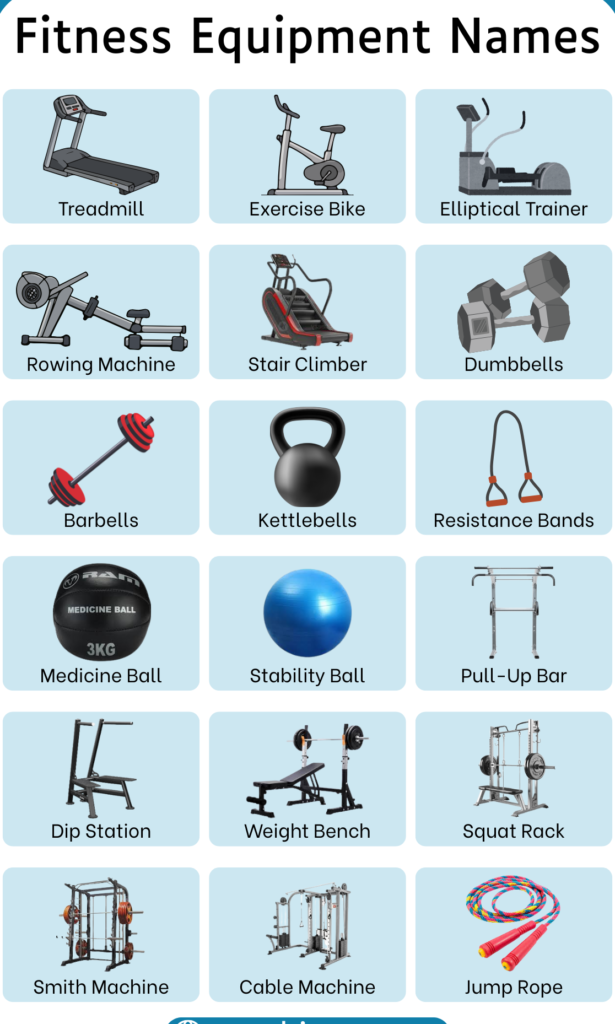
Walking into a gym and not knowing what things are called or what they do is confusing and slightly embarrassing. A quick overview removes this barrier entirely.
The barbell is the long metal bar used for the most fundamental compound lifts including the squat, deadlift, bench press, overhead press, and row. A standard Olympic barbell weighs 20 kilograms on its own before any additional weight plates are added.
Dumbbells are the paired handheld weights that come in a range of fixed sizes. They are extremely versatile and are used for everything from presses and rows to curls and lateral raises.
The squat rack or power rack is the large cage-like structure with adjustable hooks that holds the barbell at a safe height for squatting and pressing. Learning to set the safety bars correctly before using the rack is essential.
The cable machine is the large adjustable pulley system that allows for pulling and pushing movements in multiple directions. It is used for exercises like cable rows, lat pulldowns, cable curls, and tricep pushdowns.
The leg press machine supports your back while you push a weighted platform away with your feet. It is a safer alternative to the barbell squat for beginners who have not yet developed the mobility and technique for a safe barbell squat.
The pull-up bar is mounted high and used for pull-ups and hanging exercises. Most gyms also have an assisted pull-up machine that counterbalances your bodyweight to make the exercise accessible to beginners.
Resistance machines in general follow guided movement paths that make them easier to use safely with less technique requirement than free weights. They are a reasonable starting point for beginners but should be supplemented with free weight compound exercises as technique improves.
Use Our Free Tools to Support Your Gym Journey
Understanding your body’s numbers gives your gym training real direction and removes the guesswork from your nutrition and goal-setting.
Calculate Your BMR Your Basal Metabolic Rate tells you how many calories your body burns at rest. This is the foundation of your nutrition plan. Use our BMR Calculator to find your personal resting calorie burn.
Calculate Your TDEE Your Total Daily Energy Expenditure accounts for all your daily activity and is the number that determines whether you gain, lose, or maintain weight. Use our TDEE Calculator to find your personalized maintenance calorie level.
Set Your Calorie Target Use our Calorie Calculator to establish the daily intake that aligns with your specific gym goal, whether that is fat loss, muscle building, or body recomposition.
Check Your BMI Use our BMI Calculator to understand where your current weight sits relative to healthy ranges and to track progress over time as your body composition changes.
Find Your Ideal Weight Use our Ideal Weight Calculator to set a science-based, realistic weight goal for your height, age, and body type that gives your training a clear and meaningful target.
Measure Your Body Fat Percentage Use our Body Fat Calculator to track the metric that actually reflects the quality of your physical progress rather than just the number on the scale.
Optimize Your Sleep Schedule Recovery happens during sleep. Use our Sleep Calculator to find the sleep timing that maximizes your overnight recovery and ensures your training produces the results it should.
Common Beginner Gym Mistakes to Avoid
Knowing the most common pitfalls in advance saves weeks of wasted effort and potentially months of recovery from avoidable injury.
Training without a program. Showing up and deciding what to do based on available equipment or whatever looks interesting produces inconsistent, unbalanced training that fails to apply progressive overload systematically. Follow a structured program from day one.
Ego lifting. Adding weight before the current weight can be controlled through the full range of motion with good form is one of the most reliable ways to get hurt. Leave your ego outside. The weight on the bar is irrelevant. The adaptation in your muscles is what matters.
Neglecting compound lifts in favor of isolation exercises. Beginners frequently gravitate toward bicep curls, tricep pushdowns, and cable crossovers because these exercises feel familiar and safe. Compound lifts like squats, deadlifts, rows, and presses produce far greater total muscle activation, hormonal response, and training efficiency. Isolation exercises have their place but should supplement, not replace, compound movements.
Skipping legs. The leg day excuse is real and pervasive among male gym beginners in particular. The lower body contains the largest muscle groups in the body. Training legs produces significant systemic hormonal responses including testosterone and growth hormone elevation that benefit upper body development as much as direct upper body training. Skipping legs is leaving the majority of your results untrained.
Doing excessive cardio. Many beginners, particularly those with fat loss goals, spend the majority of their gym time on treadmills and bikes and very little time on the weights floor. Cardio has real value and absolutely belongs in a balanced program. But for body composition specifically, resistance training produces superior results for maintaining muscle while losing fat. Do not replace weight training with cardio. Add cardio to a resistance training foundation.
For more on how to incorporate cardio effectively into a gym-based training plan, read our article on best cardio exercises. And for a comparison of morning and evening training timing, read our guide on morning vs evening workout.
FAQ
1. What should a beginner do at the gym?
A beginner should follow a structured three-day full-body program built around fundamental compound movements including squats, deadlifts, presses, and rows. The priority in the first four to six weeks should be learning correct movement technique with manageable weights rather than lifting as heavy as possible. Three sessions per week on non-consecutive days is the optimal starting frequency.
2. How long should a beginner spend at the gym?
Forty-five to sixty minutes per session is sufficient for a complete and effective beginner gym session. This includes a five to ten minute warm-up, thirty to forty minutes of structured exercise, and five to ten minutes of cool-down and stretching. Sessions longer than ninety minutes are generally unnecessary and counterproductive for beginners who do not yet have the training capacity to sustain high quality work for extended periods.
3. How soon will a beginner see results from the gym?
Most beginners notice improved energy, better posture, and increased strength within the first two to three weeks of consistent training. These early changes are driven primarily by neurological adaptation. Visible changes in body composition typically become apparent after six to eight weeks of consistent training combined with appropriate nutrition. Significant physical transformation takes three to six months of dedicated effort.
4. What should a beginner eat when going to the gym?
Protein is the most critical nutritional priority. Aim for at least 1.6 grams per kilogram of body weight daily from whole food sources. Total calorie intake should be aligned with your goal: a modest deficit for fat loss, maintenance or a modest surplus for muscle building. Eating a balanced meal containing protein and carbohydrates within two hours before or after training supports both performance and recovery.
5. Is it normal to feel very sore after the first gym session?
Yes, completely normal. Delayed onset muscle soreness peaks 24 to 48 hours after a session and then subsides over the following days. It reduces significantly after the first two to three weeks as the body adapts to the new training stimulus. Gentle movement, adequate hydration, and good sleep help manage and accelerate recovery from soreness. Extreme soreness that does not improve after four to five days or that is localized sharply to a joint rather than a muscle belly warrants medical attention.
6. Should beginners use machines or free weights at the gym?
Both have value and both belong in a beginner program. Machines are safer for learning basic movement patterns because they control the path of motion and reduce the stability demand. Free weights including dumbbells and barbells produce greater muscle activation, challenge stabilizing muscles, and are more transferable to real-world strength. The ideal approach for most beginners is to use machines initially to learn the movement pattern and then transition to free weights as technique and confidence develop.
7. How do I know if I am progressing at the gym?
The most reliable indicator of progress for beginners is increasing strength, meaning lifting more weight or completing more reps with the same weight on the same exercises over time. This should be tracked in a training log every session. Secondary indicators include improving body measurements, photographs taken under consistent conditions every two to four weeks, and improvements in how daily physical tasks feel. The scale alone is a poor short-term progress indicator because muscle gain can offset fat loss in ways that mask meaningful physical improvement.
Conclusion
The gym is one of the most powerful investments you can make in your physical and mental health. The research on resistance training’s benefits is unambiguous. It builds muscle, reduces body fat, improves cardiovascular health, supports bone density, enhances cognitive function, reduces anxiety and depression, and extends healthy life expectancy.
None of that requires you to be experienced, strong, or confident when you walk in the door. It only requires you to walk in the door.
This beginner gym guide has given you the ten most important principles for starting strong, a complete beginner workout program, an overview of the essential equipment you will encounter, and the tools to set meaningful, data-based goals. The rest is simply showing up consistently and applying what you know.
Use the free tools at Vitality Nexus to calculate your calorie targets, track your body composition, and optimize your sleep and recovery. Explore our full health and fitness resources for more comprehensive guidance on building the fitness lifestyle that you actually sustain over years rather than weeks.
Your first session does not need to be perfect. It just needs to happen.