You can spend eight hours in bed and wake up feeling more exhausted than when you went to sleep.
You can close your eyes at night without consciously noticing anything wrong and still have sleep that is failing you in profound ways.
Most people think of poor sleep as simply insomnia or lying awake at night. But poor sleep is far broader and far more common than that single definition captures. You can have what appears on the surface to be adequate sleep while experiencing the full consequences of sleep deprivation because the quality of what you are getting is compromised.
The human body is remarkably good at sending signals when something is wrong. The challenge is recognizing those signals as what they actually are rather than attributing them to stress, age, personality, or simply the way life is.
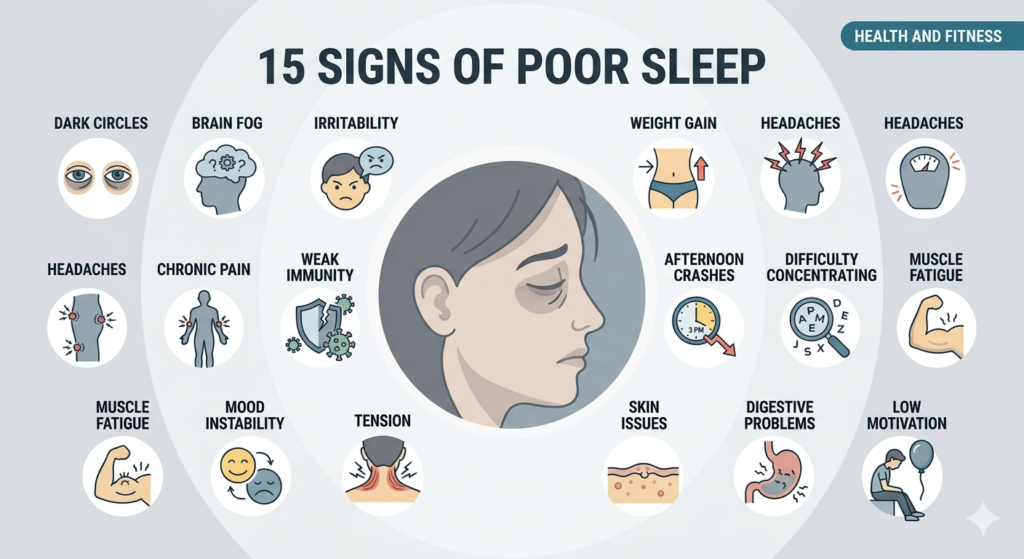
This guide covers 15 signs of poor sleep that you might not immediately recognize as sleep-related, explains what each one means about your sleep quality, and helps you understand which of these signs point toward problems you can fix yourself and which warrant professional evaluation.
Table of Contents
The Hidden Cost of Poor Sleep
Poor sleep is one of the most underestimated health problems in modern life. It is so normalized that millions of people live with the chronic consequences of inadequate or low quality sleep while attributing the symptoms to virtually everything except the actual cause.
A person struggling with focus and productivity might blame themselves for lacking discipline. Someone gaining weight despite unchanged eating and exercise might assume their metabolism has slowed. A woman experiencing mood instability might attribute it to hormones without considering that her sleep is the actual root cause. Someone with persistent headaches might take daily pain medication without addressing the sleep deficit driving them.
The physiological consequences of poor sleep are direct and measurable. A single night of poor sleep impairs cognitive performance comparably to a blood alcohol concentration of 0.05 percent. One week of sleeping five hours per night produces measurable decrements in glucose tolerance comparable to diabetes prediates. Chronic poor sleep is associated with increased risk of cardiovascular disease, obesity, type 2 diabetes, depression, anxiety, and cognitive decline.
Yet unlike an acute illness with obvious symptoms, chronic poor sleep does its damage quietly. The symptoms accumulate gradually enough that they can seem like normal aging or normal life stress rather than a reversible health problem.
According to research from the Centers for Disease Control and Prevention, approximately 35 percent of adults in the United States report getting less than seven hours of sleep per night on a regular basis. Among those sleeping seven or more hours, a substantial proportion report that the quality of their sleep is poor despite the adequate time in bed. This means that poor sleep in either quantity or quality affects a very large proportion of the population.
Recognizing the signs of poor sleep is the first step toward addressing it rather than adapting to it as simply how things are.
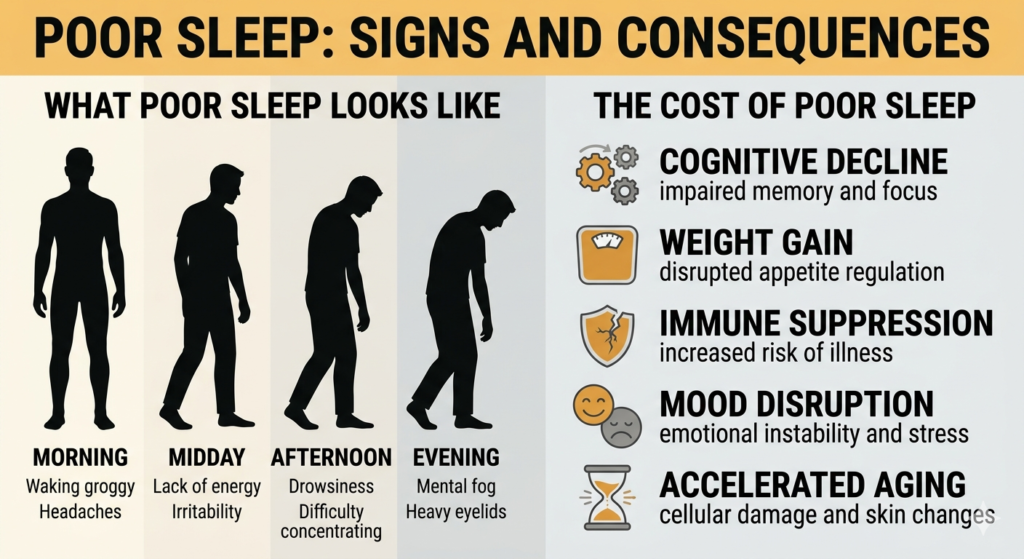
1. Dark Circles and Puffy Eyes That Do Not Go Away
The skin around the eyes is the thinnest and most delicate on the entire body, making it one of the first places that the effects of poor sleep become visibly apparent.
Dark circles under the eyes during sleep deprivation result from a combination of mechanisms. Blood vessels dilate during fatigue, which makes the blood vessels under the eyes more visible through the thin skin. The skin itself becomes pale and loses elasticity from the reduced growth hormone and collagen production that inadequate sleep compromises. And the lymphatic drainage under the eyes can become congested when the body is not getting the rest it needs to clear fluid appropriately.
Puffy or swollen eyes result from fluid accumulation in the tissues around the eyes that occurs when sleep quality is poor. The body maintains fluid balance partly through the hormonal regulation that sleep supports. When sleep is insufficient or fragmented, fluid balance is disrupted and morning puffiness becomes prominent.
Most importantly, these changes do not resolve with a single good night of sleep. They persist as long as poor sleep persists and gradually improve as sleep quality consistently improves. When dark circles or persistent puffiness appear despite adequate hours in bed, or when they do not resolve with one or two good nights of sleep, it signals that your sleep quality despite the hours is insufficient.
Unlike under-eye circles that come and go based on occasional late nights, chronic dark circles and puffiness that remain present even when you believe you have slept enough are a sign of poor sleep quality specifically and warrant investigation into what is compromising your sleep.
2. Brain Fog and Difficulty Concentrating
Brain fog, the subjective experience of mental haziness, slow thinking, and reduced mental sharpness, is one of the most consistently reported signs of poor sleep and one of the most directly explained by the neurophysiology of sleep deprivation.
The prefrontal cortex, which governs executive function, decision-making, complex problem-solving, and sustained attention, is one of the most sleep-dependent regions of the brain. When sleep is inadequate or fragmented, prefrontal cortex activity is measurably reduced. This is not a perception. It is a documented neurological change that produces genuine cognitive impairment.
Working memory, which is the capacity to hold and manipulate information in mind for problem-solving and decision-making, is one of the first cognitive functions to deteriorate with poor sleep. Tasks that require focus become noticeably harder. Reading requires re-reading paragraphs because they did not register. Conversations feel harder to follow. Decision-making feels effortful. And the overall sense of mental clarity that characterizes good cognitive function is absent.
Brain fog from poor sleep is different from occasional mental fatigue. It is persistent through the day despite adequate opportunity for rest. It does not improve simply from having quiet or focusing harder. And it is often accompanied by the other signs of poor sleep described in this list rather than being an isolated phenomenon.
For women specifically, brain fog is sometimes attributed to menopause or hormonal changes without considering that poor sleep may be the primary driver. Read our article on hormone balance for women for broader understanding of how hormones and sleep interact to affect cognitive function.
3. Irritability and Mood Swings
There are few things more telling about poor sleep than a change in mood and emotional regulation. The emotional lability that accompanies sleep deprivation is so consistent and so pronounced that it is one of the most reliable early warning signs of accumulating sleep debt.
The amygdala, which is the brain’s emotional processing center, becomes hyperactive with sleep deprivation. The prefrontal cortex, which normally provides regulatory inhibition of the amygdala’s emotional responses, is less active when sleep is poor. The result is heightened emotional reactivity to stimuli that would normally produce minimal emotional response.
A comment that would be easily brushed off after good sleep becomes the source of hurt or anger after poor sleep. A frustration that would be manageable becomes rage. A normal disappointment becomes despair. The emotional response feels disproportionate to the trigger, which it is, but the disproportionality comes from the emotional regulation being compromised by poor sleep rather than from emotional weakness.
Many people living with chronic mood instability including depression, anxiety, and bipolar disorder report that their symptoms are noticeably worse when sleep is poor and noticeably better when sleep improves, even without any change in medication or other interventions. This is not coincidental. It reflects the direct neurochemical dependence of mood stability on adequate sleep.
Partners and family members of people with poor sleep often notice this before the person with poor sleep does. Increased irritability, shorter temper, and emotional volatility without obvious cause often points to sleep as the root cause rather than to actual relationship problems or personality changes.
4. Consistent Daytime Sleepiness or Afternoon Energy Crashes
Daytime sleepiness or the tendency to fall asleep despite not intending to, if it occurs regularly rather than occasionally, is one of the most direct signs of poor sleep or insufficient sleep.
This is different from normal tiredness or lack of motivation. It is the experience of your body actively fighting to stay awake, heaviness in the eyes and head, the need to consciously suppress yawning and the urge to lie down. It often appears most prominently in the early afternoon, between 1 and 3pm, and can be strong enough to lead to microsleeps where a person briefly falls asleep without realizing it is happening.
The afternoon energy crash is so common that many people consider it normal. Coffee becomes a necessity multiple times per day just to maintain waking alertness. Without the caffeine, afternoon productivity becomes nearly impossible. And evening alertness is delayed until hours after the normal bedtime would be appropriate.
This pattern indicates that the previous night’s sleep, or more commonly the cumulative effect of multiple nights of poor or insufficient sleep, has left the brain with a significant sleep debt. The afternoon crash is the brain’s attempt to collect that debt even during waking hours when it should not be.
For anyone experiencing significant daytime sleepiness, before attributing it to low motivation or personality, evaluating sleep quality and quantity is essential. Daytime sleepiness that is unexplained by obvious causes including shift work or late nights is sometimes the first sign of sleep disorders including sleep apnea, narcolepsy, or other conditions that warrant professional evaluation.
5. Waking Up Multiple Times During the Night
Sleep fragmentation, where sleep is repeatedly interrupted by wakings throughout the night, is one of the most common and most damaging forms of poor sleep despite being less obvious than insomnia where a person cannot fall asleep at all.
The most common causes of fragmented sleep include needing to urinate multiple times during the night, restless legs that prevent sustained sleep, sleep apnea where breathing interruptions cause brief arousals, and general environmental factors including noise, temperature, or an uncomfortable bed.
What makes fragmented sleep particularly problematic is that it can accumulate to what appears on the surface to be adequate total hours while delivering significantly compromised sleep quality. A person might be in bed for eight hours but wake four times and have multiple interruptions throughout the night, effectively accumulating only six to seven hours of consolidated sleep because of the fragmentation.
The impact on next-day function is disproportionate to the total hour loss because fragmented sleep is particularly damaging to deep sleep stages. Each awakening partially resets the sleep cycle, requiring the brain to reorganize and return to deep sleep. If awakenings occur frequently, the deep sleep stages that require extended uninterrupted time to complete do not get sufficient opportunity to accumulate.
Waking frequently throughout the night is not something that someone becomes accustomed to or simply has to live with. It is a sign of a sleep problem with an identifiable cause, most of which are addressable once they are identified.
6. Difficulty Falling Asleep Despite Feeling Tired
The experience of going to bed while genuinely feeling tired but being unable to fall asleep for significant periods despite that tiredness is paradoxical and frustrating, and it is one of the most distinctive signs of poor sleep quality.
This pattern frequently indicates that the nervous system is in a state of elevated arousal even though the conscious mind desires sleep. The sympathetic nervous system, which drives the stress response, is activated at a level that prevents the parasympathetic nervous system, which governs sleep, from taking control.
The causes are numerous. Mental overactivity where the mind races with thoughts despite physical tiredness. Anxiety or worry that prevents the mental settling that sleep requires. Consuming caffeine too late in the day. Training or stressful activity too close to bedtime. A racing heartbeat or physical tension that prevents the relaxation necessary for sleep onset. And sometimes a pattern of conditioned wakefulness where the bedroom has become associated with struggling to sleep rather than with sleep itself.
What is important to recognize is that difficulty falling asleep despite fatigue is not simply insomnia in the sense of being unable to sleep ever. It is a sign that something is interfering with the sleep onset process, and identifying what that interference is allows it to be addressed.
For women specifically, difficulty falling asleep often increases during the luteal phase of the menstrual cycle when progesterone, which normally supports sleep, is declining. Read our article on hormone balance for women for comprehensive guidance on the hormonal dimensions of sleep.
7. Unrefreshed Waking Despite Adequate Hours
This is perhaps the most important sign of poor sleep to recognize because it directly contradicts the common assumption that if you are in bed for eight hours, your sleep is adequate.
You can spend adequate or even excessive time in bed and wake up feeling completely unrefreshed, physically heavy, and as exhausted as when you went to sleep. This indicates that while you were sleeping, the deep sleep stages that provide genuine physical and mental restoration were either insufficient or fragmented throughout the night.
Unrefreshed waking despite adequate hours suggests poor sleep quality specifically. The causes include frequent awakenings that fragment sleep and prevent deep sleep accumulation, sleep apnea where oxygen disruptions prevent restorative sleep, poor sleep hygiene factors that keep sleep light and fragmented, or underlying sleep disorders that prevent normal sleep architecture from developing.
The most telling sign that this represents a genuine problem rather than simply being a tired person is that the unrefreshed feeling persists even after multiple nights in a row of adequate hours. A genuinely well-rested person wakes with a sense of physical restoration and readiness. A person with poor quality sleep wakes with a sense that the night did not actually provide rest.
When this pattern is present, investigating the causes of poor sleep quality is more important than simply trying to get more hours. Sometimes improving sleep quality by identifying and addressing specific problems produces better results than increasing total sleep time.
8. Increased Appetite and Sugar Cravings
Poor sleep produces a dramatic effect on the hormones that regulate appetite, creating both an increase in hunger and a specific shift toward craving high-calorie, high-sugar foods.
Two primary appetite-regulating hormones, leptin and ghrelin, are directly affected by poor sleep. Leptin, which signals fullness and satiety, decreases when sleep is inadequate. Ghrelin, which signals hunger, increases. The combined effect is that a sleep-deprived person feels hungrier than a well-rested person despite identical eating.
Beyond the volume of hunger, sleep deprivation creates a specific shift in food preferences toward high-calorie, high-sugar foods. The brain, particularly the prefrontal cortex, relies very heavily on glucose for energy. When sleep-deprived, the brain increases its drive to seek glucose, promoting cravings for sweets, refined carbohydrates, and highly palatable foods.
This is not a willpower problem or a character flaw. It is a direct neurochemical consequence of poor sleep that makes resistance genuinely harder. The same person eating identical meals might be able to easily decline dessert after good sleep but experience intense cravings after poor sleep.
For anyone struggling with weight management or nutritional adherence, poor sleep is frequently an overlooked factor that can undermine all the discipline and effort applied to eating well. Improving sleep can make maintaining good nutrition markedly easier without any increase in willpower required.
9. Weight Gain Without Changes in Diet or Exercise
When weight gain occurs despite no meaningful change in eating or exercise habits, poor sleep is one of the most underrecognized contributing factors.
The mechanisms are multiple and compound. Reduced sleep decreases the metabolic rate through reduced growth hormone and increased cortisol, meaning the same food consumption produces greater fat storage than it would after good sleep. The increased hunger and sugar cravings described in the previous section lead to greater total intake. Reduced motivation and energy from poor sleep make people less likely to exercise.
Additionally, poor sleep specifically promotes the accumulation of visceral abdominal fat rather than subcutaneous fat elsewhere. This is particularly relevant because visceral fat is metabolically more harmful than subcutaneous fat and is associated with metabolic syndrome, insulin resistance, and increased cardiovascular risk.
Research has found that sleep restriction produces weight gain independent of caloric changes, through the metabolic and hormonal effects of reduced sleep. In one study, healthy subjects restricted to five hours of sleep per night gained weight over two weeks despite eating the same measured calories as they had during a period of nine hours of sleep per night. The weight gain was driven entirely by the effect of poor sleep on metabolism and hormonal regulation.
When someone begins gaining weight without explanation despite stable diet and activity, evaluating sleep quality alongside other factors is an important diagnostic step.
10. Getting Sick More Frequently Than Usual
The immune system is one of the most directly affected by sleep quality. When sleep is poor, the immune system’s ability to fight infection and maintain immune balance is compromised, leading to increased susceptibility to viruses, bacteria, and other pathogens.
Research has quantified this effect precisely. People sleeping less than six hours per night are more than four times more likely to catch a cold when exposed to a cold virus compared to those sleeping seven or more hours. This is a massive effect size, showing just how significant the immune impact of poor sleep is.
Additionally, recovery from illness is slower and more complicated in people with poor sleep. What might be a three-day cold in a well-rested person becomes a two-week affair with more severe symptoms when sleep is poor. And vaccine responses are significantly reduced by poor sleep, meaning poor sleepers develop less robust immune protection after vaccination than well-rested people receiving the same vaccine.
Notice also that this is cumulative. A person who is slightly sleep-deprived might not notice being sick more often. But over weeks and months of consistent poor sleep, the increased illness frequency becomes noticeable. The pattern of frequent minor infections, prolonged colds, or slow recovery should prompt evaluation of sleep quality alongside other factors.
11. Persistent Headaches or Migraines
While headaches have many causes, poor sleep is one of the most consistent and most frequently unrecognized contributing factors.
The mechanism involves the vascular and chemical changes that accompany sleep deprivation. Poor sleep increases levels of inflammatory cytokines that promote migraine and headache. It reduces the effectiveness of pain-regulating systems in the brain that normally inhibit pain signal transmission. And it produces muscle tension particularly in the neck and shoulders that can drive tension headaches.
Additionally, the disruption of circadian rhythm that accompanies chronically poor sleep can trigger migraines specifically. For people with migraine disorder, poor sleep is often the most consistent and powerful migraine trigger, more powerful than dietary factors or other commonly recognized triggers.
The pattern to recognize is headaches that appear or worsen when sleep quality is poor and improve when sleep improves. This pattern strongly suggests poor sleep as a contributing cause.
For comprehensive guidance on headache and pain management alongside sleep optimization, read our article on natural ways to reduce anxiety which discusses the broader stress and sleep patterns that underlie pain conditions.
12. Muscle Pain, Tension, and Reduced Recovery from Exercise
Muscle recovery, muscle pain resolution, and the adaptation to training all depend critically on adequate sleep, particularly the deep sleep stages where growth hormone is most active.
When sleep is poor, the repair of training-induced micro-damage in muscle tissue is incomplete. Muscle soreness persists longer. Recovery between training sessions takes longer. And the strength and fitness gains that training is designed to produce are substantially reduced compared to training with adequate sleep.
Additionally, muscle tension, particularly in the neck, shoulders, and jaw, tends to increase with poor sleep. The muscles remain more tense during the day when sleep has been poor. The overnight relaxation and restoration of proper muscle tone that good sleep provides does not occur.
This is one of the most easily observable signs of poor sleep. The same training that produces manageable muscle soreness and quick recovery after good sleep produces excessive soreness and slow recovery after poor sleep.
For athletes and anyone engaged in regular training, protecting sleep is as important as the training itself. Read our article on men over 40 fitness for guidance on how sleep integrates with training recovery across the lifespan.
13. Decreased Motivation and Reduced Pleasure in Activities
When sleep is poor, the dopamine and serotonin systems that regulate motivation, reward, and pleasure in activity are compromised. People find themselves lacking motivation to do things they normally enjoy and finding less pleasure in activities that normally bring satisfaction.
This can manifest as difficulty getting started on work or projects despite not being particularly tired. Finding less enjoyment in hobbies or social activities. Reduced motivation for exercise despite understanding its importance. And a general flatness of mood where enthusiasm and emotional engagement are reduced.
This is distinguishable from depression by the temporal pattern. With poor sleep-related motivation loss, the reduced motivation and pleasure improve substantially when sleep improves. The pattern is temporally linked to sleep rather than being a persistent mood state independent of sleep quality.
When someone you know experiences a marked decrease in motivation or pleasure in activities without obvious cause, poor sleep is worth investigating as a potential contributor. Often the problem is simply that the person’s sleep quality has deteriorated without them consciously recognizing it.
14. Increased Sensitivity to Stress and Reduced Coping Ability
One of the most consistent observations about poor sleep is that it dramatically reduces the ability to tolerate and cope with stress. Normal stressors become more overwhelming. Emotional regulation becomes more difficult. The capacity to handle challenges gracefully is reduced.
This reflects the effect of poor sleep on the prefrontal cortex, which provides the executive function and emotional regulation needed to cope with stress effectively. When sleep-deprived, this regulatory capacity is compromised and the amygdala, which drives the stress response, operates with less oversight.
People often notice this as a reduced stress tolerance. Things that are normally manageable feel overwhelming. Decisions that normally feel straightforward feel more difficult. People are shorter with others. Frustration tolerance decreases. And the general sense of coping capacity is visibly reduced.
This is one of the most troubling aspects of chronic poor sleep because it creates a negative feedback loop. Poor sleep reduces stress coping capacity, which increases the stress that further impairs sleep, which further reduces coping capacity.
Identifying poor sleep as a contributing factor and improving it often produces more dramatic improvements in stress coping and emotional stability than other interventions because it addresses the neurophysiological foundation of stress resilience.
15. Skin Problems and Accelerated Visible Aging
The skin is extraordinarily sensitive to sleep quality and quantity, showing visible signs of poor sleep that are among the most immediately apparent physical manifestations.
During deep sleep, the skin undergoes its most active repair and regeneration. Blood flow to the skin increases. Collagen synthesis, which maintains skin elasticity and strength, is most active. Growth hormone supports skin cell turnover and repair. And the stress hormone cortisol, which damages collagen when chronically elevated, is at its lowest.
When sleep is poor, this repair is disrupted. Skin becomes dull and loses radiance. Acne tends to worsen from the inflammatory cascade activated by poor sleep. Skin texture becomes less smooth. And the fine lines that represent collagen loss become more prominent.
Additionally, the skin barrier, which protects against water loss and maintains hydration, is less effective when sleep is poor. Skin appears drier and more irritated.
Over long-term poor sleep, the cumulative skin changes can be dramatic, with visible aging progression that looks like years of additional aging concentrated in the period of poor sleep.
Unlike many signs of poor sleep that are subjective or less visible, skin changes from chronic poor sleep are visible to others and often provide external motivation to address the sleep problem. The improvement in skin quality that follows improving sleep can be quite striking.
Use Our Free Tools to Support Your Sleep Recovery
Recognizing signs of poor sleep is the first step toward addressing it. Understanding your personal sleep and health baseline helps you make targeted, effective changes. These free tools on Vitality Nexus give you the data you need.
Optimize Your Sleep Schedule The most important factor for improving sleep quality is aligning your sleep and wake times with your natural circadian rhythm. Use our Sleep Calculator to find the precise timing that gives your sleep architecture the best chance of delivering restorative deep sleep.
Calculate Your Daily Calorie Needs Poor sleep increases appetite and disrupts metabolism. Understanding your actual calorie needs prevents the accidental overeating that poor sleep creates hunger signals for. Use our Calorie Calculator for your personalized target.
Find Your TDEE Use our TDEE Calculator to calculate exactly how many calories your body burns each day, which helps you distinguish between weight gain from caloric excess and weight gain from poor sleep’s metabolic effects.
Calculate Your BMR Use our BMR Calculator to understand your resting metabolic rate and identify whether poor sleep may be suppressing it.
Check Your BMI Use our BMI Calculator to monitor overall health metrics as your sleep improves.
Find Your Ideal Weight Use our Ideal Weight Calculator to set a realistic weight goal, with the understanding that improving sleep is one of the most powerful supports for sustainable weight management.
Track Your Body Composition Use our Body Fat Calculator to track how your body composition changes as your sleep quality improves, giving you visible feedback on the positive effects of better sleep beyond what the scale shows.
What Is Causing Your Poor Sleep and What to Do About It
Once you recognize that your sleep quality is poor, the next step is identifying what is causing it and addressing that cause rather than simply accepting poor sleep as inevitable.
Environmental factors are among the most easily modified. A bedroom that is too warm or too cool interferes with sleep quality. A temperature between 16 and 19 degrees Celsius is optimal for sleep for most people. Too much light, whether from a window, clock, or device, suppresses melatonin and prevents proper sleep. Complete darkness or a sleep mask is ideal. Noise disruption from traffic, partners, or other sources fragments sleep.
Screen exposure in the evening suppresses melatonin production through blue light exposure. The optimal approach is ending all screen use at least one hour before bed and using that time for lower-stimulation activities.
Caffeine timing significantly affects sleep quality. Caffeine has a half-life of four to six hours, meaning that caffeine consumed in the afternoon remains at significant levels by bedtime. Moving all caffeine consumption to the morning hours improves sleep quality for most people.
Alcohol despite making falling asleep easier, suppresses deep sleep significantly. Eliminating or dramatically reducing evening alcohol consumption is one of the most impactful changes for improving sleep quality.
Stress and mental activity at bedtime prevent the neural settling necessary for sleep. A wind-down routine for the hour before bed that includes calming activities, reduced mental demand, and stress-relieving practices like breathing or gentle stretching supports sleep onset.
Sleep disorders including sleep apnea, restless legs syndrome, and others require professional evaluation and specific treatment. If poor sleep persists despite addressing the factors above, professional evaluation is important and often reveals a treatable underlying condition.
For comprehensive guidance on addressing the specific causes of poor sleep, read our article on insomnia, symptoms, causes, and treatment.
And for understanding how deep sleep specifically improves your health when you get it right, read our article on deep sleep benefits.
FAQ
1. What are the most common signs of poor sleep?
The most consistently reported signs include persistent fatigue despite adequate hours in bed, daytime sleepiness or afternoon energy crashes, difficulty concentrating and brain fog, mood instability and irritability, waking multiple times during the night, feeling unrefreshed despite adequate hours, dark circles and puffy eyes, difficulty falling asleep despite tiredness, increased appetite and sugar cravings, weight gain without dietary changes, and getting sick more frequently. Multiple signs appearing together strongly suggest poor sleep quality.
2. Can you have poor sleep quality despite sleeping eight hours?
Yes, absolutely. Time in bed does not equal quality sleep. A person can spend eight hours in bed but wake multiple times, have fragmented sleep interrupted by arousals, and achieve far less deep sleep than adequate. The result is poor sleep quality despite adequate total hours. This is why feeling unrefreshed despite adequate hours in bed is such an important sign of poor sleep quality specifically.
3. How long does it take for signs of poor sleep to improve?
Some signs improve quite quickly. Mood and irritability often improve noticeably within one to three nights of better sleep. Daytime sleepiness improves relatively quickly as well. Other signs take longer. Dark circles and skin quality gradually improve over weeks to months of consistent better sleep. Weight loss from improved sleep-supported metabolism takes weeks to months. Immune improvements show up over weeks as illness frequency decreases. The timeline varies, but improvement in most signs is noticeable within one to two weeks of consistent sleep improvement.
4. Is brain fog always caused by poor sleep?
No, brain fog has many causes including nutritional deficiencies, hormonal imbalances, thyroid dysfunction, medication side effects, and medical conditions. However, poor sleep is one of the most common causes and is always worth investigating when brain fog appears. If brain fog resolves or improves significantly when sleep improves, poor sleep was the primary cause. If it persists despite improved sleep, other causes should be investigated.
5. Can poor sleep cause weight gain even without eating more?
Yes, through multiple mechanisms. Poor sleep reduces metabolic rate through effects on growth hormone and cortisol. It increases hunger hormones while decreasing satiety signals, creating greater appetite. It shifts food preferences toward high-calorie foods. And it reduces motivation for physical activity. The combination of reduced calorie burn and increased calorie intake from appetite changes produces weight gain even without conscious changes in eating. This is why improving sleep is one of the most effective weight management interventions for many people.
6. When should I see a doctor about poor sleep?
See a doctor if poor sleep persists for more than a few weeks despite making lifestyle changes, if you experience severe daytime sleepiness that endangers safety, if you snore heavily or are told you stop breathing during sleep, if you experience pain during sleep or frequent night wakings, or if poor sleep is significantly impacting your mood or ability to function. These signs can indicate sleep disorders including sleep apnea that require professional evaluation and treatment.
7. What is the fastest way to improve signs of poor sleep?
Improving sleep quality through environmental optimization and consistent sleep timing produces relatively rapid improvements in most symptoms. Addressing environmental factors including temperature, darkness, and noise can improve sleep quality within nights. Establishing a consistent sleep and wake time anchors the circadian rhythm and produces improvements within days to a week. Eliminating or dramatically reducing evening alcohol produces noticeable sleep quality improvements within one to two nights. These changes together often produce visible improvements in daytime function within one to two weeks.
Conclusion
The signs of poor sleep are so common in modern life that they have become normalized. Thousands of people live with persistent fatigue, brain fog, mood instability, weight gain, and frequent illness while never connecting these problems to the quality of their sleep.
Recognizing these signs is not about self-diagnosis or self-judgment. It is about understanding that what might feel like personal failure or simply the way life is may actually be the direct result of inadequate or poor-quality sleep that is entirely addressable.
Every one of the fifteen signs covered in this guide can improve with better sleep. The fatigue can resolve. The brain fog can clear. Mood can stabilize. Weight can normalize. Immunity can improve. Pain can reduce. And aging can slow.
The first step is recognizing that poor sleep is the actual problem rather than attributing symptoms to stress, age, personality, or willpower. The next step is investigating and addressing the specific factors that are compromising your sleep. And the third step is committing to consistent improved sleep and watching as the accumulated damage of poor sleep gradually resolves.
Use our Sleep Calculator to find the sleep timing that aligns with your natural rhythm. Explore our health and fitness resources for comprehensive guidance on improving sleep alongside other health habits. And read our article on insomnia, symptoms, causes, and treatment for detailed guidance on addressing the specific causes of sleep problems.
Your body is sending you signals that something needs to change. It is worth listening.