
Here is a conversation that happens in gyms, offices, and doctors’ waiting rooms every single day.
A man hits 40 and notices things are different. The weight that used to come off easily now hangs around stubbornly. Recovery from a hard session takes two days instead of one. Energy levels are not where they were. Muscle that was relatively easy to maintain now requires more deliberate effort to keep. And somewhere in the background, a quiet voice starts suggesting that maybe this is just what getting older looks like.
That voice is wrong.
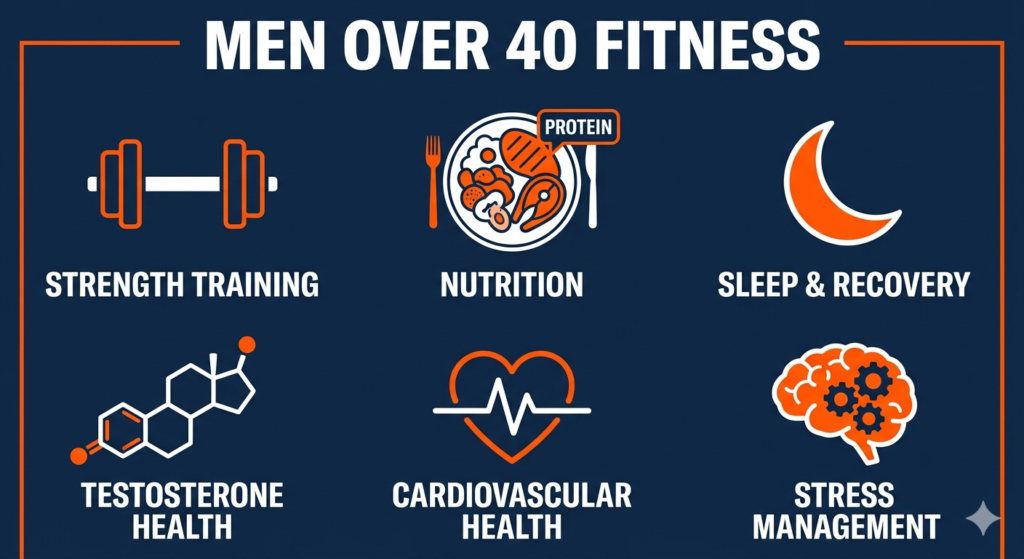
Men over 40 fitness is not about fighting a losing battle against biology. It is about understanding how the rules of the game have shifted and adjusting your approach accordingly. The men who look and feel their best in their forties, fifties, and beyond are not lucky genetic exceptions. They are men who stopped applying the same training and nutrition strategies they used at 25 and started using ones that are actually suited to where their physiology is right now.
This guide gives you those strategies. All 12 of them, backed by research, explained honestly, and practical enough to implement starting this week.
Table of Contents
Why Fitness After 40 Requires a Different Approach
The strategies that worked brilliantly at 25 do not produce the same results at 42. This is not failure. It is physiology.
Several things are genuinely different about the male body after 40 that require a shift in approach rather than simply more effort applied to the same methods.
Testosterone production has been declining at approximately one to two percent per year since around age 30. By 40, many men have meaningfully lower testosterone than they did in their prime, which affects muscle protein synthesis, fat distribution, energy levels, libido, mood, and recovery capacity.
Recovery takes longer. The inflammatory response to training is more pronounced and takes more time to resolve. Connective tissue, including tendons and ligaments, becomes slightly less elastic and requires more careful management to avoid the overuse injuries that derail progress for weeks or months.
Anabolic resistance means the muscle protein synthesis response to a given protein intake and training stimulus is somewhat blunted compared to younger years. This does not mean it is absent. It means the inputs required to produce the same output are somewhat higher.
Cortisol, the primary stress hormone, tends to run higher in men managing the compounding life pressures of career, family, and financial responsibilities that accumulate in this decade. Chronic cortisol elevation directly suppresses testosterone, promotes abdominal fat storage, and impairs recovery.
None of these changes make fitness after 40 impossible. They make doing exactly what you did at 25 less effective. The solution is not to try harder with the same approach. It is to update the approach.
According to research published by the American College of Sports Medicine, adults over 40 who engage in regular resistance training and aerobic exercise maintain significantly better physical function, metabolic health, hormonal profiles, and cognitive function compared to sedentary peers, with benefits accumulating throughout the decade rather than diminishing. The potential is there. The approach just needs to be right.
1. Make Strength Training the Foundation of Everything
If there is one single non-negotiable in men over 40 fitness, it is this. Resistance training must be the foundation. Not an occasional addition. Not something you do when you feel like it. The absolute foundation around which everything else is organized.
The reasons are multiple and compounding. Resistance training is the primary stimulus for muscle protein synthesis, which is the mechanism that combats the age-related muscle loss that begins after 30 and accelerates progressively. It raises testosterone both acutely during sessions and chronically over time as an adaptation. It improves insulin sensitivity, which deteriorates with age and sedentary behavior and drives the abdominal fat accumulation that men over 40 commonly struggle with. It maintains bone density. It preserves joint integrity by strengthening the muscles that support and protect joints. And it maintains the neuromuscular connections that keep physical capability at its peak.
The specific training approach for men over 40 should emphasize compound movements that engage multiple muscle groups simultaneously. Squats, deadlifts, bench press, rows, overhead press, and pull-ups produce the greatest total muscle activation, the largest hormonal response, and the most functional strength development of any exercises available.
Three to four sessions per week is the optimal frequency for most men over 40. This provides adequate stimulus for continued strength and muscle adaptation while allowing the slightly longer recovery time that the post-40 physiology genuinely requires compared to training every day.
For men who are currently gym members or considering joining, read our article on beginner gym guide for a complete framework for building an effective resistance training foundation. For those who prefer training at home, our article on at home workouts for men without weights covers bodyweight progressions that produce genuine muscle preservation stimulus.
2. Train Smarter Not Just Harder
This is the piece of advice that the culture of fitness most consistently gets wrong, and men over 40 pay for it the most.
Harder is not always better. Training to complete failure on every set, training six or seven days per week, constantly pushing past pain signals, treating every session as a maximum effort competition with your 25-year-old self, these approaches work reasonably well when recovery capacity is high, connective tissue is resilient, and hormonal support for adaptation is abundant. After 40, that combination is less reliably present.
Training smarter means leaving one to two reps in reserve at the end of most sets rather than training to absolute failure every time. Research on proximity to failure and hypertrophy shows that sets taken close to failure, leaving one or two reps available, produce stimulus almost equivalent to failure sets while producing substantially less systemic fatigue and connective tissue stress. Over a training week and month, this difference in accumulated fatigue is significant.
It means paying attention to pain signals that were easier to push through at 25. A sharp, localized pain in a tendon or joint is not the same signal as the general muscle discomfort of hard training. Pushing through the former leads to injuries that cost weeks or months of training. Respecting the distinction protects progress.
It means periodizing your training with planned deload weeks every four to six weeks, during which volume and intensity are reduced by 30 to 50 percent to allow accumulated fatigue to dissipate and adaptation to consolidate. These deload weeks are not lost weeks. They are when the adaptations from the preceding training block are actually realized and locked in.
3. Prioritize Recovery as Seriously as Training
Most men over 40 who are not making the progress they want are under-recovering rather than under-training. The session is not the problem. What happens, or does not happen, between sessions is.
Recovery is not passive. It is an active biological process that requires specific inputs to occur effectively. Sleep provides the growth hormone secretion, muscle protein synthesis, and tissue repair that converts training stimulus into actual physical improvement. Nutrition provides the raw material for that repair. Active recovery work including walking, mobility work, and light movement maintains blood flow to healing tissue and supports the nervous system recovery that determines how soon you can train hard again.
The men over 40 fitness landscape is filled with advice to train harder and push more. The more valuable and more commonly lacking advice is to recover better. Seven to nine hours of quality sleep. Protein at every meal. Stress managed rather than ignored. Rest days respected as training days with a different emphasis rather than as failures of discipline.
For men who are training consistently but not recovering consistently, the training is only half as productive as it could be. The adaptation is initiated but not completed. Read our article on muscle loss after 30 for a deeper understanding of how recovery interacts with the muscle preservation challenge that begins in this decade.
4. Dramatically Increase Your Protein Intake
This is possibly the most common and most costly nutritional mistake men over 40 make. They eat what they consider to be a reasonable amount of protein and wonder why their muscle mass is not responding to their training the way they expect.
The protein requirement for maximally stimulating muscle protein synthesis increases with age. Anabolic resistance means the muscle protein synthesis response per gram of protein consumed is blunted in older adults compared to younger ones. The practical implication is that more protein is needed per meal and per day to achieve the same muscle-building and muscle-preserving effect.
Research on protein requirements for muscle preservation in men over 40 consistently supports daily intakes of 1.6 to 2.2 grams per kilogram of body weight, and some researchers advocate for the higher end of this range for men over 50. For a 90-kilogram man, that is 145 to 200 grams of protein daily. For most men, this is significantly more than they are currently eating.
Per meal, research suggests that 35 to 40 grams of high-quality protein is needed to maximally stimulate muscle protein synthesis in men over 40, compared to the 20 to 25 grams that achieves the same effect in young adults. This means protein distribution across the day matters as much as total daily intake.
Eggs, lean red meat, chicken, fish, Greek yogurt, cottage cheese, and protein supplements when whole food is insufficient are your most valuable sources. The leucine content of protein, rather than protein quantity alone, is the primary trigger for muscle protein synthesis, which is why animal protein sources with high leucine content are particularly valuable.
For guidance on setting your precise daily calorie and protein targets, read our article on how many calories should I eat.
5. Address Testosterone Levels Proactively
Testosterone is the hormonal foundation of men over 40 fitness. Every other strategy in this guide produces better results in the presence of optimal testosterone and significantly diminished results when testosterone is low.
By 40, most men have meaningfully lower testosterone than they did at their peak. Some are in a range that qualifies as clinical hypogonadism. Many more are in a low-normal range that produces noticeable symptoms without meeting the clinical threshold for treatment, leaving them without medical support for a problem that is significantly affecting their quality of life.
The lifestyle strategies that support testosterone are largely the same strategies that optimize men over 40 fitness generally. Consistent resistance training with compound movements. Seven to nine hours of sleep per night. Body fat reduction through strategic caloric deficit. Stress management to reduce chronic cortisol. Adequate dietary fat for testosterone precursor supply. Zinc and magnesium sufficiency. Vitamin D optimization.
Beyond these lifestyle foundations, several evidence-backed supplements including ashwagandha, fenugreek, and D-aspartic acid have demonstrated meaningful testosterone-supporting effects in men with lower testosterone levels through controlled research.
For a comprehensive guide to everything that can be done naturally to support testosterone, read our article on how to increase testosterone naturally. And for a clear picture of what low testosterone actually looks and feels like, read our article on low testosterone symptoms in men to assess whether hormonal decline is a significant factor in your current situation.
6. Fix Your Sleep Before Anything Else
If you are currently sleeping six hours or less per night, that single fact is doing more damage to your fitness goals, your body composition, and your hormonal health than any training or nutrition variable.
The relationship between sleep and men over 40 fitness is not one of marginal influence. It is foundational. Testosterone production, growth hormone secretion, muscle protein synthesis, cortisol regulation, insulin sensitivity, appetite hormone balance, cognitive performance, and training motivation all depend on adequate sleep in ways that cannot be adequately compensated for by any other strategy.
The research is stark. Restricting sleep to five hours per night for one week reduces testosterone levels by 10 to 15 percent in healthy young men. The effect is at least as pronounced in men over 40 who already have declining testosterone. Chronically poor sleep also elevates cortisol, reduces insulin sensitivity, increases appetite for high-calorie foods, and impairs the physical recovery processes that determine whether training produces adaptation or accumulated fatigue.
Seven to nine hours of quality sleep per night is not a suggestion for men over 40. It is the physiological requirement for every other fitness effort to work as well as it should.
Consistent sleep and wake times, even on weekends, are the single most impactful habit for sleep quality because they reinforce the circadian rhythm that regulates the timing and depth of hormonal secretion during sleep. A cool, dark bedroom, no screens for the final hour before bed, and avoiding alcohol in the evening all produce meaningful improvements in sleep architecture.
Use our Sleep Calculator to find the sleep timing that aligns with your natural circadian rhythm and maximizes deep sleep duration. And read our article on magnesium for sleep for a natural, evidence-backed sleep support strategy that works through the same pathways as the hormonal support you need.
7. Add Strategic Cardio Without Overdoing It
Cardiovascular exercise belongs in men over 40 fitness for multiple important reasons. It supports heart health, improves insulin sensitivity, burns calories, reduces systemic inflammation, and provides mental health benefits that resistance training alone does not fully replicate.
The word strategic is important here because the type, amount, and intensity of cardio matter significantly for men over 40 in ways they do not for younger men.
Excessive high-intensity cardio, particularly long-duration endurance training performed frequently, elevates cortisol substantially and is associated with reduced testosterone. For men over 40 who are already managing declining testosterone and elevated baseline cortisol, adding large amounts of high-intensity cardio to their training load is counterproductive from a hormonal perspective even if it is cardiovascular beneficial.
The most testosterone-friendly cardio approach for men over 40 combines moderate-intensity steady-state cardio, such as brisk walking, cycling, or swimming, with two to three HIIT sessions per week of shorter duration. This combination provides the cardiovascular benefits and calorie burn of regular cardio without the chronic cortisol elevation and testosterone suppression of excessive endurance training.
Low-impact cardio options are particularly valuable for men over 40 because they provide cardiovascular benefit without the joint stress accumulation that eventually limits training longevity. Read our article on best cardio exercises for a comprehensive breakdown of the most effective options across different intensity levels and impact profiles.
Walking specifically deserves mention as one of the most undervalued men over 40 fitness tools. It is low impact, can be done daily without recovery cost, reduces cortisol, supports metabolic health, and is backed by remarkably strong evidence for cardiovascular health benefits. Read our article on morning vs evening workout for guidance on optimizing the timing of your cardio relative to strength training and hormonal patterns.
8. Manage Stress Like It Is a Training Variable
Men over 40 are frequently managing the peak of their life stress load simultaneously with the period when their hormonal resilience to that stress is declining. Career demands, financial pressures, parenting responsibilities, aging parents, relationship complexity, and the accumulating cognitive load of adult life all collide in this decade in ways that are physiologically significant.
Chronic psychological stress elevates cortisol persistently. Chronic cortisol elevation suppresses testosterone, promotes abdominal fat storage, impairs recovery from training, disrupts sleep, increases systemic inflammation, and reduces the cognitive function needed to make the consistent good decisions that fitness requires.
The fitness-focused reason to manage stress effectively is therefore not just about wellbeing. It is about creating the hormonal environment in which your training, nutrition, and sleep strategies can actually work as well as they should.
Meditation and mindfulness practice have the strongest research evidence for reducing cortisol levels and improving stress resilience over time. Even ten minutes of daily mindfulness practice produces measurable cortisol reduction and improvements in emotional regulation within several weeks of consistent practice.
Physical movement, paradoxically, is also one of the most effective stress management tools available, which is part of why exercise and stress management are mutually reinforcing rather than competing demands on your time.
Social connection, time in nature, adequate rest built into the weekly schedule rather than waiting for exhaustion to force it, and realistic boundaries around work demands all contribute to a sustained cortisol reduction that directly supports the hormonal environment men over 40 fitness requires.
For a detailed understanding of how cortisol affects body composition and hormonal health, read our article on low cortisol vs high cortisol.
9. Eat for Hormonal Health Not Just Calorie Balance
Calorie balance determines body weight. But for men over 40, the composition and quality of those calories has hormonal consequences that go far beyond what the number on the scale reflects.
Dietary fat is the most important macronutrient for testosterone production because cholesterol, which is derived primarily from dietary fats and endogenous synthesis, is the direct biochemical precursor to testosterone. Men who follow very low-fat diets consistently show lower testosterone levels than those who include adequate fat. Research supports a dietary fat intake of 30 to 40 percent of total calories for optimal testosterone support.
The quality of fat sources matters significantly. Monounsaturated fats from olive oil, avocados, and almonds, and saturated fats from eggs and lean red meat in moderate amounts, are the most testosterone-supportive fat sources. Omega-3 fatty acids from fatty fish reduce the systemic inflammation that impairs both testosterone production and training recovery. Read our article on omega-3 fatty acids benefits and food sources for comprehensive guidance on incorporating these essential fats.
Processed foods, refined sugars, and excessive alcohol all have negative hormonal consequences for men over 40. Sugar promotes insulin spikes associated with reduced testosterone. Alcohol directly suppresses testosterone production through multiple mechanisms. Processed foods promote the systemic inflammation that impairs hormonal signaling.
Cruciferous vegetables including broccoli, cauliflower, and kale contain indole-3-carbinol which supports estrogen clearance and helps maintain a favorable testosterone-to-estrogen ratio. Including them several times per week provides a meaningful hormonal benefit alongside their general nutritional value.
For practical meal planning that supports both hormonal health and body composition goals simultaneously, explore our article on healthy snacks for weight loss for protein-focused snack options that bridge meals without disrupting hormonal balance.
10. Look After Your Joints Intelligently
Joint health is a men over 40 fitness priority that most training programs and nutrition guides barely mention, despite it being one of the most practically significant factors in whether you can train consistently for the long term.
Connective tissue, including tendons, ligaments, and joint cartilage, becomes slightly less elastic and recovers more slowly from stress after 40. The cumulative training load of decades of activity, combined with the gradual changes in collagen cross-linking that come with age, means that joint injuries and overuse conditions become more common and take longer to resolve.
The most important joint health strategy is recognizing the difference between the productive discomfort of challenging training and the warning signals of impending injury. A general muscle burn and fatigue during a set is the former. A sharp, localized pain in a specific tendon or joint that persists after warming up is the latter.
Exercise selection and form quality matter more for men over 40 than for younger trainees. Maintaining impeccable technique under load, choosing exercise variations that allow pain-free movement through a full range of motion, and being willing to modify or substitute exercises that consistently aggravate a specific joint are all intelligent adaptations rather than concessions to aging.
Collagen peptide supplementation has emerging research support for improving tendon and ligament health when combined with vitamin C intake. Twenty grams of hydrolyzed collagen taken with vitamin C approximately one hour before training has shown benefits in multiple studies for connective tissue repair and injury prevention.
Regular mobility work, including dynamic warm-up before training and targeted stretching and joint mobility work on rest days, maintains the range of motion and tissue quality that protects joints during training and supports long-term training longevity.
11. Track the Metrics That Actually Matter
Most men over 40 who are frustrated with their fitness progress are measuring the wrong things. They focus on the scale and the mirror and ignore the metrics that actually reflect meaningful fitness progress.
Scale weight is a poor primary metric for men over 40 fitness because it does not differentiate between muscle gain and fat loss that may be occurring simultaneously. A man who gains two kilograms of muscle while losing two kilograms of fat has made excellent body composition progress while registering zero change on the scale. Judging this outcome as failure is a measurement problem, not a fitness problem.
The metrics worth tracking consistently include strength progression in key compound lifts, which directly reflects muscle mass maintenance and development. Body fat percentage, measured through consistent skinfold assessment or bioelectrical impedance under standardized conditions, reflects actual body composition change. Waist circumference is a simple and clinically meaningful indicator of visceral fat change. Resting heart rate and blood pressure reflect cardiovascular fitness improvements. Energy levels, sleep quality, and mood tracked subjectively provide important signals about the hormonal and recovery environment.
Use our Body Fat Calculator and BMI Calculator to establish your current body composition baseline and track meaningful changes over time rather than reacting to daily scale fluctuations that reflect water and food volume rather than body composition.
Photographing yourself under consistent conditions every four to six weeks provides a visual record of progress that the mirror, seen daily, cannot reliably detect because daily changes are too small to perceive but accumulate into visible transformation over months.
12. Build Consistency Over Intensity
This is the men over 40 fitness principle that separates those who make sustained long-term progress from those who cycle through periods of intense effort followed by injury, burnout, or loss of motivation.
The most important training session of the week is not the hardest one. It is the one you actually do. And the most important fitness achievement of the year is not the best session you had. It is the consistency you maintained over 52 weeks.
Men over 40 who approach fitness with a long-term framework of consistent, progressively challenging effort outperform those who approach it as an intense short-term project far more often than not. The former builds the habits, the physical capacity, and the cumulative adaptations that compound over years into a genuinely transformed physical state. The latter produces cycles of dramatic progress followed by regression that net out to very little change over the same period.
Practically, this means choosing a training frequency you can realistically sustain over months rather than the maximum your enthusiasm suggests you can manage in week one. It means having a plan B for days when the primary workout is not possible, whether that is a shortened version, a home workout, or a walk. It means treating setbacks like injuries or illness as temporary interruptions to a long-term project rather than failures that reset everything.
A man who trains three days per week consistently for two years will be in dramatically better shape than one who trains six days per week for three months, burns out, and spends the following six months not training at all.
The Best Workout Plan for Men Over 40
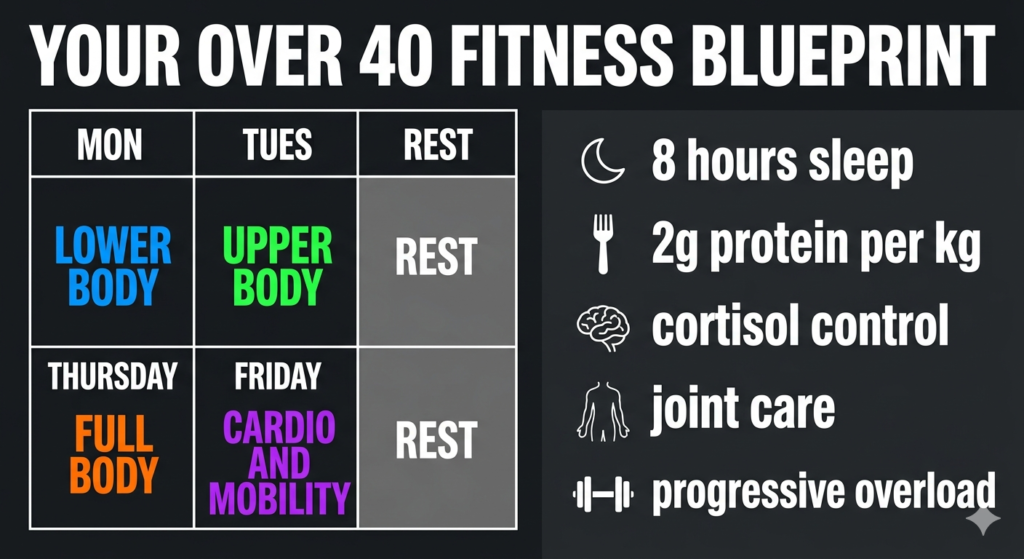
Here is a practical, evidence-aligned four-day training week structured for men over 40. It balances adequate training stimulus with realistic recovery and emphasizes the compound movements that produce the greatest hormonal and muscle-building response.
Perform this plan four days per week with at least one rest day between any two consecutive training days. A Monday, Tuesday, Thursday, Friday structure with Wednesday and the weekend as rest or active recovery days works well for most schedules.
Day 1: Lower Body Strength Barbell or goblet squat: 4 sets of 6 to 8 reps. Romanian deadlift: 3 sets of 8 to 10 reps. Bulgarian split squat: 3 sets of 8 to 10 reps each leg. Leg press: 3 sets of 10 to 12 reps. Calf raises: 3 sets of 15 reps. Core work: plank hold 3 sets of 45 seconds.
Day 2: Upper Body Push and Pull Bench press or dumbbell press: 4 sets of 6 to 8 reps. Barbell or dumbbell row: 4 sets of 8 to 10 reps. Overhead press: 3 sets of 8 to 10 reps. Lat pulldown or assisted pull-up: 3 sets of 10 to 12 reps. Incline dumbbell press: 3 sets of 10 reps. Cable or dumbbell curl: 2 sets of 12 reps. Tricep pushdown: 2 sets of 12 reps.
Day 3: Cardio and Mobility 20 to 30 minutes of moderate intensity cardio. Followed by 15 to 20 minutes of full-body mobility and stretching work targeting the hips, thoracic spine, and shoulders.
Day 4: Full Body Strength and Power Deadlift: 4 sets of 4 to 6 reps at moderate to heavy load. Push-up variation: 3 sets of 10 to 15 reps. Goblet squat or step-up: 3 sets of 10 reps each leg. Cable or dumbbell row: 3 sets of 10 reps. Farmer carry: 3 sets of 30 meters. Core work: dead bug 3 sets of 10 reps each side.
Add weight to each exercise as soon as you complete all prescribed reps with good form for two consecutive sessions. This is your progressive overload built directly into the structure.
Use Our Free Tools to Support Your Fitness Journey
Men over 40 fitness works best when you are working with real numbers tailored to your body rather than generic guidelines. These free tools on Vitality Nexus give you the personalized data you need.
Calculate Your TDEE Your Total Daily Energy Expenditure tells you exactly how many calories your body burns each day at your current activity level. This is the foundation of any nutrition plan that supports your training goals. Use our TDEE Calculator to find your personal maintenance number.
Set Your Calorie Target Use our Calorie Calculator to establish the daily intake that supports either fat loss, muscle building, or body recomposition depending on your specific goals.
Calculate Your BMR Your Basal Metabolic Rate reflects your resting calorie burn and is directly influenced by your muscle mass. Use our BMR Calculator to establish your current baseline and track how it improves as your muscle mass increases over time.
Check Your Body Fat Percentage Scale weight does not tell you whether you are gaining muscle or losing fat. Use our Body Fat Calculator to track the metric that actually reflects your training progress accurately.
Find Your Ideal Weight Use our Ideal Weight Calculator to establish a realistic, science-based target weight for your height, age, and body type.
Check Your BMI Use our BMI Calculator to monitor your overall body composition as your fitness routine produces change over weeks and months.
Optimize Your Sleep Schedule Sleep is the foundation of men over 40 fitness. Use our Sleep Calculator to find the sleep timing that maximizes deep sleep duration and the hormonal recovery it produces.
Supplements Worth Considering for Men Over 40
While no supplement replaces consistent training, adequate sleep, and proper nutrition, several have meaningful research support for the specific challenges men over 40 face.
Creatine monohydrate is the most evidence-backed and cost-effective supplement available for muscle preservation and strength in men over 40. Three to five grams daily consistently augments the muscle and strength gains from resistance training in older adults beyond what training alone produces.
Vitamin D3 combined with vitamin K2 supports testosterone production through its role in Leydig cell function, maintains bone density, and supports immune function. Most men in northern latitudes are deficient. Testing and supplementing to an optimal level of 50 to 80 nanograms per milliliter is a high-priority intervention. Read our article on vitamin D3 and K2 benefits for comprehensive guidance.
Magnesium glycinate or magnesium threonate supports testosterone bioavailability, sleep quality, stress regulation, and muscle function, all of which are priority concerns for men over 40. Read our article on 7 types of magnesium and their benefits to understand which form is most effective for your specific needs.
Omega-3 fatty acids from a high-quality fish oil supplement, providing at least 2 to 3 grams of combined EPA and DHA daily, reduce systemic inflammation, support testosterone production, and directly stimulate muscle protein synthesis in older adults through mechanisms that make them particularly valuable for men over 40.
Ashwagandha has multiple controlled trials showing significant cortisol reduction and corresponding testosterone increases, making it one of the most relevant adaptogens for the specific hormonal challenges men over 40 face.
Protein powder, specifically whey concentrate or whey isolate for post-workout and casein for pre-sleep use, is not a replacement for whole food protein but makes reaching the elevated protein targets that men over 40 require significantly more practical on busy days.
Common Fitness Mistakes Men Over 40 Make
Knowing what not to do saves time, money, and injury recovery periods. These are the most common and most costly mistakes in men over 40 fitness.
Training like a 25-year-old without adjusting for recovery capacity. The training volume and frequency that produced results in your twenties may be generating more accumulated fatigue than adaptation in your forties. Managing training load intelligently, including planned deload periods, is not weakness. It is what makes the training actually work.
Neglecting protein intake. Most men over 40 are eating 80 to 100 grams of protein daily and wondering why they are not making progress despite training regularly. The target for muscle preservation and building after 40 is 1.6 to 2.2 grams per kilogram of body weight. For a 90-kilogram man, that is 145 to 200 grams daily. This gap is enormous and explains a large proportion of stalled progress.
Doing too much cardio and not enough weights. The cultural default for men who want to lose weight is to increase cardio. For men over 40, this approach sacrifices the resistance training that protects muscle mass and metabolic rate while potentially elevating cortisol further. Resistance training should be primary. Cardio should be strategic and supplementary.
Ignoring hormonal health. Many men attribute the symptoms of declining testosterone to simply getting older and do not investigate or address it. Fatigue, reduced libido, difficulty building muscle, mood changes, and increasing abdominal fat in a man over 40 deserve a hormonal assessment, not passive acceptance.
Prioritizing aesthetics over function. The men who feel and perform best in their forties and beyond are those who train for capability, strength, and health rather than exclusively for how they look. Performance-based goals such as a certain squat weight, completing a challenging hike, or maintaining the physical capacity to play actively with children and grandchildren tend to produce more consistent long-term motivation than purely aesthetic goals.
FAQ
1. Can men over 40 still build muscle?
Yes, absolutely. The capacity for muscle hypertrophy does not disappear after 40. It requires higher protein intake, slightly more recovery time, and consistent progressive overload to produce the same results that came more easily in younger years. But multiple controlled research studies have demonstrated significant muscle mass gains in men in their forties, fifties, and sixties in response to appropriate resistance training and nutrition. The biology supports it fully.
2. How often should men over 40 work out?
Three to four resistance training sessions per week is the evidence-supported sweet spot for most men over 40. This provides adequate training stimulus for continued muscle adaptation while allowing the somewhat longer recovery time that the post-40 physiology requires. Additional light activity including walking and mobility work on rest days supports recovery and maintains metabolic health without adding meaningful training stress.
3. What is the best exercise for men over 40?
Compound resistance training exercises are the most valuable for men over 40 because they engage the largest muscle mass, produce the strongest hormonal response, and build the functional strength that matters most for health and capability. Squats, deadlifts, bench press, rows, and overhead press should form the core of any men over 40 fitness program. Joint-friendly cardio options like walking, cycling, and swimming complement resistance training effectively.
4. How do men over 40 lose belly fat?
Abdominal fat in men over 40 is strongly driven by declining testosterone, elevated cortisol, and insulin resistance, alongside the standard calorie balance considerations. Addressing these hormonal factors through resistance training, adequate sleep, stress management, and testosterone optimization is as important as the caloric deficit for effective and lasting results. A moderate caloric deficit of 300 to 500 calories per day combined with high protein intake and consistent resistance training is the most effective evidence-based approach.
5. How much protein do men over 40 need daily?
Men over 40 need significantly more protein than standard dietary guidelines suggest for the purpose of muscle preservation and building. Research supports daily intakes of 1.6 to 2.2 grams per kilogram of body weight. For a typical 85 to 90-kilogram man, this means 135 to 200 grams of protein daily. This should be distributed across three to four meals rather than concentrated at one meal for maximum muscle protein synthesis throughout the day.
6. Is testosterone replacement therapy necessary for men over 40?
Not necessarily. Many men over 40 who address the lifestyle factors driving testosterone decline through resistance training, sleep optimization, fat loss, stress management, and nutritional deficiency correction see meaningful testosterone improvements without medical intervention. Testosterone replacement therapy is appropriate and beneficial for men with clinically diagnosed hypogonadism based on consistently low blood levels combined with significant symptoms. This decision should be made with proper medical guidance based on a complete hormonal assessment rather than symptoms alone.
7. What should men over 40 avoid in their fitness routine?
Men over 40 should avoid training to absolute failure every set, which generates excessive cumulative fatigue and connective tissue stress. They should avoid excessive high-intensity cardio volume, which elevates cortisol and suppresses testosterone when overused. They should avoid very low-calorie diets, which accelerate muscle loss through hormonal suppression. They should avoid neglecting mobility and recovery work. And they should avoid applying the same training approach they used at 25 without adjusting for the genuinely different physiological environment of their forties.
Conclusion
Men over 40 fitness is not about working harder than you did in your twenties. It is about working smarter, recovering better, eating more deliberately, and understanding the specific physiological shifts that require a thoughtful update to how you approach your body and your training.
The men who look and perform their best in their forties and beyond are not doing something extraordinary. They are applying the principles in this guide with consistency and patience. Resistance training as the foundation. Protein at every meal in adequate amounts. Sleep protected as a hormonal priority. Testosterone and cortisol managed through lifestyle rather than ignored. Cardio used strategically rather than as the primary tool. And progress measured in the right metrics over a timeline long enough for real change to compound.
Use the free tools at Vitality Nexus to calculate your personalized calorie, protein, and body composition targets. Explore our men’s health resources and our full health and fitness section for comprehensive guidance on every aspect of the lifestyle that makes the difference.
The forties are not the beginning of the end of your physical capability. For men who approach this decade with the right strategies, they are often the beginning of the best physical shape of their lives.