Every year, millions of women quietly carry the weight of anxiety, depression, burnout, and emotional exhaustion without ever being asked how they are really doing. They show up for their families, their jobs, their friends, and their communities while putting their own mental health last on the list.
That is exactly why women’s mental health month exists. It is a dedicated time to put women’s emotional wellbeing at the center of the conversation, to raise awareness about the unique mental health challenges women face, and to encourage women everywhere to seek the support, rest, and care they deserve.
If you have been wondering when women’s mental health month falls, what it actually covers, and how to make it meaningful rather than just another awareness calendar date, this guide answers all of that and more.
Table of Contents
When Is Women’s Mental Health Month?
Women’s mental health month is observed in May each year. May is also recognized as Mental Health Awareness Month more broadly in the United States and many other countries, making it a powerful and concentrated period of focus on emotional and psychological wellbeing across all populations.
Within May, specific observances include Mental Health Awareness Week, which is typically observed in the second week of May in the United Kingdom, and various campaign events organized by mental health organizations globally throughout the entire month.
Some organizations and advocacy groups also recognize March as a month with significant women’s mental health focus, coinciding with Women’s History Month and International Women’s Day on March 8th. During this time, conversations about the unique pressures women face, including gender-based discrimination, caretaking burdens, and reproductive health challenges, often include mental health as a central theme.
The most widely recognized and institutionally supported observance, however, remains May, driven by organizations like the National Alliance on Mental Illness (NAMI) and the Mental Health America organization, which has led Mental Health Awareness Month in the United States since 1949.
For women specifically, May offers a timely and meaningful opportunity to reflect on their own mental health, seek support if needed, and advocate for better mental healthcare access for women everywhere.

Why Women’s Mental Health Deserves Its Own Month
You might wonder why women’s mental health needs a separate focus within the broader Mental Health Awareness Month. The answer lies in numbers, biology, and lived experience.
Women are diagnosed with anxiety disorders at nearly twice the rate of men. They are significantly more likely to experience depression, post-traumatic stress disorder, and eating disorders. They are disproportionately affected by conditions tied to reproductive transitions like postpartum depression, premenstrual dysphoric disorder, and perimenopausal mood changes.
At the same time, women are more likely to carry what researchers call the “mental load,” the invisible cognitive and emotional labor of managing households, relationships, children, and aging parents, often alongside full-time careers. This invisible burden creates chronic stress that accumulates quietly and relentlessly.
According to the World Health Organization, depression is the leading cause of disability worldwide and affects women at disproportionately higher rates than men. Despite this, women’s mental health conditions are frequently under-researched, under-funded, and under-treated.
A dedicated month of awareness creates space for these specific conversations, reduces the stigma that still silences many women from seeking help, and encourages healthcare systems, communities, and individuals to pay closer attention to women’s emotional wellbeing.
The Most Common Mental Health Challenges Women Face
Understanding what women are actually dealing with is the foundation of meaningful awareness. These are the most prevalent mental health conditions affecting women today.
Anxiety Disorders
Anxiety is the most common mental health condition among women. Generalized anxiety disorder, social anxiety, panic disorder, and specific phobias all affect women at significantly higher rates than men. Hormonal fluctuations across the menstrual cycle, pregnancy, and menopause all influence anxiety levels in ways that are still not fully understood or adequately addressed in clinical practice.
Depression
Depression affects approximately one in five women at some point in their lives. Postpartum depression, which affects up to 15 percent of new mothers, is one of the most common and most undertreated forms. Perimenopausal depression is another frequently overlooked variant that many women experience as they approach midlife.
For a deeper understanding of depression and its treatment options, read our article on depression, symptoms, causes, and treatment.
Burnout and Chronic Stress
Burnout is not a diagnosis in the traditional medical sense, but its impact on women’s lives is very real and very serious. The combination of professional pressure, domestic responsibility, and the expectation to always be emotionally available creates a form of chronic depletion that affects millions of women. Read our detailed guide on mental drain, burnout causes, symptoms, and solutions to understand the full picture.
Eating Disorders
Women account for the large majority of eating disorder diagnoses. Anorexia, bulimia, and binge eating disorder all carry serious physical and psychological consequences and are closely tied to body image pressures, trauma, and emotional dysregulation.
PTSD and Trauma
Women are more likely than men to experience certain types of trauma, including sexual assault, domestic violence, and childhood abuse, and are twice as likely to develop PTSD following a traumatic event. Trauma-related mental health conditions in women are often underdiagnosed and undertreated.
How Hormones Affect Women’s Mental Health
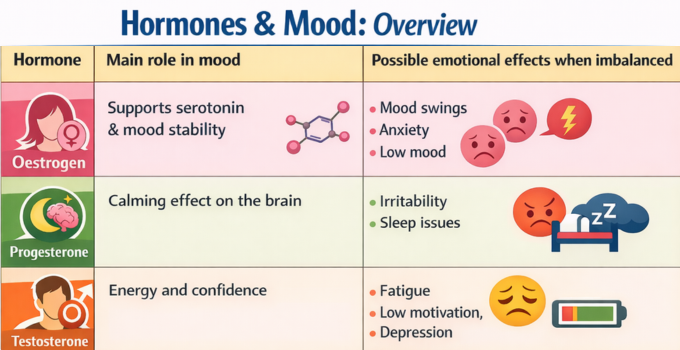
One of the things that makes women’s mental health uniquely complex is the profound influence of hormones on mood, cognition, and emotional regulation.
Estrogen and progesterone do not just regulate the reproductive system. They interact directly with neurotransmitter systems including serotonin, dopamine, and GABA, which are the same brain chemicals that most psychiatric medications target. When these hormone levels shift, whether through the natural phases of the menstrual cycle, pregnancy, postpartum recovery, or perimenopause, the psychological effects can be dramatic.
Many women report significant mood changes in the week before their period. This is not imaginary or exaggerated. It reflects real neurochemical shifts driven by falling estrogen and progesterone levels in the luteal phase of the cycle.
The perimenopausal transition is another period of significant hormonal volatility that many women and their healthcare providers are still not adequately prepared for. Anxiety, depression, sleep disruption, and cognitive changes during this period are common, underreported, and frequently misattributed to other causes.
Read our articles on perimenopause vs menopause and how hormones affect women’s skin for more on how hormonal shifts shape women’s physical and emotional experience throughout life.
The Stress and Women’s Health Connection
Stress is not just a mental experience. For women, chronic stress has measurable consequences across multiple body systems that can create a cascade of physical and emotional health problems over time.
When cortisol, the primary stress hormone, stays elevated for extended periods, it disrupts sleep, impairs immune function, elevates blood pressure, promotes weight gain particularly around the abdomen, and directly interferes with reproductive hormone balance.
Women who experience chronic high stress are more likely to develop irregular menstrual cycles, reduced fertility, worsened PMS symptoms, and more difficult perimenopausal transitions. The mind and body are not separate systems. Stress in one cascades into the other.
Read our article on how stress affects women’s reproductive health to understand exactly how this connection works and what women can do to interrupt the cycle.
Understanding cortisol’s role in health more broadly is also worthwhile. Our article on low cortisol vs high cortisol covers the full spectrum of what happens when this hormone is out of balance.
7 Powerful Ways to Honor Women’s Mental Health Month
Awareness is only meaningful when it leads to action. Here are seven genuinely impactful things women can do during women’s mental health month and beyond.
1. Schedule a Mental Health Check-In with Yourself
Take thirty minutes this month to sit quietly and honestly assess how you are actually doing. Not how you are managing, but how you are feeling. Journaling can help make this concrete. Ask yourself what is draining you most right now, what you have been tolerating that you should not be, and what you genuinely need that you have not been giving yourself.
2. Have the Conversation You Have Been Avoiding
Women’s mental health month is a culturally supported moment to start conversations that feel difficult in normal circumstances. Talk to your doctor about symptoms you have been dismissing. Tell someone you trust that you have been struggling. Ask your partner, friend, or colleague how they are really doing. These conversations save lives.
3. Prioritize Sleep as a Non-Negotiable
Sleep deprivation is one of the most potent amplifiers of anxiety, depression, and emotional dysregulation. Yet it is one of the first things women sacrifice when life gets busy. Protecting your sleep is not selfish. It is essential. Use our Sleep Calculator to find the sleep schedule that aligns with your natural circadian rhythm and actually allows your nervous system to recover.
For more on the connection between sleep and mental health, read our article on insomnia, symptoms, causes, and treatment.
4. Move Your Body in a Way That Feels Good
Exercise is one of the most evidence-based interventions for anxiety and depression available to anyone. It does not need to be intense or structured to be beneficial. A thirty-minute walk in a green space, a yoga session, a dance class, or a gentle swim all produce real neurochemical benefits that improve mood and reduce anxiety. Find what you enjoy and do it consistently.
5. Reduce the Mental Load Where You Can
One of the most meaningful things a woman can do for her mental health is to stop carrying more than her share. This might mean having a direct conversation about redistributing household responsibilities. It might mean saying no to a commitment that is draining rather than fulfilling. It might mean delegating something you have always done alone because you never asked for help. The mental load is real and it is heavy. Reducing it is not a luxury.
6. Invest in Nutritional Support for Your Brain
Several nutritional deficiencies are directly linked to depression, anxiety, and poor cognitive function in women. Magnesium, omega-3 fatty acids, vitamin D3, and iron are among the most important. Read our article on vitamin deficiency skin signs in women as a starting point for understanding how nutritional gaps show up in women’s health. And explore our nutrition and supplements category for comprehensive guidance.
7. Seek Professional Support Without Guilt
Therapy, counseling, and psychiatric care are not last resorts for when things have completely fallen apart. They are legitimate, effective tools that women deserve access to throughout their lives. Women’s mental health month is a culturally supported moment to make that first appointment you have been postponing, return to therapy after a break, or speak to your doctor about medication options if other approaches have not been sufficient.
Use Our Free Tools to Support Your Wellbeing
Women’s mental health is inseparable from physical health. These free tools on Vitality Nexus help you understand your body’s baseline and identify physical factors that may be affecting your emotional wellbeing.
Optimize Your Sleep Schedule Sleep is the foundation of mental health. Use our Sleep Calculator to find your ideal sleep timing and protect the overnight recovery your nervous system genuinely needs.
Check Your BMI Physical health factors including excess weight, metabolic imbalance, and nutritional deficiency all influence mood and mental health. Use our BMI Calculator to understand where your physical health currently stands.
Find Your Ideal Weight Use our Ideal Weight Calculator to set a realistic and healthy goal that supports both physical and mental wellbeing.
Calculate Your Daily Calorie Needs Undereating is a surprisingly common source of anxiety, mood instability, and fatigue in women. Use our Calorie Calculator to make sure you are fueling your brain and body adequately every day.
Track Your Pregnancy Due Date For women navigating pregnancy, perinatal mental health is a critical area of focus. Use our Pregnancy Due Date Calculator to plan ahead and ensure mental health support is part of your prenatal and postnatal care plan.
How to Support the Women in Your Life
Women’s mental health month is not only for women. The people around them, partners, family members, friends, and colleagues, play a significant role in whether a woman feels safe enough to acknowledge her struggles and seek help.
The most powerful thing you can do is ask and then actually listen. Not ask and immediately offer solutions. Not ask and redirect to your own experience. Ask and sit with what you hear. Create space for an honest answer.
Practical support matters enormously too. Offering to take something off a woman’s plate, showing up consistently rather than only in crisis moments, and normalizing mental health conversations in everyday life all reduce the isolation that makes mental health struggles harder to bear.
If you are concerned about someone’s mental health, you do not need to have the perfect words. Saying “I have noticed you seem really overwhelmed lately and I want you to know I am here” is more than enough to open a door that might otherwise stay closed for a very long time.
Breaking the Stigma Around Women’s Mental Health
Despite decades of mental health awareness campaigns, stigma remains one of the biggest barriers to women seeking help. The specific stigma women face is layered in ways that are worth naming clearly.
Women who express emotional distress are frequently dismissed as dramatic, hormonal, or oversensitive. Women in professional settings fear that acknowledging mental health struggles will damage their careers or their credibility. Mothers fear judgment from other parents or from social services. Women from certain cultural backgrounds face additional layers of shame and family pressure that make seeking help feel impossible.
This stigma has real consequences. It delays diagnosis. It prevents treatment. And in serious cases, it costs lives.
Talking openly about women’s mental health, using accurate language, sharing experiences without shame, and treating mental healthcare as the legitimate medical need it is, are all acts of stigma reduction that women’s mental health month actively encourages.
For a comprehensive look at mental health awareness and emotional wellness, read our guide on mental health awareness and emotional wellness.
When to Seek Professional Help
One of the most important questions women ask during women’s mental health month is how to know when their struggles have crossed into territory that needs professional support.
The honest answer is: sooner than most women think.
You do not need to be in crisis to benefit from therapy. You do not need to feel completely unable to function to deserve medication evaluation. You do not need to have the worst anxiety or the deepest depression in the room to have a valid reason to reach out to a mental health professional.
Some specific signals that professional support is warranted include persistent sadness or anxiety lasting more than two weeks, significant changes in sleep or appetite, difficulty performing everyday tasks or going to work, withdrawal from relationships and activities you normally enjoy, feelings of hopelessness or worthlessness, and any thoughts of self-harm or suicide.
If you are experiencing thoughts of self-harm or suicide, please reach out to a crisis service immediately. In the United States, the 988 Suicide and Crisis Lifeline is available by calling or texting 988. In the United Kingdom, the Samaritans can be reached at 116 123. These services are confidential and available around the clock.
For a broader understanding of what a mental health crisis looks like and how to respond, read our article on signs of a mental breakdown.
FAQ
1. When is women’s mental health month?
Women’s mental health month is primarily observed in May, which is also Mental Health Awareness Month in the United States. Some organizations also hold women’s mental health awareness events in March during Women’s History Month. May remains the most widely recognized and officially supported month for mental health awareness globally.
2. Who created Women’s Mental Health Month?
Mental Health Awareness Month was established in the United States in 1949 by Mental Health America. Over time, specific advocacy organizations and healthcare groups have focused particular attention on women’s mental health within this broader awareness month, driven by data showing that women are disproportionately affected by many common mental health conditions.
3. Why are women more affected by mental health conditions than men?
The higher rates of anxiety, depression, and PTSD in women reflect a combination of biological factors including hormonal fluctuations, social factors including gender-based trauma and the mental load of caregiving, and systemic factors including gender inequality and discrimination. Women are also more likely to seek help and receive diagnoses, which partially explains higher reported rates.
4. What are the most important mental health issues for women?
The most prevalent and impactful mental health issues for women are anxiety disorders, depression including postpartum and perimenopausal depression, burnout from chronic stress, eating disorders, and PTSD related to trauma. Reproductive mental health across pregnancy, postpartum recovery, and menopause is also an increasingly recognized area of focus.
5. How can I improve my mental health during Women’s Mental Health Month?
Start with sleep, movement, and nutrition as foundational physical supports for mental health. Add a genuine check-in with yourself about how you are actually doing. Have one honest conversation with someone you trust. Consider scheduling a therapy appointment or speaking to your doctor about any symptoms you have been dismissing. Small, consistent steps taken in May can build habits that serve your mental health year-round.
6. Is there a Women’s Mental Health Week as well?
Mental Health Awareness Week is observed annually, typically in May in the United States and in a slightly different week in May in the United Kingdom. While not branded specifically as Women’s Mental Health Week, many organizations dedicate this week to amplifying conversations about the specific mental health challenges women face.
7. Where can I find mental health resources for women?
Organizations including Mental Health America at mhanational.org, the National Alliance on Mental Illness at nami.org, and the Women’s Mental Health Consortium offer resources specifically for women. Your primary care doctor can also refer you to local mental health services. In a crisis, the 988 Suicide and Crisis Lifeline in the US and the Samaritans at 116 123 in the UK are available around the clock.
Conclusion
When is women’s mental health month? It is May. But the truth is that women’s mental health deserves attention, investment, and honest conversation every month of the year.
May gives us a culturally supported moment to start those conversations, to seek the help we have been putting off, to check in on the women around us, and to advocate for mental health systems that actually serve women’s specific needs. That momentum does not have to end on June 1st.
If this article resonated with something you have been carrying quietly, let this be the nudge to take one small action today. Book the appointment. Make the call. Have the conversation. Use the free tools at Vitality Nexus to understand your physical health baseline. Explore our full women’s health resources and mental health section for ongoing support.
You have been showing up for everyone else for a long time. This month, and every month, you deserve to show up for yourself too.