
The moment your workout ends, the real work begins.
Most people think the training session itself is where the adaptation happens. You lift the weight, you run the distance, you complete the intensity, and that is where the change occurs. But that is only half the story.
Training creates the stimulus for change. Recovery is where the actual change happens. The micro-tears in muscle from resistance training are repaired and rebuilt stronger. The depleted glycogen stores are restocked. The nervous system is recalibrated. The immune system is activated to manage the inflammatory response that training produces. And the hormonal environment is adjusted to support the growth and adaptation that the training signal requested.
Without proper recovery after workout, the training stimulus is wasted. You create damage without the repair that converts it into improvement. You accumulate fatigue without the adaptation that converts it into fitness. You increase injury risk without increasing capability.
This guide covers 12 evidence-based recovery after workout strategies that work across all fitness levels, explains exactly why each one matters, and shows you how to implement them in ways that actually fit your life rather than requiring perfect conditions.
Table of Contents
Why Recovery After Workout Is Not Optional
Recovery is not a passive state that happens automatically while you rest. It is an active biological process that requires specific inputs and conditions to proceed optimally.
When you exercise, you create a controlled stress on your body. You deplete energy stores, create micro-damage in muscle fibers, trigger inflammatory responses, and activate the nervous system. These are all necessary to create the stimulus for adaptation. But without proper recovery, they remain damage without the repair and adaptation that converts them into improved capability.
The fundamental principle is this: training is the signal, recovery is the adaptation. You cannot have one without the other. No amount of training without recovery produces results. And recovery without training stimulus has nothing to adapt to.
Research has consistently demonstrated that the quality of recovery is as important as the quality of training for determining outcomes. Athletes and exercisers with identical training programs but different recovery practices show dramatically different rates of progress, with those prioritizing recovery making substantially faster gains and experiencing fewer injuries.
According to research published by the American College of Sports Medicine, active recovery strategies, proper nutrition timing, and adequate sleep are among the most impactful factors for training results yet are among the most frequently neglected by recreational exercisers who focus exclusively on training intensity.
The practical implication is clear. If you are investing time and effort in training but not investing equivalent thought and effort into recovery after workout, you are leaving most of your potential results on the table.
1. Cool Down and Gradually Lower Heart Rate
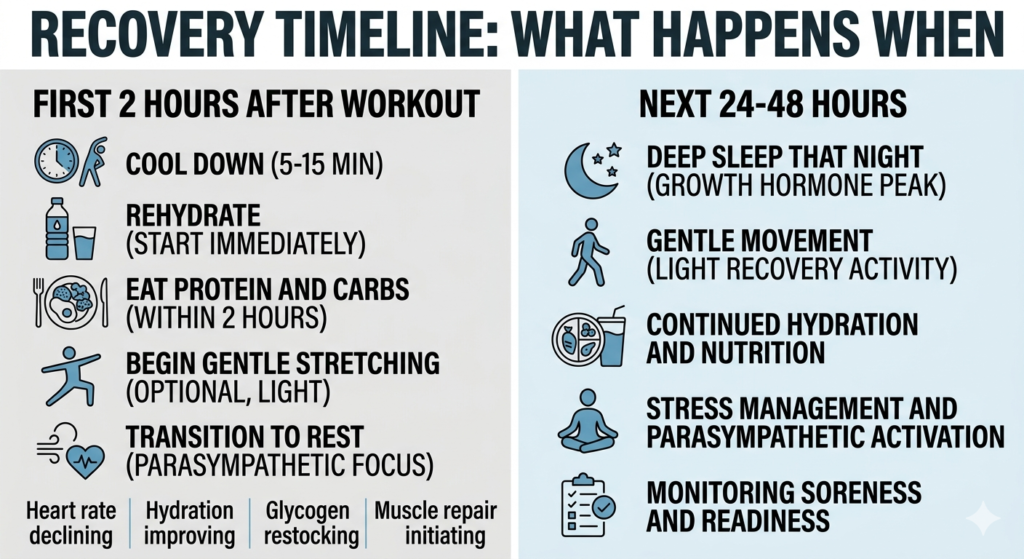
The cool-down period immediately after exercise is not optional warming-down time before getting on with your day. It is a critical component of the recovery process that begins the shift from sympathetic nervous system activation, which governs the training response, to parasympathetic nervous system activation, which governs the recovery process.
During intense training, the sympathetic nervous system is activated. Heart rate is elevated. Blood pressure is high. Breathing is fast. Hormones including adrenaline and cortisol are elevated. This state is necessary for the training stimulus but incompatible with the recovery process.
A gradual cool-down, consisting of five to fifteen minutes of lower-intensity movement that allows heart rate to decline gradually, signals to the nervous system that the threat or demand has passed. This allows the parasympathetic nervous system to activate and begin the recovery processes that cannot proceed while sympathetic activation continues.
The most effective cool-down consists of continuing the same general activity you were doing during training but at a much lower intensity. After a hard run, a slow walk. After intense strength training, light bodyweight movements or stretching. After a cycling session, easy pedaling at very low resistance. The goal is to maintain movement while allowing intensity to drop significantly.
Without a proper cool-down, the nervous system remains in a heightened state longer than necessary, extending the stress response and delaying the onset of the recovery process.
2. Rehydrate Immediately and Throughout the Day
Rehydration is one of the most important and most frequently under-dosed aspects of recovery after workout.
During exercise, particularly sweating-inducing exercise, significant fluid is lost from the body. This fluid loss affects every system simultaneously. It reduces blood volume, which impairs oxygen delivery to working tissues. It concentrates electrolytes and other dissolved substances in the blood, affecting cellular function. It reduces the fluid available for the processes of recovery including glycogen synthesis and protein synthesis.
The practical target is to drink approximately 16 to 24 ounces of fluid for every pound of body weight lost during the workout. A person who loses two pounds during training should drink 32 to 48 ounces of fluid over the next few hours. This amount exceeds what you might intuitively drink and is necessary to fully rehydrate because some of the fluid you drink is lost through continued sweating and urination rather than being retained in the body.
The fluid should include electrolytes, particularly sodium, which helps with fluid retention and maintains the osmotic balance that allows fluid to be absorbed and retained. This is why sports drinks are effective despite the common criticism about their sugar content. The combination of carbohydrate for glycogen restoration, electrolytes for fluid retention, and fluid for hydration together addresses multiple recovery needs simultaneously.
Plain water, while better than nothing, is less effective for rehydration than water with electrolytes because it does not provide the electrolyte component that prevents the diluted blood from triggering increased urination that leads to fluid loss.
3. Eat Protein and Carbohydrates Within Two Hours
The post-workout window is a specific period of elevated capacity for nutrient uptake and utilization that should be leveraged for optimal recovery after workout.
Protein is required for the muscle protein synthesis that repairs training-induced muscle damage and builds muscle tissue. Research has consistently shown that consuming protein within two hours of training produces greater muscle protein synthesis and faster muscle growth than consuming the same protein several hours later.
The specific amount required is approximately 20 to 40 grams of high-quality complete protein. This is sufficient to maximally stimulate muscle protein synthesis in most people. More than this does not provide additional benefit in the immediate post-workout period, though total daily protein intake still matters for cumulative muscle development.
Carbohydrates are equally important in the immediate post-workout period because they replenish the glycogen stores that were depleted during training. Muscle glycogen is the primary fuel for most types of training, and replenishing it promptly supports recovery and prepares the body for the next training session. Carbohydrate consumed in the post-workout window is preferentially directed toward glycogen restoration rather than fat storage because of the activation of glucose uptake transporters in muscle tissue immediately after training.
The practical implementation is straightforward. Within one to two hours of finishing a workout, consume a meal or snack containing both protein and carbohydrates. A turkey sandwich on whole grain bread. Greek yogurt with fruit. Chicken with rice and vegetables. A protein smoothie with banana. The specific food matters far less than consuming the combination of protein and carbohydrate in adequate amounts within the window when it is most effective.
For detailed guidance on nutrition timing and composition, read our article on how many calories should I eat.
4. Get Deep Sleep That Night
Sleep is the most powerful recovery tool available, and the deep sleep stages are where the most important recovery processes occur.
During deep sleep, growth hormone reaches its highest levels of the 24-hour cycle. This growth hormone drives protein synthesis, tissue repair, and the cellular regeneration that is fundamental to recovery from training. Without adequate deep sleep, the growth hormone pulse that drives overnight recovery is reduced, and the repair of training-induced damage is compromised.
Additionally, sleep is when the nervous system consolidates the motor learning that occurred during training. If you learned a new movement pattern, trained a specific skill, or practiced a technique, that learning is solidified during sleep, particularly during the REM sleep stages. Without adequate sleep, this consolidation is incomplete.
The research is unambiguous. Athletes sleeping seven to nine hours per night recover faster, adapt to training more quickly, maintain better injury prevention capacity, and show better performance compared to those sleeping less than six hours per night. The difference is not small. In most cases, adequate sleep produces more improvement in training outcomes than most other interventions.
For comprehensive guidance on sleep quality and the specific mechanisms through which sleep supports recovery, read our articles on deep sleep benefits and signs of poor sleep.
Use our Sleep Calculator to find the sleep and wake times that maximize deep sleep quantity and quality.
5. Move Gently on Rest Days
The concept of recovery does not mean complete inactivity. It means strategic, less intense movement that supports recovery processes without adding significant training stress.
Light movement on rest days increases blood flow to muscle tissue, which delivers oxygen and nutrients needed for repair while clearing metabolic waste products accumulated during training. It supports lymphatic drainage, which removes inflammatory byproducts and supports immune system function. And it maintains mobility and prevents the stiffness that complete inactivity produces.
The optimal rest day activity is low-intensity, low-impact movement that does not trigger a significant training response. Walking at an easy pace, easy cycling, swimming, or gentle yoga are all appropriate. The goal is movement that feels restorative rather than effortful, that does not elevate heart rate significantly, and that does not create additional fatigue.
This is distinct from active recovery that is too intense, which adds stress rather than supporting recovery. The difference is felt in the intensity and in how the person feels after the activity. True recovery movement leaves someone feeling energized and more mobile. Too-intense rest day activity leaves someone feeling fatigued, which indicates it was stressful to the system rather than supportive of recovery.
For guidance on movement options that support recovery without adding training stress, read our article on best cardio exercises which discusses how to calibrate exercise intensity appropriately for different training phases.
6. Manage Inflammation Without Suppressing It Completely
Inflammation gets universally criticized, but the inflammatory response to training is actually a necessary and important part of the recovery and adaptation process.
When muscle is trained, the mechanical stress creates microscopic damage. This damage triggers an inflammatory response that activates immune cells and releases signaling molecules that drive the repair and rebuilding process. Without this inflammation, the adaptation signal would not be sent and the training would not produce improvement.
The problem arises not from inflammation itself but from excessive or prolonged inflammation that exceeds what is necessary for adaptation. Complete suppression of inflammation through aggressive anti-inflammatory strategies including excessive ice use, immediate anti-inflammatory medication, or other aggressive measures can actually impair recovery by preventing the necessary inflammatory response from occurring.
The balanced approach is to allow the inflammatory response to proceed while managing the symptoms and excess. This means ice in the immediate post-workout period to manage acute pain and swelling, but not for extended periods that completely suppress inflammation. It means elevation and gentle movement to manage swelling without immobilizing the area. And it means allowing some muscle soreness to be present as feedback that training occurred, while managing excessive soreness through the other recovery strategies in this guide.
Most importantly, evidence supports active recovery and gentle movement as superior to complete rest or aggressive anti-inflammatory strategies for optimizing the inflammatory response toward adaptation rather than excessive inflammation.
7. Stretch and Address Mobility Restrictions
Flexibility and mobility changes often occur after intense training, particularly when training involves large ranges of motion or novel movement patterns. Addressing restrictions before they become chronic prevents long-term movement quality issues and supports efficient recovery.
Post-workout stretching, particularly the gentle, sustained stretching that occurs while muscles are still warm from training, helps maintain the ranges of motion that training may have temporarily restricted. It also provides proprioceptive feedback that supports the nervous system’s awareness of muscle length and tension.
The most effective post-workout stretching is not intense or painful. It is gentle, sustained holding of positions that lightly stretch the trained muscles for 20 to 30 seconds each. This is different from aggressive flexibility training, which creates additional training stimulus that adds to recovery demand rather than supporting it.
Foam rolling on rest days or on the day after intense training can address muscular tension and adhesions that restrict movement. The technique should be exploratory and gentle rather than aggressive and painful. The goal is to identify areas of restriction and apply sustained, moderate pressure until tension gradually releases rather than aggressively crushing tissue.
For comprehensive guidance on mobility and flexibility, read our article on best home workouts for beginners which includes mobility work appropriate for all fitness levels.
8. Use Heat and Cold Strategically
Both heat and cold have roles in recovery after workout, but they are most effective when used at specific times and for specific purposes rather than indiscriminately.
Cold application in the immediate post-workout period reduces acute swelling and can reduce pain in the short term. This is why ice is commonly used right after intense training or injury. However, cold application beyond the immediate post-workout period may impair the inflammation and healing processes that are necessary for adaptation. Extended icing in the hours following training can be counterproductive.
Heat application, particularly in the hours after training or on recovery days, increases blood flow to muscle tissue, which supports nutrient delivery and waste removal. Heat also tends to feel relaxing and supports the parasympathetic nervous system activation that characterizes recovery. Warm showers, saunas, or heating pads applied to trained areas support recovery more than continued cold exposure.
The practical approach is ice or cold water immersion in the immediate 10-20 minutes post-workout if there is significant acute swelling or pain. Then transition to heat in the following hours and days to support ongoing recovery. Heat is generally superior for recovery after workout unless there is specific acute injury with significant swelling.
9. Manage Stress and Support the Nervous System
The nervous system is directly stressed by intense training. The recovery period is when the nervous system needs to downregulate and return to baseline.
Chronically elevated cortisol from unmanaged stress interferes with recovery by promoting muscle breakdown, suppressing growth hormone, and impairing the anabolic recovery processes that training is designed to trigger. For someone training hard while managing high stress, the combined hormonal burden can exceed recovery capacity, leading to the state called overtraining where training produces fatigue and performance decline rather than improvement.
Supporting nervous system recovery requires reducing stressors during the recovery window. This means avoiding intense decision-making, high-stress activities, and stimulating content in the hours after intense training. It means practices that activate the parasympathetic nervous system including breathwork, meditation, gentle stretching, and time in nature.
The most effective post-workout stress management is taking 10-15 minutes immediately after training or later that day for deliberate parasympathetic activation through deep breathing, meditation, or gentle movement. This actively signals to the nervous system that the demand has passed and recovery can proceed.
For comprehensive guidance on stress management and its interaction with training, read our article on how stress affects women’s reproductive health which discusses how stress and training load interact to affect hormonal recovery.
10. Support Your Microbiome and Gut Health
The gut microbiome directly influences recovery after workout through its effects on immune function, inflammation regulation, and nutrient absorption.
The intense training stimulus produces a temporary increase in intestinal permeability, sometimes called leaky gut, that is part of the normal inflammatory response to training. This permeability allows the immune system to sample and respond to the contents of the gut. However, if the microbiome is unhealthy and depleted in beneficial bacteria, this intestinal permeability allows pathogenic bacteria or their byproducts to cross into the bloodstream, triggering an immune response that is not training-related and competing for recovery resources.
Supporting the microbiome for optimal recovery means providing it with the fiber and diverse plant foods that beneficial bacteria depend on. It means including probiotic foods including plain yogurt with live cultures, kefir, sauerkraut, and kimchi. And it means minimizing the antibiotics and processed foods that damage bacterial populations.
The practical implication is that people with depleted or unhealthy microbiomes recover more slowly and experience greater post-workout inflammation than those with healthy microbiomes, even with identical training and nutrition. Supporting gut health is therefore a meaningful part of recovery after workout strategy.
11. Get Adequate Magnesium and Key Minerals
Magnesium is profoundly depleted by intense training through multiple pathways. It is lost in sweat. It is consumed in the muscle relaxation and recovery processes. And it is required for the enzymatic processes of glycogen synthesis that replenish depleted glycogen stores.
Magnesium deficiency impairs recovery through multiple mechanisms. It increases muscle tension and soreness. It impairs sleep quality, which directly impairs recovery. It reduces the capacity for parasympathetic nervous system activation needed for the recovery processes. And it impairs glucose metabolism and glycogen synthesis.
Supplementing with magnesium in the post-workout window or in the evening supports recovery. Magnesium glycinate or magnesium malate are the forms most bioavailable and most relevant for post-workout recovery. Approximately 300 to 400 milligrams in the evening or immediately after training supports the recovery processes that magnesium is involved in.
Additionally, sodium and potassium lost in sweat need to be replaced for full rehydration and electrolyte balance. This is why sports drinks are more effective than plain water despite containing sugar. The electrolytes are essential for recovery from intense training that produces significant fluid loss.
For comprehensive guidance on mineral supplementation for recovery, read our article on magnesium benefits, deficiency symptoms, and food sources.
12. Track Recovery Metrics and Adjust Accordingly
Recovery is not one-size-fits-all. Individual differences in genetics, age, training experience, stress levels, and dozens of other factors mean that the same recovery approach produces different results in different people.
The most effective approach is to track simple recovery metrics and adjust based on what you observe. These metrics include resting heart rate, which tends to be lower when recovery is adequate and higher when recovery is insufficient or accumulated fatigue is present. Sleep quality, which should improve as recovery practices are implemented properly. Muscle soreness, which should be present but not excessive. Motivation for training, which should be high when recovery is adequate and low when recovery is insufficient. And performance, which should show progression when recovery is adequate and plateau or decline when it is insufficient.
Using these simple observations, you can assess whether your current recovery practices are sufficient or whether additional emphasis on certain strategies is needed. If resting heart rate is elevated, sleep quality is poor, or motivation is low despite adequate hours in bed, improving sleep or managing stress is probably needed. If muscle soreness is excessive and not improving over days, additional recovery movement or attention to inflammation management may be needed. If performance plateaus, adequate recovery may not be the only issue, but it is the first to address.
The key is making one adjustment at a time and observing the effect over at least one to two weeks before concluding whether it is working. Training and recovery are not instantaneous. Changes take time to show their full effect.
Use our Sleep Calculator to optimize sleep timing, which is the foundation on which all other recovery depends.
How Long Recovery Actually Takes
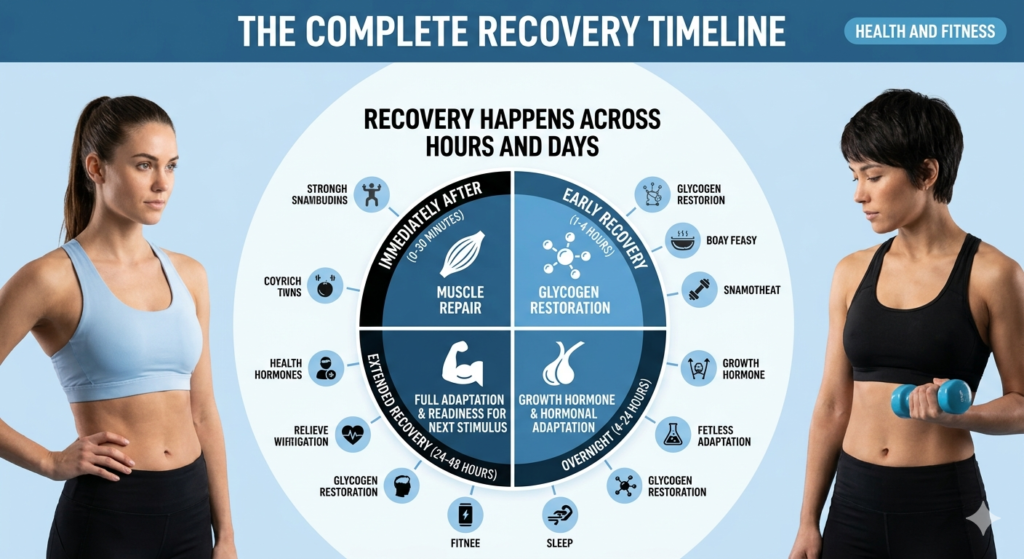
The timeline for recovery after workout varies based on the intensity and volume of training, but understanding the phases helps you structure recovery appropriately.
The immediate recovery phase lasts 0-30 minutes after training ends. This is when the cool-down occurs, when parasympathetic activation begins, and when the acute inflammatory response is managed. Rehydration begins here, though it continues for hours.
The early recovery phase lasts 1-4 hours after training. This is when glycogen restoration is most active, when the post-workout nutrition window is most important, and when the body is still metabolically elevated from training.
The overnight recovery phase lasts 4-24 hours after training. This is when growth hormone is at its highest, when deep sleep does its most important recovery work, and when the adaptation processes driven by the training stimulus occur.
The extended recovery phase lasts 24-48 hours after training. This is when muscle soreness typically peaks and then gradually resolves, when full glycogen restoration is completed, and when the nervous system fully downregulates from the training stress.
Most recovery processes are substantially complete within 24-48 hours for moderate training, though very intense training or high-volume training may require longer. This is why training frequency needs to account for recovery time. Training the same muscle group or energy system daily without adequate recovery leads to accumulated fatigue and performance decline rather than improvement.
For someone training intensely four days per week, the other three days must be either complete rest days or very light activity days that do not add meaningful training stress. For someone training six days per week, at least one or two days must be complete rest, and the training intensity must be less aggressive than the four-day approach to avoid exceeding recovery capacity.
Use Our Free Tools to Support Your Training and Recovery
Effective training and recovery require understanding your personal caloric needs, sleep requirements, and overall health baseline. These free tools help you make targeted, effective decisions.
Calculate Your Daily Calorie Needs Adequate nutrition is fundamental to recovery. Undereating impairs recovery even when you are sleeping well and implementing other strategies. Use our Calorie Calculator to establish the daily intake that supports your training and recovery.
Find Your TDEE Use our TDEE Calculator to calculate how many calories your body burns each day, accounting for your actual training volume and intensity.
Calculate Your BMR Use our BMR Calculator to understand your resting calorie needs and how training increases them.
Optimize Your Sleep Schedule Sleep is the most important recovery tool. Use our Sleep Calculator to find the sleep timing that aligns with your training schedule and maximizes deep sleep duration.
Track Your Body Composition Use our Body Fat Calculator to monitor the actual body composition changes produced by your training and recovery practices.
Check Your BMI Use our BMI Calculator to monitor overall health metrics as your training and recovery improve.
Find Your Ideal Weight Use our Ideal Weight Calculator to set a realistic goal that aligns with your training objectives.
Signs Your Recovery Is Insufficient
Recognizing when recovery is inadequate allows you to adjust before the consequences become serious. Key signs include persistent muscle soreness that does not improve over days, resting heart rate that is elevated despite adequate sleep, motivation for training that is low despite adequate rest, sleep quality that is poor despite adequate hours in bed, and performance that plateaus or declines despite consistent training.
Additionally, getting sick more frequently, experiencing more frequent injuries, or noticing your mood is worse than usual despite stable life circumstances can all indicate that recovery capacity is exceeded.
When these signs appear, the response should be to deliberately reduce training volume and intensity while emphasizing the recovery strategies in this guide. This is not failure. It is intelligent response to a signal that the system is overwhelmed. Continuing hard training during inadequate recovery leads to overtraining, which can set back progress by weeks or months.
For comprehensive guidance on addressing signs of inadequate recovery, read our articles on signs of poor sleep and how stress affects women’s reproductive health which discuss how insufficient recovery manifests across multiple body systems.
FAQ
1. How long should recovery after workout take?
Most recovery processes are substantially complete within 24-48 hours for moderate training. Immediate recovery lasts 0-30 minutes, early recovery lasts 1-4 hours, overnight recovery occurs during sleep, and extended recovery continues through the next day. Very intense training or high volume may require longer. The specific timeline depends on training intensity and volume.
2. Is ice or heat better for recovery after workout?
Ice is appropriate in the immediate post-workout period if there is significant acute swelling or pain, typically for 10-20 minutes. Heat is generally superior for recovery in the hours and days after training because it increases blood flow and supports the recovery processes. Extended icing can impair the necessary inflammatory response that drives adaptation.
3. How much protein do I need after a workout?
Approximately 20-40 grams of high-quality complete protein within one to two hours of training is optimal for maximizing muscle protein synthesis and recovery. More than this amount in the immediate post-workout window does not provide additional benefit, though total daily protein intake still matters for cumulative muscle development.
4. Can you train hard every day without recovery?
No. High-intensity training every day without adequate recovery leads to accumulated fatigue, performance decline, increased injury risk, and the state called overtraining. Most people require at least one to two complete rest days per week, with the remaining days either lighter training or focused on different energy systems than the hard training days.
5. Does recovery speed up with age or does it slow down?
Recovery generally slows with age, particularly the deep sleep that is most critical for recovery. However, implementing proper recovery strategies becomes increasingly important with age and can meaningfully counteract the age-related decline. An older person with excellent recovery practices will recover significantly faster than a younger person with poor recovery practices.
6. What is the most important recovery after workout strategy?
Sleep is the single most important recovery tool. Everything else supports and enhances sleep’s recovery functions, but without adequate deep sleep, other recovery strategies are partially compromised. Protecting sleep quantity and quality should be the priority above all other recovery interventions.
7. Can you overdo recovery strategies?
Some recovery strategies can be counterproductive if overdone. Excessive ice immediately after training can impair necessary inflammation. Excessive anti-inflammatory medication can suppress necessary adaptation processes. However, the other strategies including nutrition, hydration, gentle movement, and stress management cannot realistically be overdone through reasonable implementation.
Conclusion
Recovery after workout is not something that happens automatically or passively. It is an active biological process that requires specific inputs, proper timing, and strategic implementation to occur optimally.
The 12 strategies in this guide address every major system involved in recovery: the nervous system, the endocrine system, the immune system, the metabolic system, and the structural tissues themselves. Implementing all of them comprehensively produces dramatically better results than training alone without recovery support.
The most important practical insight is that recovery is as much a part of your training program as the training sessions themselves. The time you invest in proper sleep, nutrition timing, hydration, stress management, and the other recovery strategies is just as productive toward your training goals as time spent in the gym or on the track.
Start with the strategies that are easiest to implement in your current life. Establish a post-workout routine that includes cool-down, rehydration, and nutrition timing. Protect your sleep as your primary recovery priority. Then progressively add the additional strategies as your foundation becomes solid.
Use our Sleep Calculator to optimize the sleep that is the foundation of all recovery. Explore our health and fitness resources for comprehensive guidance on building training and recovery practices that work for your specific situation and goals.
Recovery is not something that happens to you while you wait. It is something you create through deliberate choices and consistent implementation. Make those choices wisely and watch as your training produces the results it is capable of.