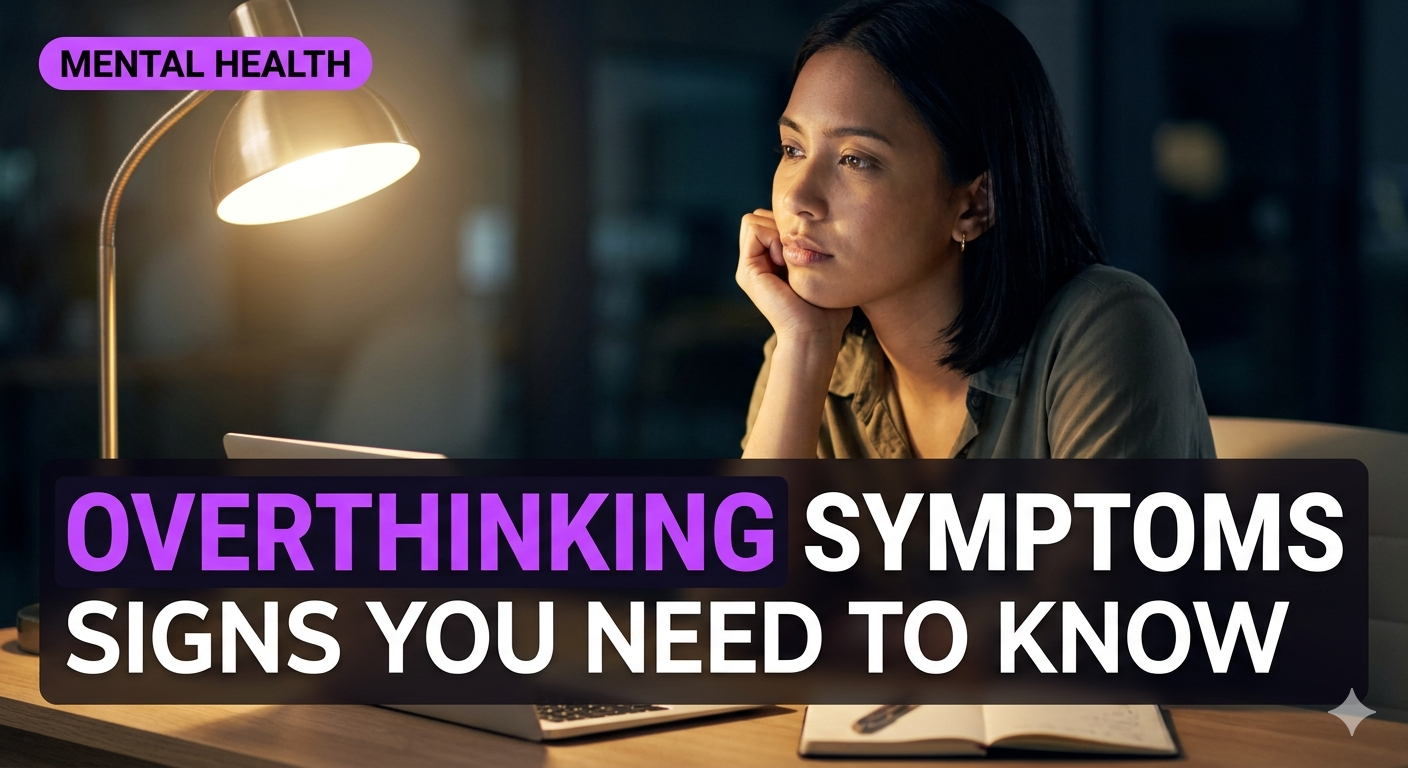
Everyone has moments of deep thought. Replaying a difficult conversation. Running through the what-ifs of a big decision. Mentally rehearsing something important that is coming up.
That is not overthinking. That is being human.
Overthinking is something different. It is when that mental loop runs on repeat without producing anything useful. When your brain becomes a machine that generates worry, regret, and catastrophic scenarios at high volume and refuses to stop, even when you desperately want it to.
It is exhausting. It is isolating. And for a lot of people, it has become so familiar that they no longer recognize it as something that is happening to them. They just assume this is how their mind works.
If you have been wondering whether what you experience qualifies as overthinking, this article will give you a clear and honest answer. These are the 12 most common overthinking symptoms that mental health professionals recognize, why each one happens, and what you can actually do about it.
Table of Contents
What Is Overthinking and Why Does It Happen?
Overthinking is the habit of dwelling on a thought, problem, or situation far beyond what is useful or productive. It is characterized by repetitive, circular thinking that generates anxiety and consumes mental energy without moving toward any resolution.
There is an important distinction between productive problem-solving and overthinking. Productive thinking has a direction. It analyzes a situation, considers options, reaches a conclusion, and moves on. Overthinking goes around the same loop indefinitely. The same fears, the same scenarios, the same worst-case outcomes, cycling endlessly without arriving anywhere useful.
The brain’s threat-detection system, known as the amygdala, plays a central role in overthinking. When the amygdala perceives a threat, whether that threat is a predator in the wild or an unanswered text message from someone important, it activates the stress response and keeps the mind focused on the potential danger until it is resolved.
In modern life, many of the threats that trigger this response are social, emotional, or ambiguous rather than physical and immediate. They do not resolve quickly. And so the amygdala keeps circling back, pulling attention toward the worry, trying to solve something that cannot be solved through thinking alone.
Overthinking is particularly common in people with anxiety disorders, depression, perfectionism, low self-esteem, and a history of trauma or unpredictable early environments. It is also increasingly prevalent in the general population, driven by always-on digital communication, social comparison through social media, and the general pace and uncertainty of modern life.
According to research from the American Psychological Association, chronic overthinking is one of the most significant contributors to anxiety and depression in adults, affecting a substantial portion of the population at clinically meaningful levels.

1. Your Mind Races and Will Not Slow Down
This is the most fundamental of all overthinking symptoms. The experience of a mind that simply will not stop. Thoughts arrive faster than you can process them. One worry leads to another. One what-if branches into three more. You follow each thread and it takes you deeper into a tangle rather than toward any kind of resolution.
Racing thoughts are particularly intense at certain times of day. Many people who overthink describe the period just before sleep as the worst. The daytime distractions that keep the thought loop partially at bay disappear when the room goes quiet, and the mind rushes in to fill the silence with everything it has been accumulating.
The racing quality of overthinking thoughts is different from the natural flow of ideas during creative thinking or problem-solving. It has a driven, compulsive quality. You do not choose to revisit the worry. It pulls your attention back involuntarily. This involuntary quality is one of the clearest distinguishing features of genuine overthinking versus ordinary reflective thinking.
If your mind races persistently and the quality of your thoughts feels anxious, repetitive, and circular rather than generative and forward-moving, that is a significant overthinking symptom worth taking seriously.
2. You Replay Past Events Constantly
Rumination is the technical term for replaying past events in the mind, and it is one of the most thoroughly researched overthinking symptoms in clinical psychology.
The pattern looks familiar to most people who overthink. Something happened, maybe days, weeks, or even months ago. A conversation that went badly. A decision you wish you had made differently. Something you said or did not say that still makes you cringe internally. And your mind keeps going back to it, replaying it with slight variations, imagining how it could have gone differently, analyzing what it meant about you or the other person.
Rumination feels like reflection. It feels like your mind is trying to understand something or learn from it. But genuine learning from past events requires reaching a conclusion and moving on. Rumination never reaches a conclusion. It simply cycles. The same event from a slightly different angle, producing the same discomfort and the same fruitless analysis.
Research published in the journal Clinical Psychology Review found that rumination is one of the strongest predictors of both the onset and the duration of depressive episodes. It is not just unpleasant. It is genuinely harmful to mental health when it becomes a habitual response to difficulty.
If you find yourself regularly returning to past events that you have already examined thoroughly without being able to release them, that rumination is one of the clearest signs of problematic overthinking.
3. You Catastrophize Everything
Catastrophizing is the cognitive pattern of automatically imagining the worst possible outcome of any given situation and treating that outcome as probable or inevitable despite limited evidence that it will actually occur.
It shows up in subtle ways that can feel like realistic caution rather than distorted thinking. Your boss sends you a brief email asking for a quick chat and you immediately assume you are about to be fired. Your partner seems quieter than usual and your mind leaps to the conclusion that something is seriously wrong in the relationship. A mild physical symptom sends you down a spiral of self-diagnosis toward the most alarming possibility.
The common thread is the automatic jump from an ambiguous or mildly concerning situation to the most catastrophic interpretation available, combined with difficulty holding onto more realistic and proportionate possibilities.
Catastrophizing is closely related to anxiety and is driven by the same amygdala-based threat amplification. The brain, trying to protect you from harm, exaggerates potential threats to ensure they receive maximum attention. The problem is that in modern life this mechanism fires at situations that rarely carry the consequences the mind imagines, creating a state of chronic low-grade alarm that is genuinely exhausting to live with.
Recognizing catastrophizing as a thought pattern rather than an accurate read on reality is one of the most important first steps toward reducing its impact on daily life.
4. You Cannot Make Decisions Without Agonizing Over Them
Decision paralysis is one of the most practically disruptive overthinking symptoms because it interferes directly with daily functioning. Simple decisions that most people make quickly and without much thought become genuinely difficult, time-consuming, and anxiety-provoking.
What to order at a restaurant. Which route to take. Whether to respond to a message now or later. Which of two similar products to buy. For an overthinker, any of these can trigger an extended mental process of weighing options, imagining outcomes, second-guessing initial instincts, and circling back to reconsider choices already made.
The mechanism behind decision paralysis in overthinkers is the perceived high stakes of being wrong. When your internal narrative treats decisions as tests with serious consequences for getting it wrong, your mind naturally devotes disproportionate resources to analyzing the choice before committing.
The frustrating irony is that most decisions do not carry the weight the overthinking mind assigns to them. Research consistently shows that humans overestimate the emotional impact of both good and bad outcomes of decisions, and that we adapt to the results of our choices far more effectively than we predict when we are in the decision-making process.
The energy spent agonizing over a decision is rarely proportional to the actual stakes involved. Recognizing this gap between perceived and actual consequence is helpful for interrupting the paralysis when it occurs.
5. You Have Serious Trouble Sleeping
Sleep disruption is one of the most physically felt overthinking symptoms, and it creates a particularly vicious cycle. Overthinking disrupts sleep. Sleep deprivation worsens anxiety and reduces the brain’s ability to regulate emotional responses. Poorer emotional regulation makes overthinking worse. And so the loop continues.
The relationship between overthinking and sleep difficulty is well established in research. A study published in the journal Cognitive Therapy and Research found that pre-sleep cognitive arousal, which is essentially lying in bed with a racing, worrying mind, was the strongest predictor of sleep onset difficulty and middle-of-the-night waking compared to physical arousal or environmental factors.
For many overthinkers, bedtime is when the mental activity becomes most intense. The quiet and lack of stimulation that nighttime provides removes the distractions that kept the thought loop manageable during the day. The mind, without external input to focus on, turns inward and the volume of the worrying thoughts increases significantly.
If you regularly lie awake replaying events, worrying about future situations, or finding it genuinely difficult to quiet your mind enough to fall asleep, sleep disruption as a direct result of mental overactivity is a clear overthinking symptom.
Managing sleep as part of an overthinking recovery approach is essential because every other cognitive and emotional challenge associated with overthinking is significantly worsened by sleep deprivation.
Use our Sleep Calculator to find the optimal sleep timing that supports your natural circadian rhythm. And read our article on insomnia, symptoms, causes, and treatment for more comprehensive guidance on breaking the sleep-overthinking cycle.
6. Your Body Shows Physical Symptoms
This is the overthinking symptom that most surprises people when they first encounter it. Overthinking is a mental activity. But it produces very real, very measurable physical effects in the body.
The mechanism is straightforward. Overthinking activates the stress response. The stress response releases cortisol and adrenaline. These hormones increase heart rate, tighten muscles, elevate blood pressure, alter digestion, and create a state of physiological readiness for threat response that the body was never designed to sustain for extended periods.
Chronic overthinkers commonly experience persistent headaches or migraines driven by muscle tension in the neck and scalp. Digestive complaints including nausea, irritable bowel symptoms, and appetite changes are extremely common because the gut is extraordinarily sensitive to stress hormone fluctuations. Muscle tension particularly in the neck, shoulders, and jaw creates chronic discomfort that people often attribute to physical causes without connecting it to their mental state. Heart palpitations, chest tightness, and a persistent feeling of physical restlessness are also frequently reported.
The gut-brain connection is particularly significant here. The enteric nervous system lining the digestive tract is in constant bidirectional communication with the brain. Chronic mental stress creates chronic digestive distress in a pattern that many overthinkers experience as a persistent stomach sensitivity or digestive unpredictability that has no obvious physical explanation.
If you have physical symptoms that doctors have been unable to explain through physical causes, and you also recognize yourself in the other overthinking symptoms described in this article, the connection between your mental state and your physical experience is worth exploring seriously.
7. You Constantly Second-Guess Yourself
Second-guessing is the post-decision version of decision paralysis. You made the decision. You moved forward. And now your mind will not let you be at peace with the choice you made.
Did I say the right thing? Was that the best option? Should I have done it differently? What if I made the wrong call? These questions cycle through the minds of chronic overthinkers even after decisions have been made and outcomes have unfolded, sometimes long after any practical ability to change course has passed.
This pattern is rooted in a deep discomfort with uncertainty and an internal narrative that treats being wrong as significantly more consequential than it realistically is. The mind keeps returning to closed decisions hoping to find a way to be more certain, even though certainty about past decisions is by definition no longer available.
Second-guessing yourself habitually erodes confidence over time. When every decision is followed by a period of doubt and self-questioning, you begin to trust your own judgment less. The result is often a paradox: the more you second-guess yourself, the less confident you feel, and the less confident you feel, the more you second-guess every subsequent decision.
Recognizing second-guessing as a symptom of overthinking rather than an accurate signal that your original decision was wrong is an important step toward interrupting this pattern.
8. You Ask for Reassurance Repeatedly
Reassurance-seeking is a behavioral overthinking symptom that most people do not immediately connect to overthinking. It presents as a relational pattern rather than an internal one, which makes it easier to miss.
The pattern looks like this. You feel uncertain or anxious about something. You ask someone you trust whether your concern is valid, whether you made the right choice, whether everything is going to be okay. They reassure you. You feel better briefly. And then the doubt returns and you feel the urge to seek reassurance again.
The brief relief provided by reassurance feels helpful in the moment. But it does not address the underlying source of the anxiety. It simply provides a temporary external input that quiets the alarm long enough to feel okay until the next time the worry resurfaces.
Over time, reassurance-seeking actually strengthens the anxiety it is meant to relieve. It teaches the mind that the worry is legitimate enough to require external validation, which makes the anxiety response more likely to fire again in similar situations. Research on anxiety disorder treatment consistently shows that reducing reassurance-seeking is one of the most important behavioral changes for long-term anxiety and overthinking reduction.
If you notice that you frequently seek reassurance from the same people about similar concerns, and that the relief you feel is consistently short-lived before the doubt returns, that pattern is an important overthinking symptom worth addressing directly.
9. You Struggle to Be Present in the Moment
Presence requires mental availability. When your mind is preoccupied with replaying the past or anticipating the future, it has limited capacity left for what is actually happening right now.
This overthinking symptom shows up in everyday experience as a feeling of being physically present but mentally elsewhere. You are sitting at dinner with people you care about but your mind is on a work situation from earlier in the day. You are watching something you normally enjoy but cannot absorb it because your thoughts keep pulling you back to a worry you cannot resolve. You are in a conversation and the other person has to repeat themselves because your attention drifted to your own internal monologue.
The Buddhist concept of mindfulness addresses this specific symptom directly, and the research on mindfulness-based interventions for overthinking and anxiety is genuinely robust. The ability to anchor attention in present-moment sensory experience, what you can see, hear, feel, smell, and taste right now, short-circuits the thought loops that depend on mental time-travel to past events or future scenarios.
Difficulty being present is not just a symptom. It is also a significant quality of life issue. Some of the most meaningful experiences of daily life, connection with others, enjoyment of pleasure, a sense of peace and groundedness, all require presence to be fully accessed. Chronic overthinking quietly steals these experiences by keeping the mind perpetually elsewhere.
10. You Feel Mentally Exhausted All the Time
Mental fatigue that is disproportionate to your actual physical activity or intellectual demands is one of the most consistently reported overthinking symptoms and one of the most disabling in terms of daily functioning.
Thinking burns energy. The brain consumes a significant proportion of the body’s total energy budget even at rest. When that mental activity is turbocharged by chronic worry, rumination, and anxious anticipation, the energy consumption increases dramatically. The result is a form of exhaustion that sleep does not fully relieve, that is present from the moment of waking, and that makes normal cognitive demands like concentration, decision-making, and creative thinking feel far more effortful than they should.
Many chronic overthinkers describe feeling tired all the time without being able to explain why. They are not working harder than other people. They are not sleeping less. But the constant background hum of an overactive mind is consuming energy continuously that is simply not available for other functions.
This mental exhaustion is compounded by the sleep disruption that overthinking causes, the physical tension that chronic stress hormone elevation produces, and the emotional weight of carrying worry about multiple situations simultaneously.
Recognizing that your exhaustion has a mental rather than purely physical source is important for choosing the right recovery strategies.
For more on how mental exhaustion and burnout develop and how to address them, read our article on mental drain, burnout causes, symptoms, and solutions.
11. Overthinking Symptoms Appear in Your Body Language
This is an overthinking symptom that other people often notice before the overthinker does themselves. Chronic mental tension expresses itself in physical posture and movement in recognizable ways.
Tension in the jaw from habitual clenching. Raised or rounded shoulders held rigid from sustained muscle tension. A furrowed brow that reflects a mind in constant analytical effort. Restless hands, fidgeting fingers, or leg bouncing from the physical expression of the nervous energy that chronic stress hormone elevation produces. Shallow, upper-chest breathing rather than the deep diaphragmatic breathing of a relaxed nervous system.
These physical expressions of mental overactivity are partly involuntary responses to sustained sympathetic nervous system activation. They are also feedback loops. Tense body posture sends signals back to the brain that confirm a threat-response state is appropriate, which further sustains the overthinking cycle.
Deliberate physical interventions like deep diaphragmatic breathing, progressive muscle relaxation, and gentle movement all work partly through this reverse pathway, using the body to signal the brain that the threat response can be reduced, which then allows mental activity to slow.
Noticing these physical expressions in yourself can serve as useful real-time indicators that your overthinking has become activated, giving you an earlier intervention point before the thought loop has fully escalated.
12. Small Problems Feel Overwhelming and Unsolvable
The final overthinking symptom on this list is one that produces enormous frustration because it is so clearly disproportionate yet so difficult to override through rational awareness alone.
A minor administrative task that keeps being postponed because starting it feels overwhelming. A small conflict with someone that feels much larger and more significant than it is. An everyday logistical challenge that produces a sense of mental paralysis as if it were a genuinely complex problem.
When the mind is already operating at a high baseline of arousal from chronic overthinking and stress, its capacity for tolerating additional challenge is significantly reduced. Small problems that a rested, calm mind would handle with minimal effort feel enormous because they arrive on top of an already full cognitive and emotional load.
This symptom is particularly important to recognize because it is often interpreted as personal failure or inadequacy rather than as a signal of a nervous system that is genuinely overwhelmed. The problem is not you. The problem is the state your nervous system is in, and that state is addressable.
For a broader understanding of what happens when the mental load reaches its limit, read our article on signs of a mental breakdown.

How Overthinking Affects Your Overall Health
Overthinking is not just uncomfortable. When it becomes chronic and persistent, it has measurable consequences across multiple dimensions of physical and mental health.
Cardiovascular health is directly affected by the chronic cortisol and adrenaline elevation that overthinking produces. Sustained elevated blood pressure, increased heart rate variability, and arterial inflammation are all associated with chronic psychological stress. For more on how stress affects heart health, read our article on signs your heart is out of shape.
Immune function is suppressed by chronic stress hormone exposure. Overthinkers tend to get sick more frequently and recover more slowly than people with lower baseline stress levels, because cortisol directly inhibits the immune response.
Reproductive health, particularly in women, is affected by chronic cortisol elevation through its interference with estrogen and progesterone balance. Read our article on how stress affects women’s reproductive health for a detailed look at this connection.
Mental health consequences include significantly elevated risk of developing clinical anxiety disorders and depression. Overthinking is both a symptom and a driver of these conditions, creating a bidirectional relationship that can become self-reinforcing without intervention.
Weight and metabolism are also affected. Chronic cortisol elevation promotes fat storage particularly around the abdomen, increases appetite for high-calorie foods, and disrupts the hormonal signals that regulate hunger and fullness. Read our article on low cortisol vs high cortisol to understand how this hormonal disruption plays out in the body.
Use Our Free Tools to Support Your Mental Wellbeing
Overthinking is often worsened by physical health factors that go unaddressed. Poor sleep, nutritional deficiencies, and unmanaged physical health all feed the nervous system state that makes overthinking worse. These free tools on Vitality Nexus help you address the physical foundations of mental wellbeing.
Optimize Your Sleep Schedule Sleep is the single most powerful recovery tool for an overactive mind. Use our Sleep Calculator to find the sleep timing that aligns with your natural circadian rhythm and gives your nervous system the overnight rest it genuinely needs.
Calculate Your BMR Understanding your baseline calorie needs helps ensure you are fueling your brain adequately. An undernourished brain is a more anxious brain. Use our BMR Calculator to find your resting calorie burn.
Check Your BMI Physical health and mental health are deeply connected. Use our BMI Calculator to understand your current physical health baseline and identify any areas worth addressing alongside your mental health focus.
Find Your Ideal Weight Use our Ideal Weight Calculator to set a realistic, science-based health goal that reduces one potential source of physical and psychological stress.
Calculate Your Daily Calorie Needs Stable blood sugar is essential for stable mood and reduced anxiety. Undereating or erratic eating creates the blood glucose fluctuations that amplify anxious thinking. Use our Calorie Calculator to ensure your nutrition supports your mental state.
Powerful Ways to Break the Overthinking Cycle
Recognizing overthinking symptoms is the first step. Understanding how to interrupt and gradually reduce the pattern is equally important.
Scheduled worry time is a counterintuitive but research-supported technique. Rather than trying to suppress worrying thoughts throughout the day, designate a specific 15 to 20 minute window each day as the time when you allow yourself to think through your concerns. When a worrying thought arises outside this window, acknowledge it and redirect your attention, knowing you will address it during the designated time. Over days and weeks, this trains the mind to contain worry rather than allowing it to spread throughout the day.
Physical movement is one of the most immediate and effective interruptions for an overthinking spiral. Exercise reduces cortisol, increases serotonin and dopamine, and shifts blood flow patterns in the brain in ways that reduce activity in the rumination-associated areas. Even a 10-minute brisk walk can meaningfully reduce the intensity of an active overthinking episode. Read our article on best cardio exercises for practical movement options that support mental health.
Mindfulness practice builds the neural capacity to observe thoughts without being controlled by them. Research consistently shows that eight weeks of regular mindfulness practice produces measurable changes in the brain regions associated with overthinking and anxiety. Start with five minutes per day of focused attention on the breath and build gradually.
Journaling externalizes the thought loop onto paper, which activates the language-processing parts of the prefrontal cortex and reduces the emotional intensity of the thoughts. Writing about what you are worried about and why, without censoring or editing, for ten minutes per day provides a productive outlet for the mental activity of overthinking.
Addressing nutritional deficiencies that worsen anxiety and mental exhaustion. Magnesium is particularly important. It regulates the NMDA receptors involved in excitatory nervous system activity, and deficiency is directly associated with increased anxiety and overthinking severity. Read our article on magnesium benefits, deficiency symptoms, and food sources for comprehensive guidance on this underappreciated mental health nutrient.
For a broader and more comprehensive set of strategies for managing anxiety and reducing the mental distress that drives overthinking, read our article on natural ways to reduce anxiety.
When Overthinking Becomes Something More Serious
For most people, the overthinking symptoms described in this article exist on a spectrum from occasional and manageable to frequent and disruptive but not clinically severe. Lifestyle changes, mindfulness practice, better sleep, exercise, and nutritional support make meaningful differences for this group.
But for some people, what begins as overthinking has crossed into territory that requires professional support.
It is time to speak with a mental health professional when your overthinking is significantly interfering with your ability to function at work, maintain relationships, or take care of basic daily responsibilities. When it is accompanied by persistent low mood, loss of interest in things that used to matter, or feelings of hopelessness. When physical symptoms are pronounced and persistent. When the thought loops involve thoughts of self-harm or hopelessness about the future.
Cognitive Behavioral Therapy, specifically the techniques focused on identifying and restructuring the cognitive distortions that drive overthinking, is one of the most evidence-based and effective treatments available for chronic overthinking, rumination, and the anxiety disorders that frequently accompany them.
For a deeper look at when mental health symptoms have escalated beyond what self-help strategies can adequately address, read our article on signs of a mental breakdown and our comprehensive mental health awareness and emotional wellness guide.
If you or someone you know is experiencing thoughts of self-harm, please contact a crisis service immediately. In the United States, call or text 988 to reach the Suicide and Crisis Lifeline. In the United Kingdom, call the Samaritans at 116 123. These services are available 24 hours a day and are completely confidential.
FAQ
1. What are the most common overthinking symptoms?
The most widely recognized overthinking symptoms include a racing mind that will not slow down, ruminating on past events, catastrophizing potential outcomes, difficulty making decisions, persistent sleep disruption, physical symptoms like headaches and muscle tension, constant self-doubt, reassurance-seeking behavior, difficulty being present, chronic mental exhaustion, and feeling overwhelmed by small problems. Multiple symptoms occurring together consistently is a strong indicator of problematic overthinking.
2. Is overthinking a mental illness?
Overthinking itself is not classified as a standalone mental illness. However, it is a core feature of several recognized mental health conditions including generalized anxiety disorder, obsessive-compulsive disorder, depression, and PTSD. Chronic overthinking that significantly impairs daily functioning warrants professional assessment to determine whether an underlying condition is present and to access appropriate treatment.
3. What causes overthinking?
Overthinking is caused by a combination of biological factors including a more reactive threat-detection system in the brain, psychological factors including perfectionism, low self-esteem, and a history of trauma, and environmental factors including chronic stress, uncertainty, and relationship or work-related pressures. It is typically maintained by avoidance behaviors, reassurance-seeking, and the absence of effective coping strategies for managing anxious thoughts.
4. How do I know if I am overthinking or just thinking?
The key distinction is productivity and resolution. Normal reflective thinking moves toward a conclusion. You think about something, reach an understanding or decision, and move on. Overthinking cycles without resolution. The same thoughts return repeatedly, producing anxiety without clarity. If a thought loop has been running for more than a few days without producing any new insight or useful action, it has likely crossed into overthinking territory.
5. Can overthinking cause physical symptoms?
Yes, and this surprises many people who associate overthinking purely with mental experience. Chronic overthinking activates the stress response, which releases cortisol and adrenaline that create measurable physical effects. Persistent headaches, digestive complaints, muscle tension, heart palpitations, chest tightness, and fatigue are all commonly reported physical overthinking symptoms. These physical symptoms often improve significantly when the underlying mental overactivity is addressed.
6. Does overthinking go away on its own?
Mild overthinking triggered by a specific stressful situation often reduces naturally once the situation resolves. Chronic habitual overthinking that has been present for months or years rarely resolves without active intervention. Mindfulness practice, cognitive behavioral techniques, lifestyle changes including improved sleep and regular exercise, and in some cases professional therapy are all effective at reducing chronic overthinking significantly.
7. What is the fastest way to stop overthinking in the moment?
The most immediately effective technique is to shift attention to immediate sensory experience rather than trying to suppress the thoughts. Name five things you can see right now, four things you can touch, three things you can hear, two things you can smell, one thing you can taste. This grounds attention in the present moment and interrupts the thought loop at a neurological level. Physical movement, slow diaphragmatic breathing, and brief cold water exposure to the face or wrists are also highly effective immediate interrupts for an active overthinking episode.
Conclusion
Overthinking is one of those experiences that can feel so familiar and so constant that it starts to seem like just the way your mind works. It is not. It is a pattern. And like any pattern, it can be understood, interrupted, and gradually changed.
The 12 overthinking symptoms covered in this article give you a clear picture of what this pattern looks like across mental, physical, and behavioral dimensions. If several of these resonate strongly and consistently, that recognition is valuable. Not because it gives you something else to worry about, but because you cannot change what you have not first clearly seen.
Use the free tools at Vitality Nexus to support the physical foundations of mental wellbeing through better sleep, proper nutrition, and physical health awareness. Explore our full mental health resources for more practical guidance on managing anxiety, stress, and the mental patterns that make daily life harder than it needs to be.
Your mind is capable of so much more than worry. It just needs the right support and the right strategies to demonstrate that.